
Giant grouper
A massive Indo-Pacific reef fish and one of the largest bony species on Earth.
The giant grouper is a large marine ray-finned fish found across the Indo-Pacific. It holds the record for the largest bony reef fish and is heavily targeted for food and aquaculture hybrids.
- Maximum recorded length is 270 centimetres.
- One of the largest bony fish species on Earth.
- Females can change sex to become males.
- Hybrid offspring grow faster than parent species.
- Found across the entire Indo-Pacific region.
What it is
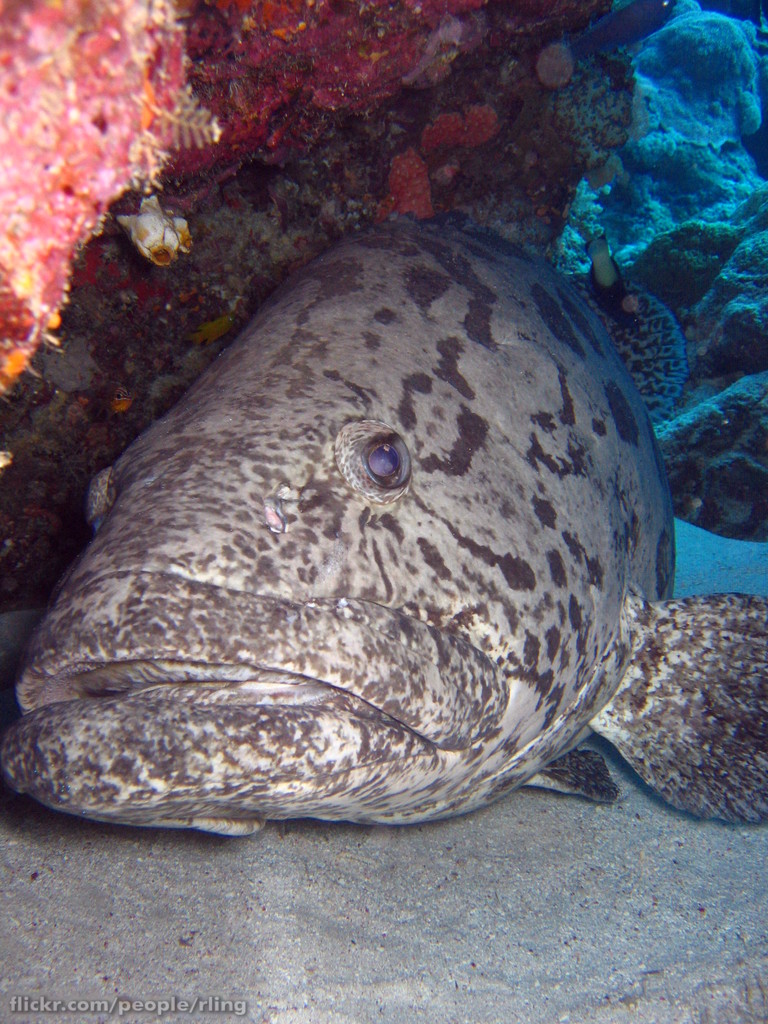
This robust marine ray-finned fish belongs to the subfamily Epinephelinae within the family Serranidae. Adults display a grayish-brown body with a mottled pattern and darker fins. Juveniles appear yellow with wide dark bars and spots. The species reaches a maximum standard length of 270 centimetres and can weigh up to 400 kilograms. Its head profile is convex, and it possesses 11 dorsal spines along with 14 to 16 soft rays. The lateral line contains between 54 and 62 scales.
Where it lives
The giant grouper has the widest distribution of any grouper species. Its range spans the Indo-Pacific region, extending from the Red Sea and eastern Africa south to Algoa Bay in South Africa. It crosses the Indian Ocean into the Western Pacific, reaching as far east as Hawaii and the Pitcairn Islands. In Australia, populations exist from Western Australia northward along tropical coasts and down to New South Wales. Occurrences are also noted around Christmas Island, Cocos Islands, and parts of New Zealand.
How it lives
These solitary fish inhabit shallow waters between 1 and 100 metres deep, typically associating with reefs, caves, and wrecks. They act as opportunistic ambush predators, swallowing prey whole. Their diet includes reef fish, crabs, lobsters, molluscs, juvenile sea turtles, and small sharks. While generally curious toward divers, large individuals may attack if hand-fed. They hold territories on outer reefs and lagoons, often remaining hidden during the day.
Breeding and life cycle
Giant groupers are diandric protogynous hermaphrodites, meaning females change sex to become males. Spawning occurs in aggregations following a lunar cycle, lasting approximately seven days. Multiple females usually spawn with a single dominant male. Studies indicate that subordinate males and even recently transformed males contribute to fertilization as the event progresses. Some males develop directly without passing through a female reproductive phase.
Fish and people
This species is highly valued as a food fish in commercial and recreational fisheries. In Hong Kong, smaller specimens are traded live for the reef food fish market. Parts such as the skin and gall bladder are utilized in Traditional Chinese Medicine. Aquaculture programs in Taiwan produce captive juveniles for growth in Southeast Asia. A hybrid known as the Hulong grouper, created by crossing this species with the brown-marbled grouper, dominates global production, yielding significant economic output.
Status and threats
The International Union for Conservation of Nature lists the giant grouper as Near Threatened. Overfishing poses a significant risk due to its slow growth and late maturity. The related Hulong hybrid grouper presents an invasive threat when released or escaping from farms into wild ecosystems. These hybrids breed with themselves and back-cross, potentially disrupting local populations. Management efforts focus on restricting supply chains and monitoring farm discharges.


Questions people ask about Giant grouper
How big does a giant grouper get?
They reach a maximum standard length of 270 centimetres and can weigh up to 400 kilograms. Most adults are smaller, averaging around 180 centimetres in length.
What do giant groupers eat?
They are ambush predators that swallow prey whole. Their diet consists of reef fish, crabs, spiny lobsters, molluscs, juvenile sea turtles, and small sharks.
Is the giant grouper dangerous to humans?
They are not generally considered dangerous but can attack if hand-fed. Divers are advised to treat large specimens with caution and maintain a safe distance.
What is the Hulong grouper?
It is a commercial hybrid created by crossing the giant grouper with the brown-marbled grouper. It grows faster and is more disease-resistant than either parent.
Good reading and sources
- Giant grouper on WikipediaEncyclopedia
- More photos on Wikimedia CommonsPhotos
- Wikidata recordOpen data
The facts on this page come from the Wikipedia article "Giant grouper", written by its contributors and used under the CC BY-SA 4.0 licence, and from its Wikidata record (CC0). EveryFish rewrote the text in its own words, with AI assistance, and compares every page with the article to make sure no passage is copied. It may be reused under the same CC BY-SA 4.0 licence with a link back.
It may contain mistakes, and figures change over time. Nothing here is investment or buying advice. If something is wrong, tell us. Last refreshed 2026-11-15.
Like Giant grouper
All reef fish WorldGreen humphead parrotfish
The largest parrotfish species, known for its massive head and role in reef bioerosion.Reef fish · Coasts and shelves
 🇺🇸 United States and 2 moreRainbow parrotfish
Largest Atlantic parrotfish found on coral reefs and in mangroves.Reef fish · Coasts and shelves
 🇲🇾 Malaysia and 4 moreHumphead wrasse
The largest reef-dwelling wrasse, known for its forehead hump and endangered status.Reef fish · Coasts and shelves · 1801
 🇦🇺 Australia and 4 moreLeopard coral grouper
A spotted reef predator prized for food across the Pacific.Perch-like · Coasts and shelves · 1802
More from Serranidae
All of them Southeast AsiaHumpback grouper
A spotted marine fish with a distinctive humped head profile.Perch-like · Coral reefs · 1828
 WorldPotato grouper
Large Indo-Pacific reef grouper with dark blotches.Perch-like · Coral reefs · 1959
 WorldBlue-spotted grouper
A widely distributed Indo-Pacific grouper known for its blue spots and invasive impact in Hawaii.Other · Coasts and shelves
 WorldSea goldie
A colourful reef fish that changes sex.Perch-like · Coasts and shelves