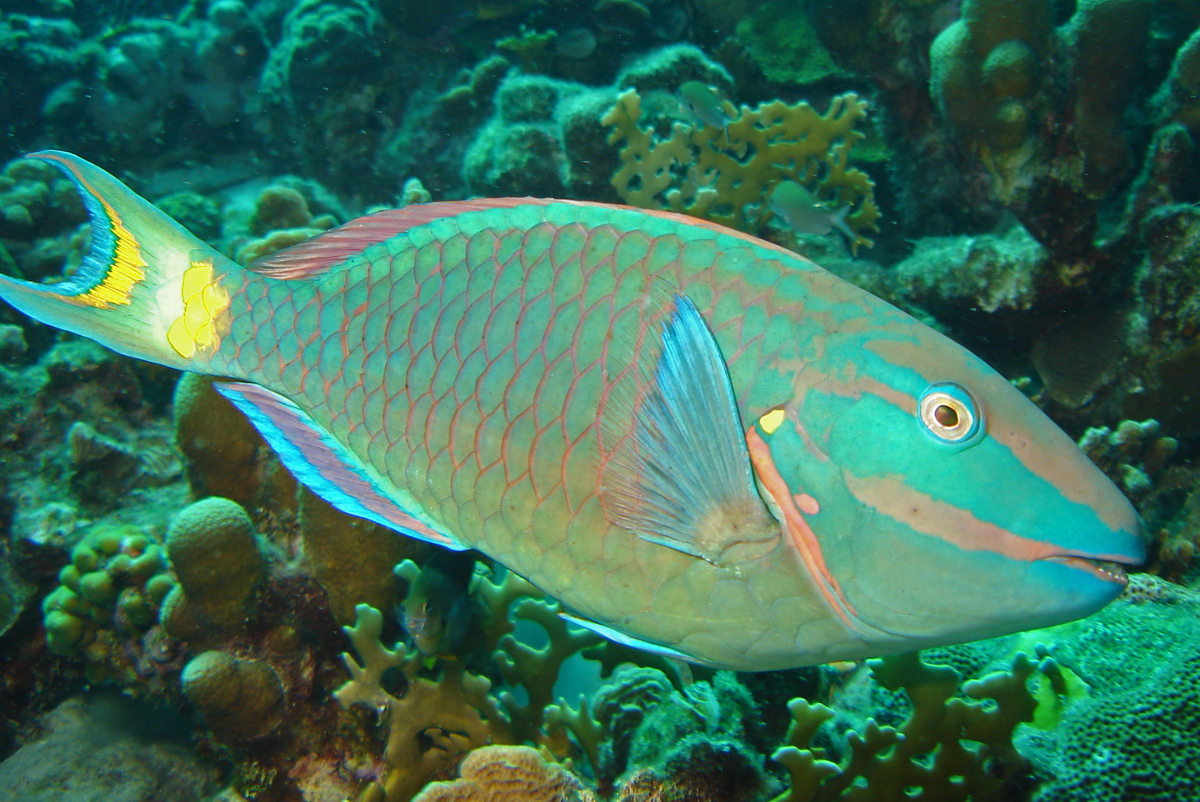
Rainbow parrotfish
Largest Atlantic parrotfish found on coral reefs and in mangroves.
The rainbow parrotfish is a large reef dweller native to the western Atlantic Ocean. It grows up to 1.2 metres long and feeds on detritus and sponges. This species plays a key role in coastal ecosystems by grazing in shallow waters.
- Largest parrotfish species in the Atlantic Ocean
- Grows up to 1.2 metres long and 20 kg
- Feeds on detritus, bacteria and sponges
- Young fish recruit mainly to mangrove habitats
- Listed as Near Threatened by the IUCN
What it is
This fish belongs to the parrotfish family and is the largest of its kind in the Atlantic Ocean. Only the humphead parrotfish grows bigger globally. Adults reach lengths of 1.2 metres and can weigh up to 20 kilograms. Their bodies show a greenish-brown hue overall. The fins appear dull orange with green markings. Distinctive blue-green dental plates help them graze. Males and females look similar in appearance.
Where it lives
Its territory spans the western Atlantic Ocean. Populations exist from Bermuda down through South Florida and the Bahamas. The range extends across the Caribbean Sea to the coast of Venezuela. These fish prefer shallow marine environments. They inhabit coral reefs, mangrove forests and sea grass beds. Individuals typically stay at depths between three and twenty-five metres.
How it lives
Young fish often settle in mangrove areas for protection. As they mature, they move to broader reef systems. The species acts primarily as a detritivore. It consumes decaying organic matter and bacterial films. Small invertebrates known as meiofauna are also part of the diet. Sponges are taken occasionally. This feeding behaviour helps clean the reef substrate.
Fish and people
Local communities in the Caribbean harvest this fish for food. It supports subsistence fisheries across many islands. Despite its size, it remains relatively rare in most locations. Bermuda reports higher numbers compared to other parts of its range. The species is valued for its meat in local diets.
Status and threats
The International Union for Conservation of Nature lists it as Near Threatened. Previous assessments classified it as Vulnerable due to habitat loss and overfishing. Current data do not allow precise estimates of population decline. Consequently, the status was adjusted. It faces pressure from coastal development and fishing activities.


Questions people ask about Rainbow parrotfish
How big does the rainbow parrotfish get?
It is the largest parrotfish in the Atlantic. Adults can reach 1.2 metres in length and weigh up to 20 kilograms. The maximum recorded age for this species is sixteen years.
Where does the rainbow parrotfish live?
It inhabits the western Atlantic from Bermuda to Venezuela. You can find it in shallow waters around coral reefs, mangroves and sea grass beds at depths of three to twenty-five metres.
What does the rainbow parrotfish eat?
This fish is primarily a detritivore. It feeds on decaying matter, bacterial colonies and small meiofauna. It also consumes sponges occasionally while grazing on the reef structure.
Good reading and sources
- Rainbow parrotfish on WikipediaEncyclopedia
- More photos on Wikimedia CommonsPhotos
- Wikidata recordOpen data
The facts on this page come from the Wikipedia article "Rainbow parrotfish", written by its contributors and used under the CC BY-SA 4.0 licence, and from its Wikidata record (CC0). EveryFish rewrote the text in its own words, with AI assistance, and compares every page with the article to make sure no passage is copied. It may be reused under the same CC BY-SA 4.0 licence with a link back.
It may contain mistakes, and figures change over time. Nothing here is investment or buying advice. If something is wrong, tell us. Last refreshed 2026-11-15.
Like Rainbow parrotfish
All reef fish WorldGreen humphead parrotfish
The largest parrotfish species, known for its massive head and role in reef bioerosion.Reef fish · Coasts and shelves
 WorldGiant grouper
A massive Indo-Pacific reef fish and one of the largest bony species on Earth.Reef fish · Coasts and shelves · 1790
 WorldBluespotted cornetfish
Long, slender reef fish with a tubular snout and blue spots.Reef fish · Coasts and shelves
 WorldRegal blue tang
Bright blue reef fish with a yellow tail and black markings.Reef fish · Coral reefs