
Regal blue tang
Bright blue reef fish with a yellow tail and black markings.
The regal blue tang is a vibrant Indo-Pacific surgeonfish found on coral reefs. It is highly prized in the global aquarium trade but holds little value as food due to poor taste and toxicity risks.
- Only member of the genus Paracanthurus
- Sharp caudal spine can cause deep wounds
- Eats algae to help keep coral reefs healthy
- Successfully captive-bred for the first time in 2016
- Popular aquarium fish featured in Finding Dory
What it is
This surgeonfish features a compressed, elliptical body with a terminal snout. Its colouration is striking, with a royal blue trunk, a bright yellow triangular tail, and a black palette-like pattern on its side. The black area encloses the pectoral fin tip, creating a blue oval near the eye. Small scales cover the body, while larger bony plates protect the head. Nine dorsal spines and three anal spines provide defence. A sharp spine sits in a groove on the caudal peduncle, ready to extend when the fish feels threatened.
Where it lives
These fish inhabit the Indo-Pacific region, ranging from East Africa and Sri Lanka to Japan, Australia, and the Pacific islands. They prefer clear waters on exposed outer reef slopes or in channels with strong currents. While they primarily live on coral reefs, they also visit seagrass beds, mangroves, and rocky areas. Their depth range spans from two to forty metres. Occasional sightings occur outside this zone, such as in the Mediterranean, likely due to aquarium releases.
How it lives
Active during the day, this species lives in pairs or small groups of up to fourteen individuals. Juveniles school together for protection among branching corals. Adults help maintain reef health by grazing on filamentous algae and microalgae that might otherwise smother coral. They also consume zooplankton. Males and females exist in roughly equal numbers. At night, their blue pigmentation fades slightly in response to light changes, making them appear paler.
Breeding and life cycle
Spawning happens throughout the year, peaking between April and September. In the late afternoon, males court females aggressively. The group rushes upward to release eggs and sperm into the water column. The tiny pelagic eggs contain an oil droplet for flotation and hatch within twenty-four hours. Larvae rely on yolk reserves for the first few days. Young fish reach sexual maturity at nine to twelve months, measuring about 149 mm in length.
Fish and people
Aquarists value this fish highly, making it one of the most traded marine species globally. Harvesters target wild juveniles because they school and are easier to catch. Captive breeding succeeded in 2016, offering a sustainable alternative. As food, it is unpopular due to strong odour and risk of ciguatera poisoning. Handlers must beware of the sharp tail spine, which can cause deep, infected wounds. The character Dory in popular animated films boosted public interest in the species.
Status and threats
The International Union for Conservation of Nature lists the species as Least Concern. Populations remain widespread, though specific trends are unclear due to limited catch data. Threats include overharvesting for the aquarium trade and destruction of coral reef habitats. Since eighty percent of related surgeonfish have lost significant reef cover, habitat loss poses a serious risk. Monitoring wild stocks is essential to prevent overexploitation, as most specimens still come from natural environments.


Questions people ask about Regal blue tang
Is the regal blue tang safe to eat?
No, it is not recommended for consumption. The flesh has a strong, unpleasant odour and is not highly prized. More importantly, eating this fish carries a risk of ciguatera poisoning, a type of foodborne illness caused by toxins in reef fish.
Why do handlers need to be careful with this fish?
The fish has a sharp spine on each side of its tail base. When stressed, it extends these spines and thrashes its tail. This motion can inflict deep cuts that may swell, discolour, and become infected, posing a health risk to humans.
Did the movie Finding Dory increase wild catches?
Online searches for the fish increased after the film's release, but import data did not show a significant rise in trade. While rumours suggested a surge in demand similar to the Nemo effect, peer-reviewed analysis found no major spike in imports following the sequel.
Good reading and sources
- Paracanthurus on WikipediaEncyclopedia
- More photos on Wikimedia CommonsPhotos
- Wikidata recordOpen data
The facts on this page come from the Wikipedia article "Paracanthurus", written by its contributors and used under the CC BY-SA 4.0 licence, and from its Wikidata record (CC0). EveryFish rewrote the text in its own words, with AI assistance, and compares every page with the article to make sure no passage is copied. It may be reused under the same CC BY-SA 4.0 licence with a link back.
It may contain mistakes, and figures change over time. Nothing here is investment or buying advice. If something is wrong, tell us. Last refreshed 2026-11-15.
Like Regal blue tang
All reef fish 🇮🇩 Indonesia and 2 moreRed lionfish
Venomous coral reef fish native to the Indo-Pacific and invasive in the Atlantic.Reef fish · Coral reefs · 1758
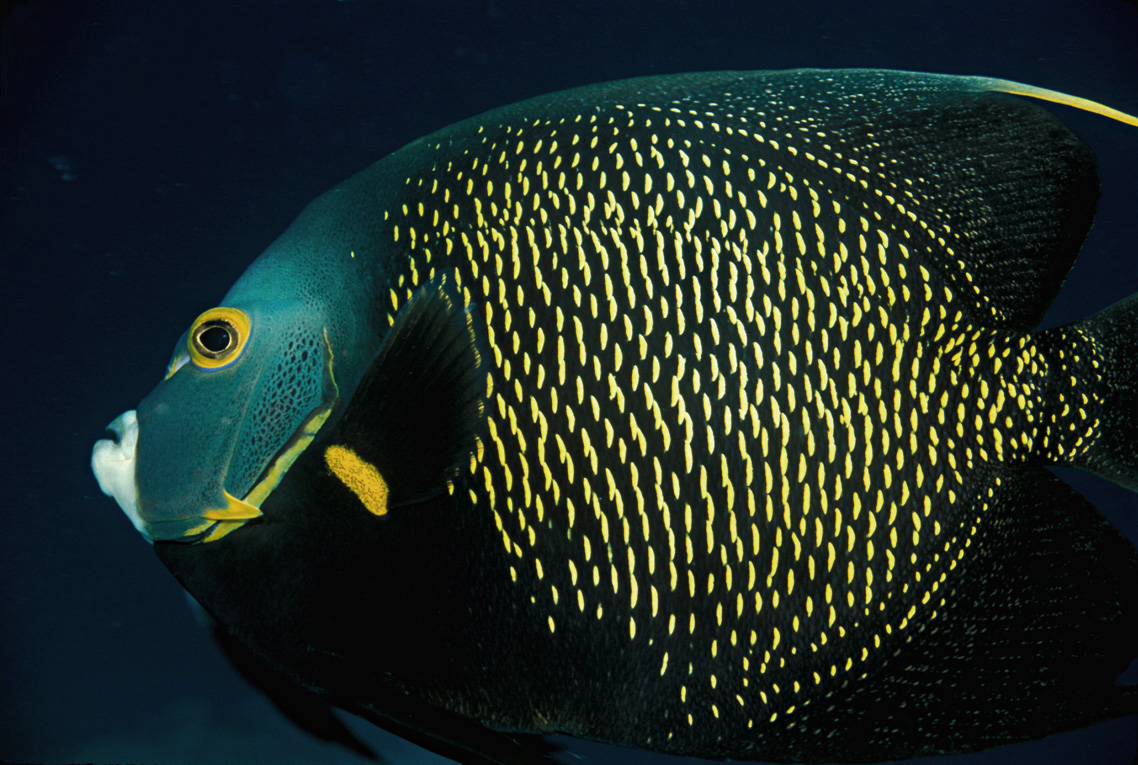 🇧🇷 Brazil and 1 moreFrench angelfish
A slow-growing Caribbean reef fish known for its sponge diet.Reef fish · Coasts and shelves · 1799
 WorldTriggerfish
Armoured reef fish with a locking dorsal spineReef fish · Coasts and shelves · 1810
 WorldBluespotted cornetfish
Long, slender reef fish with a tubular snout and blue spots.Reef fish · Coasts and shelves
More from Acanthuridae
All of them WorldSurgeonfish
Marine fish family with sharp tail spines and algae diets.Reef fish · Coasts and shelves
 WorldConvict tang
Striped marine surgeonfish found across the Indo-Pacific.Reef fish · Coasts and shelves · 1758
 WorldClown unicornfish
A reef-dwelling surgeonfish with orange tail spines and a black face mask.Reef fish · Coral reefs · 1801
 OceaniaAchilles tang
A black reef fish with an orange tail spot.Reef fish · Coral reefs · 1803