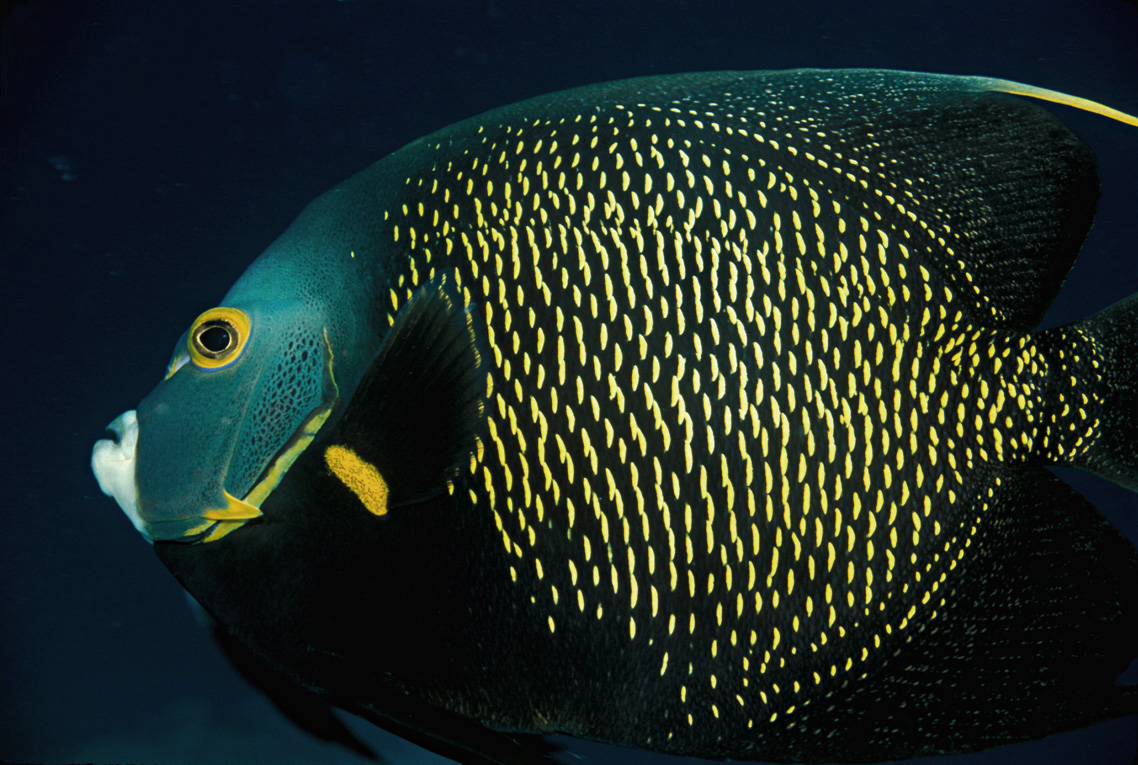
French angelfish
A slow-growing Caribbean reef fish known for its sponge diet.
The French angelfish is a marine species found in the western Atlantic and Caribbean. It lives in coral reefs, feeds mainly on sponges as an adult, and acts as a cleaner fish when young. The species is popular in the aquarium trade but faces risks from overcollection due to its slow growth rate.
- Adults eat mostly sponges, using special teeth to grind them.
- Juveniles act as cleaner fish for turtles and other large fish.
- They form monogamous pairs and mate at dusk.
- Individuals can live up to 27 years in the wild.
- Females can change sex to male if needed.
What it is
The French angelfish has a deep, vertically compressed body that appears flat from the front. Adults feature black or dark grey bodies with bright yellow scale tips, a white mouth, and yellow eye orbits. A long yellow filament extends from the dorsal fin. Juveniles look different, displaying almost black bodies with five vertical yellow bands. This species reaches a maximum length of about 41 centimetres.
Where it lives
This fish inhabits the western Atlantic, ranging from Florida and the Gulf of Mexico down to Brazil. It is common in the Caribbean, including the Antilles and Roatan. Populations also exist in the eastern Atlantic near Ascension Island and St. Paul's Rocks. They live in coral reefs and rocky shores at depths from 4.5 metres down to the mesophotic zone at 150 metres.
How it lives
Adults are territorial and usually found in pairs near sea fans. They feed primarily on sponges, using comb-like teeth to grind them. Juveniles serve as cleaner fish, removing parasites from larger species like turtles, jacks, and morays at cleaning stations. As they grow, their diet shifts from parasites to sponges. They are active during the day and hide at night.
Breeding and life cycle
French angelfish form monogamous pairs and are protogynous hermaphrodites, meaning females can change sex if no male is present. Mating occurs at dusk, with pairs swimming upward in a curve while keeping their vents close. Little is known about egg release. The species grows slowly, with otolith analysis showing individuals can live up to 27 years.
Fish and people
The species is highly valued in the marine aquarium trade, with significant exports from Brazil to the United States and Europe. It is also harvested for food, though its flesh can cause ciguatera poisoning. Captive breeding has been achieved. Its slow growth and late maturity make it vulnerable to overcollection, despite its current least concern status.
Status and threats
The International Union for Conservation of Nature lists the French angelfish as least concern. However, its slow growth rate and heavy exploitation in the ornamental fish trade pose future risks. Bycatch also threatens populations. Experts suggest it could move to near threatened or vulnerable status if collection pressures continue without management.


Questions people ask about French angelfish
What do French angelfish eat?
Adults primarily eat sponges, which make up about 70% of their diet. Juveniles feed on ectoparasites found on larger fish and sea turtles, acting as cleaner fish until they grow large enough to switch to sponges.
Are French angelfish dangerous to humans?
They are not aggressive towards humans, but their flesh has been reported to cause ciguatera poisoning if eaten. This toxin accumulates in reef fish that consume certain algae or organisms, posing a risk to consumers.
How do French angelfish reproduce?
They form monogamous pairs and mate at dusk. The pair swims upward in a curve, keeping their bodies close. The species is a protogynous hermaphrodite, so females can change into males if no male is available in the pair.
Why are they at risk if they are least concern?
They grow slowly and mature late, making it hard for populations to recover from heavy fishing. The aquarium trade exploits them heavily, especially in Brazil, which could push them toward a threatened status in the future.
Good reading and sources
- French angelfish on WikipediaEncyclopedia
- More photos on Wikimedia CommonsPhotos
- Wikidata recordOpen data
The facts on this page come from the Wikipedia article "French angelfish", written by its contributors and used under the CC BY-SA 4.0 licence, and from its Wikidata record (CC0). EveryFish rewrote the text in its own words, with AI assistance, and compares every page with the article to make sure no passage is copied. It may be reused under the same CC BY-SA 4.0 licence with a link back.
It may contain mistakes, and figures change over time. Nothing here is investment or buying advice. If something is wrong, tell us. Last refreshed 2026-11-15.
Like French angelfish
All reef fish 🇮🇩 Indonesia and 2 moreRed lionfish
Venomous coral reef fish native to the Indo-Pacific and invasive in the Atlantic.Reef fish · Coral reefs · 1758
 WorldRegal blue tang
Bright blue reef fish with a yellow tail and black markings.Reef fish · Coral reefs
 🇲🇾 Malaysia and 4 moreHumphead wrasse
The largest reef-dwelling wrasse, known for its forehead hump and endangered status.Reef fish · Coasts and shelves · 1801
 WorldTriggerfish
Armoured reef fish with a locking dorsal spineReef fish · Coasts and shelves · 1810
More from Pomacanthidae
All of them WorldEmperor angelfish
A striking reef fish with bold blue and yellow stripes.Reef fish · Coral reefs · 1787
 WorldRoyal angelfish
A striped marine angelfish from Indo-Pacific reefs.Reef fish · Coral reefs · 1772
 WorldQueen angelfish
A colourful reef fish with a blue crown spot.Reef fish · Coasts and shelves · 1758
 OceaniaFlame angelfish
Bright orange-red marine angelfish from Pacific reefsReef fish · Coral reefs