
Emperor angelfish
A striking reef fish with bold blue and yellow stripes.
The emperor angelfish is a marine species native to the Indian and Pacific Oceans. It lives on coral reefs and is prized in the aquarium trade for its vivid colour patterns that change from juvenile to adult stages.
- Juveniles have concentric blue and white circles.
- Adults display horizontal blue and yellow stripes.
- Found on coral reefs from 1 to 100 metres deep.
- Eats sponges and acts as a cleaner fish.
- Can produce a knocking sound when frightened.
What it is
This marine angelfish displays a dramatic shift in appearance as it matures. Juveniles possess a dark blue body covered in concentric white and pale blue circles. Adults feature horizontal blue and yellow stripes, a light blue face with a dark eye mask, and a yellow tail fin. The dorsal fin contains thirteen to fourteen spines, while the anal fin has three. Males in the Pacific population often have a trailing filament on the dorsal fin, which is absent in Indian Ocean specimens. They grow up to forty centimetres in length.
Where it lives
Its distribution spans the Indo-Pacific region. The range extends from the Red Sea down the East African coast to Mozambique and Madagascar. It reaches east through the Indian and Pacific Oceans to the Tuamotu and Line Islands. Northern limits include southern Japan and the Kansai region. Southern boundaries cover the Great Barrier Reef, New Caledonia, and the Austral Islands. Vagrants appear in Hawaii. Records exist off Florida and Puerto Rico. Since 2009, it has migrated into the eastern Mediterranean via the Suez Canal.
How it lives
Adults inhabit clear lagoons, channels, and seaward reefs with rich coral growth. They typically stay under ledges or inside caves. Subadults frequent reef cavities and surge channels. Juveniles seek shelter in protected channel areas and outer reef flats. Their diet consists mainly of sponges, tunicates, and other encrusting organisms. Both young and mature individuals may act as cleaner fish, removing parasites from larger species. When threatened, they can produce a knocking sound to signal distress or warn others.
Breeding and life cycle
These fish form pairs during their reproductive cycle. Specific details regarding spawning seasons, egg deposition, or larval development are not detailed in the available records. The pairing behaviour suggests a monogamous or semi-monogamous social structure during breeding periods. Further biological data on fertilisation methods and juvenile growth rates would require additional scientific study beyond the current summary.
Fish and people
Aquarists highly value this species for its brilliant and unique colouration. It is a common subject in the marine aquarium trade. Photographers and artists also favour it due to its striking visual patterns. The Dutch name Keyser van Iapan, meaning Emperor of Japan, reflects its majestic look. There are no major reports of commercial fishing for food. Its primary interaction with humans is through ornamental keeping and underwater observation.
Status and threats
The population is generally stable across its wide range. It faces no major threats of extinction at present. The International Union for Conservation of Nature lists it as Least Concern. While it has entered the Mediterranean as a migrant, numbers remain low there. Habitat degradation on coral reefs could pose future risks, but current data does not indicate significant decline. Conservation efforts focus on maintaining healthy reef ecosystems rather than specific species protection.


Questions people ask about Emperor angelfish
How does the appearance change with age?
Juveniles are dark blue with concentric white and pale blue circles. Adults develop horizontal blue and yellow stripes, a yellow tail, and a dark mask over the eyes. This distinct shift helps them blend into different reef structures at various life stages.
What do emperor angelfish eat?
Their diet primarily includes sponges, tunicates, and other encrusting organisms found on reef surfaces. They use their small mouths to pick these food sources from crevices and coral heads, playing a role in controlling sponge growth on reefs.
Where can this fish be found?
It lives in the Indian and Pacific Oceans, ranging from the Red Sea and East Africa to Hawaii and French Polynesia. It is also found in southern Japan and Australia. Rare sightings occur in the Atlantic and Mediterranean due to migration.
Good reading and sources
- Emperor angelfish on WikipediaEncyclopedia
- More photos on Wikimedia CommonsPhotos
- Wikidata recordOpen data
The facts on this page come from the Wikipedia article "Emperor angelfish", written by its contributors and used under the CC BY-SA 4.0 licence, and from its Wikidata record (CC0). EveryFish rewrote the text in its own words, with AI assistance, and compares every page with the article to make sure no passage is copied. It may be reused under the same CC BY-SA 4.0 licence with a link back.
It may contain mistakes, and figures change over time. Nothing here is investment or buying advice. If something is wrong, tell us. Last refreshed 2026-11-15.
Like Emperor angelfish
All reef fish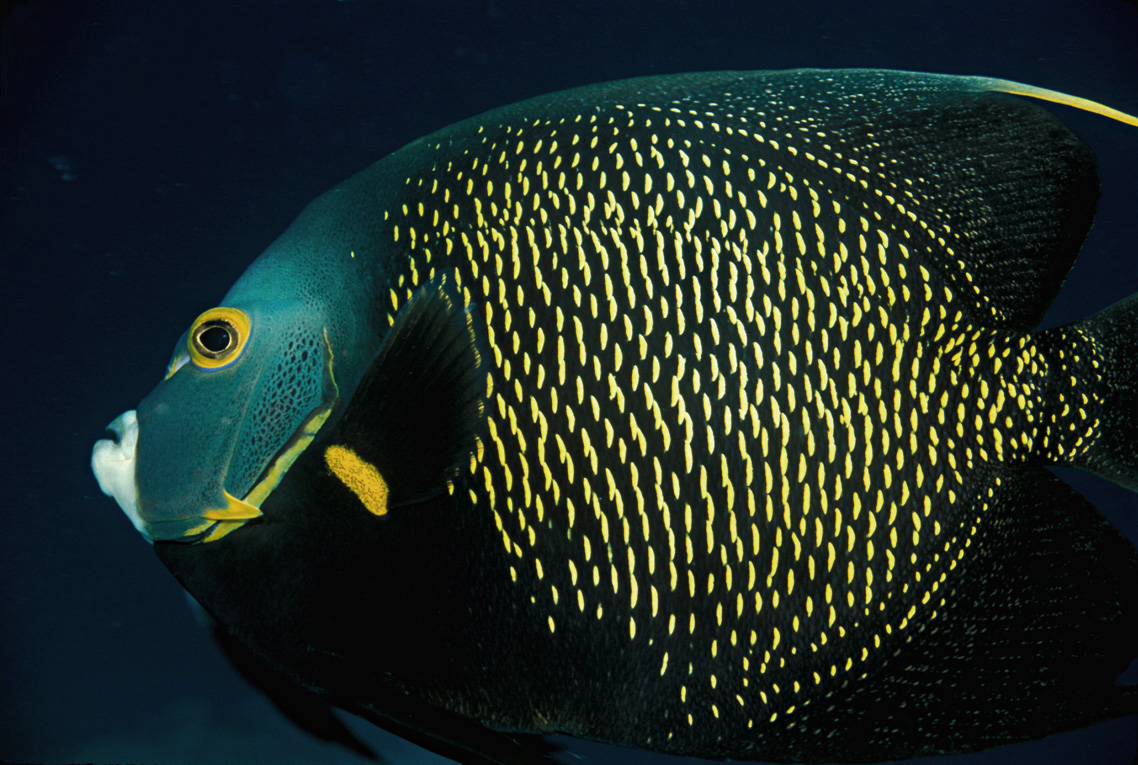 🇧🇷 Brazil and 1 moreFrench angelfish
A slow-growing Caribbean reef fish known for its sponge diet.Reef fish · Coasts and shelves · 1799
 WorldTrumpetfish
Marine fish with a long tubular snout found in tropical reefs worldwide.Reef fish · Coasts and shelves · 1766
 WorldButterflyfish
A global family of colourful tropical reef fish known for their bright patterns and coral diets.Reef fish · Coasts and shelves · 1815
 WorldYellow boxfish
A bright yellow, cube-shaped reef fish with toxic mucus.Reef fish · Coasts and shelves · 1758
More from Pomacanthidae
All of them WorldRoyal angelfish
A striped marine angelfish from Indo-Pacific reefs.Reef fish · Coral reefs · 1772
 WorldQueen angelfish
A colourful reef fish with a blue crown spot.Reef fish · Coasts and shelves · 1758
 OceaniaFlame angelfish
Bright orange-red marine angelfish from Pacific reefsReef fish · Coral reefs