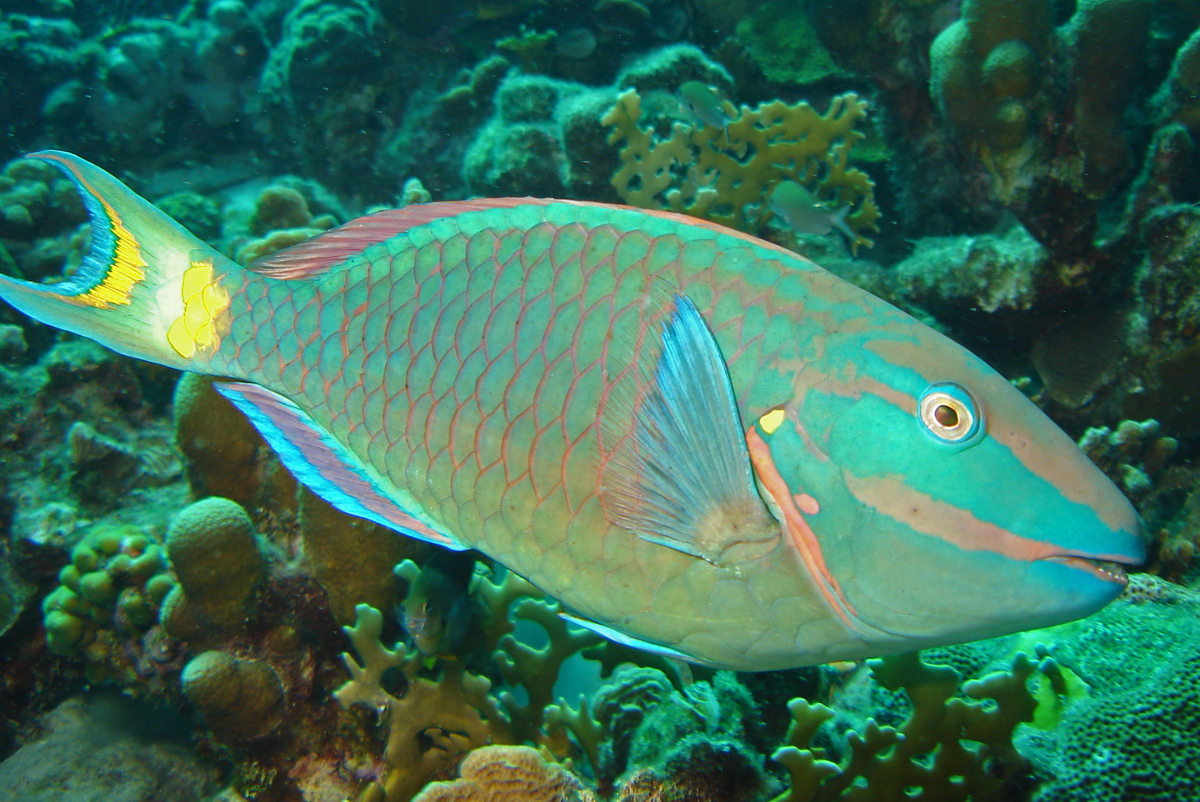
Stoplight parrotfish
A colourful reef grazer that changes sex from female to male.
The stoplight parrotfish is a marine species found in the Caribbean and western Atlantic. It grazes on algae using specialised teeth and plays a key role in reef health. This fish changes sex during its life, shifting from female to male as it matures.
- Changes sex from female to male during its life
- Grazes on algae to keep coral reefs healthy
- Lives up to 8 years on offshore reefs
- Named for a yellow spot on mature males
- Active only during the day in shallow waters
What it is
The stoplight parrotfish is a ray-finned marine fish belonging to the family Scaridae. It gets its name from a bright yellow spot near the pectoral fin, visible mainly in mature males. Adults typically measure between 30 and 45 cm, though they can grow up to 64 cm. The fish displays distinct colour phases. Juveniles and initial phase individuals are brown with red bellies. Terminal phase males turn vivid green with yellow spots at the base of the tail. This species inhabits shallow coral reefs and is active only during daylight hours.
Where it lives
This species lives in the western Atlantic Ocean. Its range extends from Bermuda and Florida through the Caribbean Sea and Gulf of Mexico down to Brazil. It prefers undisturbed shallow coral reefs at depths between 3 and 50 metres. During the day, it forages in these areas, often selecting sites with high algal production. In the Florida Keys, it frequents areas with dense macroalgae cover. At night, the fish hides under coral boulders or within crevices for protection. Offshore reefs tend to support larger and older individuals compared to onshore locations.
How it lives
Stoplight parrotfish are diurnal, meaning they are active by day and rest at night. They spend their time swimming, hovering, or grazing. Their feeding strategy involves scraping and excavating algae from dead coral substrates. They prefer large, sparse algal turfs due to their high protein content. While primarily herbivorous, they may occasionally eat living coral. Adult fish stay in limited home ranges. Smaller individuals hover more often, while larger ones swim and shelter in crevices. They are ecologically significant in the Caribbean for controlling algal growth on reefs.
Breeding and life cycle
This fish is a protogynous hermaphrodite, starting life as a female and changing to a male. The transition involves hormonal changes, particularly in testosterone levels, and a shift in colouration. Some males retain female colours, known as female-mimic males. Breeding occurs year-round in harem groups. Terminal phase males defend territories containing several females. Mating happens within these defended areas. The timing of sex change depends on population density and mortality rates. Fish on offshore reefs live longer, reaching seven or eight years, whereas onshore fish rarely exceed four years.
Fish and people
The stoplight parrotfish is ecologically important for maintaining healthy coral reefs. By grazing on algae, it prevents overgrowth that can smother corals. In declining reef systems, however, their occasional feeding on living coral may add stress to already damaged ecosystems. They are not typically targeted for commercial food fisheries but are observed by divers and researchers. Their vibrant colours and behaviour make them a notable species for underwater photography and ecological study in the Caribbean region.
Status and threats
No specific conservation status is provided in the available data. The species is abundant in the Caribbean and plays a vital ecological role. Threats to its habitat include human disturbance of reefs and potential declines in coral health. Offshore populations appear more stable and long-lived than those in onshore areas, which may face higher mortality or emigration pressures.


Questions people ask about Stoplight parrotfish
Why is it called the stoplight parrotfish?
The name comes from a marked yellow spot near the pectoral fin. This spot is clearly visible only in specimens that have reached the terminal phase, which are definitely male.
Do stoplight parrotfish change sex?
Yes, they are protogynous hermaphrodites. They start as females and change to males later in life. This change is accompanied by a shift in colour from brown to vivid green.
What do stoplight parrotfish eat?
They feed almost exclusively on algae associated with dead coral. They use a scraping and excavating method to graze. Occasionally, they may also feed on living coral.
Good reading and sources
- Stoplight parrotfish on WikipediaEncyclopedia
- More photos on Wikimedia CommonsPhotos
- Wikidata recordOpen data
The facts on this page come from the Wikipedia article "Stoplight parrotfish", written by its contributors and used under the CC BY-SA 4.0 licence, and from its Wikidata record (CC0). EveryFish rewrote the text in its own words, with AI assistance, and compares every page with the article to make sure no passage is copied. It may be reused under the same CC BY-SA 4.0 licence with a link back.
It may contain mistakes, and figures change over time. Nothing here is investment or buying advice. If something is wrong, tell us. Last refreshed 2026-11-15.
Like Stoplight parrotfish
All reef fish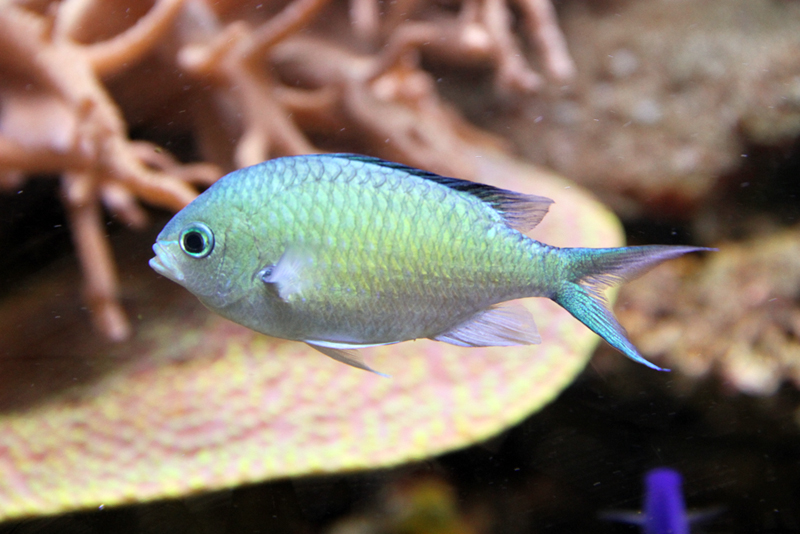 WorldGreen chromis
Small iridescent reef damselfish found across the Indo-Pacific.Reef fish · Coral reefs
 WorldRegal blue tang
Bright blue reef fish with a yellow tail and black markings.Reef fish · Coral reefs
 East AsiaTomato clownfish
A bright orange-red marine fish from the Western Pacific.Reef fish · Coasts and shelves
 WorldBluespotted cornetfish
Long, slender reef fish with a tubular snout and blue spots.Reef fish · Coasts and shelves
