
Foureye butterflyfish
Atlantic reef fish with false eyespots for defence
The foureye butterflyfish is a marine species in the family Chaetodontidae. It lives in the Western Atlantic from New England to South America. The fish uses large rear spots to confuse predators and swims through complex coral structures.
- Large rear spots mimic eyes to confuse predators
- Swims upside down through complex coral structures
- Forms lifelong monogamous pairs
- Found from New England to northern South America
- Feeds on anemones, worms and crustaceans
What it is
This marine ray-finned fish belongs to the butterflyfish family. It has a deep body that is flattened from side to side. A single dorsal fin runs along its back. The mouth is small and holds tiny bristle-like teeth. The body colour is light grey, often with a yellow tint. Dark chevrons point forward across the flanks. Two large black spots with white margins sit near the tail. These ocelli look like eyes and give the fish its name. The real eyes are smaller and hidden by a vertical black bar.
Where it lives
The species inhabits the Western Atlantic Ocean. Its distribution stretches from New England down through Bermuda and the West Indies. It reaches as far south as northern South America. These fish prefer shallow inshore waters. They are commonly found around coral heads and reefs. The complex structure of these habitats provides shelter and feeding grounds.
How it lives
It feeds on various invertebrates including zoantharians and sea anemones. The diet also includes scleractinians, polychaete worms, gorgonians, tunicates and crustaceans. Fish eggs are sometimes consumed. The fish displays remarkable agility in tight spaces. It can swim on its side or upside down to navigate intricate coral passages. When threatened, it may lower its head and erect its spines. This posture resembles a charging bull and may intimidate predators.
Breeding and life cycle
This species forms lifelong pair bonds. Mated couples are frequently observed together. Such monogamous behaviour is uncommon among fish. The focus remains on the social structure of adult pairs.
Fish and people
Photos of this species appear in the Sealife Collection. This suggests interest from aquarium enthusiasts or marine observers. The striking appearance and unique swimming ability likely make it a subject of underwater photography.
Status and threats
The provided material does not state a conservation status.


Questions people ask about Foureye butterflyfish
Why is it called the foureye butterflyfish?
The name comes from two large black spots on the rear of its body. These ocelli have white margins and look like eyes. They are more visible than the real eyes, which are hidden by a black bar. This pattern helps disorientate predators.
What does the foureye butterflyfish eat?
It feeds mainly on invertebrates in shallow waters. The diet includes zoantharians, sea anemones, polychaete worms, gorgonians, tunicates and crustaceans. It may also consume fish eggs occasionally.
Where does this fish live?
It is found in the Western Atlantic Ocean. The range extends from New England through Bermuda and the West Indies to northern South America. It prefers shallow inshore waters near coral heads and reefs.
How does it defend itself from predators?
The fish uses automimicry with rear eyespots to confuse attackers. If escape is impossible, it faces the predator with spines erect and head lowered. This aggressive posture may intimidate the threat.
Good reading and sources
- Foureye butterflyfish on WikipediaEncyclopedia
- More photos on Wikimedia CommonsPhotos
- Wikidata recordOpen data
The facts on this page come from the Wikipedia article "Foureye butterflyfish", written by its contributors and used under the CC BY-SA 4.0 licence, and from its Wikidata record (CC0). EveryFish rewrote the text in its own words, with AI assistance, and compares every page with the article to make sure no passage is copied. It may be reused under the same CC BY-SA 4.0 licence with a link back.
It may contain mistakes, and figures change over time. Nothing here is investment or buying advice. If something is wrong, tell us. Last refreshed 2026-11-15.
Like Foureye butterflyfish
All reef fish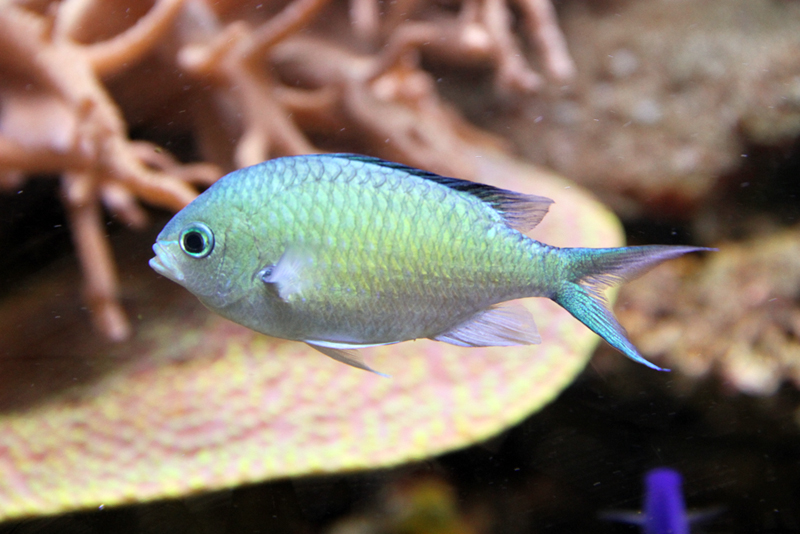 WorldGreen chromis
Small iridescent reef damselfish found across the Indo-Pacific.Reef fish · Coral reefs
 WorldRegal blue tang
Bright blue reef fish with a yellow tail and black markings.Reef fish · Coral reefs
 East AsiaTomato clownfish
A bright orange-red marine fish from the Western Pacific.Reef fish · Coasts and shelves
 WorldBluespotted cornetfish
Long, slender reef fish with a tubular snout and blue spots.Reef fish · Coasts and shelves
More from Chaetodontidae
All of them WorldThreadfin butterflyfish
A tropical marine fish with a trailing dorsal filament.Reef fish · Coasts and shelves
 WorldCopperband butterflyfish
A long-snouted reef fish with yellow stripesReef fish · Coasts and shelves
 WorldRaccoon butterflyfish
A striped marine fish with a distinctive facial mask.Reef fish · Coasts and shelves · 1802
 WorldButterflyfish
A global family of colourful tropical reef fish known for their bright patterns and coral diets.Reef fish · Coasts and shelves · 1815