European river lamprey
A parasitic freshwater and marine fish found across Europe.
The European river lamprey is a jawless fish that migrates between rivers and the sea. It feeds on other fish as an adult and dies after spawning. Populations have recovered from pollution but face regional threats.
- Lacks jaws and uses a sucking disc to feed on fish
- Migrates from sea to rivers to spawn in spring
- Declared extinct in Spain in August 2018
- Traditional delicacy in Latvia and Finland
- Global status is Least Concern since 2008
What it is
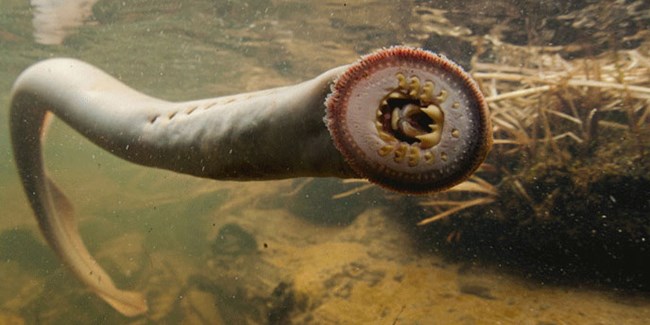
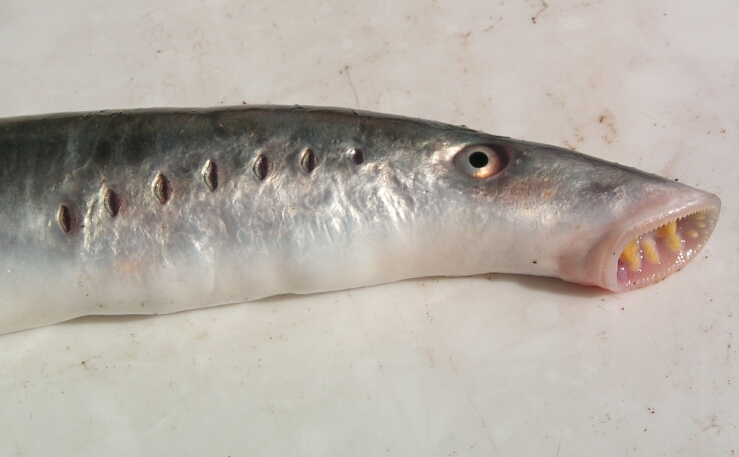
This species is a jawless fish with a long, slender body. It lacks paired fins and possesses a circular sucking disc instead of jaws. The back is dark grey, fading to pale yellow or white on the belly. Seven gill slits sit behind each eye, and a single nostril is present. Adults grow between 25 and 40 centimetres. Marine forms are generally larger than those living in lakes. Sharp teeth line the oral disc, allowing it to attach to hosts. It resembles the brook lamprey but has more widely separated dorsal fins.
Where it lives
Its distribution covers coastal waters around most of Europe. The range extends from the northwestern Mediterranean Sea northwards to Finland, Scotland, Norway, and Russia. It inhabits rivers in the Alps and lakes such as Mjøsa in Norway. Specific populations exist in Nakkila, Finland, and Latvian towns like Carnikava. In August 2018, Spain declared the species extinct within its territory. The fish moves between marine environments and freshwater rivers for reproduction.
How it lives
Adults act as ectoparasites on other fish. They use their sucker to cling to the flanks or gills of host fish. Once attached, they rasp away tissue to feed. This predatory behaviour occurs during their time in marine or large lake habitats. They spend two to three years in these waters before returning to rivers. Larvae, called ammocoetes, live buried in soft sediment for several years. These young stages are difficult to distinguish from related species at the genus level.
Breeding and life cycle
The reproductive cycle mirrors that of salmon. Adults migrate upstream from the sea during autumn and winter. Spawning activity peaks in the springtime. After laying eggs, the adult fish die. The larvae remain in riverbed sediments for several years. They eventually undergo metamorphosis and migrate to the sea as adults. This anadromous life history involves distinct freshwater and marine phases. The total lifespan reaches approximately ten years.
Fish and people
River lampreys are a traditional local delicacy in parts of Europe. They are particularly valued in Latvian coastal towns and Finland. Historical dishes include lamprey pie. The species holds cultural significance in regions where it is harvested. Fishing practices target migrating adults in rivers. Consumption is tied to local heritage rather than widespread commercial trade. The fish is not typically kept in aquariums due to its parasitic nature and specific life cycle requirements.
Status and threats
The global conservation status is Least Concern as of 2008. This improvement followed population recovery after pollution issues in central and western Europe. However, the Baltic Sea population remains Near Threatened according to 2014 and 2024 assessments. Spain listed the species as officially extinct in its territory in 2018. Pollution and habitat barriers likely contributed to past declines. Continued monitoring is necessary to maintain stable numbers in vulnerable regions.

Questions people ask about European river lamprey
How does the European river lamprey feed?
It acts as an ectoparasite. The fish attaches to other fish using a circular sucking disc. It then uses sharp teeth to rasp away tissue from the host's flanks or gills.
Where can you find this lamprey?
It lives in coastal waters around Europe, from the Mediterranean to Finland and Russia. It also enters rivers and lakes, including those in the Alps and Scandinavia.
Is the European river lamprey endangered?
Globally, it is listed as Least Concern since 2008 due to population recovery. However, it is considered Near Threatened in the Baltic Sea and extinct in Spain.
Good reading and sources
- European river lamprey on WikipediaEncyclopedia
- More photos on Wikimedia CommonsPhotos
- Wikidata recordOpen data
The facts on this page come from the Wikipedia article "European river lamprey", written by its contributors and used under the CC BY-SA 4.0 licence, and from its Wikidata record (CC0). EveryFish rewrote the text in its own words, with AI assistance, and compares every page with the article to make sure no passage is copied. It may be reused under the same CC BY-SA 4.0 licence with a link back.
It may contain mistakes, and figures change over time. Nothing here is investment or buying advice. If something is wrong, tell us. Last refreshed 2026-11-15.
Like European river lamprey
All ancient fish 🇨🇳 ChinaChinese sturgeon
Critically endangered giant migratory fish of the YangtzeAncient · Rivers and lakes
 🇺🇸 United States and 4 moreSea lamprey
A jawless, parasitic fish native to the Northern Hemisphere that attacks other fish.Ancient · Rivers and lakes · 1758
 WorldLamprey
Jawless fish with a sucking mouth found in temperate waters worldwide.Ancient · Rivers and lakes
 🇺🇸 United States and 1 moreLake sturgeon
A large, long-lived freshwater fish native to North America.Ancient · Rivers and lakes