
European brook lamprey
A small, non-parasitic freshwater lamprey native to Europe.
The European brook lamprey is a tiny jawless fish found only in European freshwaters. It spends its entire life cycle in rivers and streams, unlike many relatives that migrate to the sea.
- Adults measure twelve to fourteen centimetres.
- They lack jaws and paired fins completely.
- Larvae filter-feed on detritus for years.
- Adults die shortly after spawning.
- Found from Portugal to the Volga River.
What it is
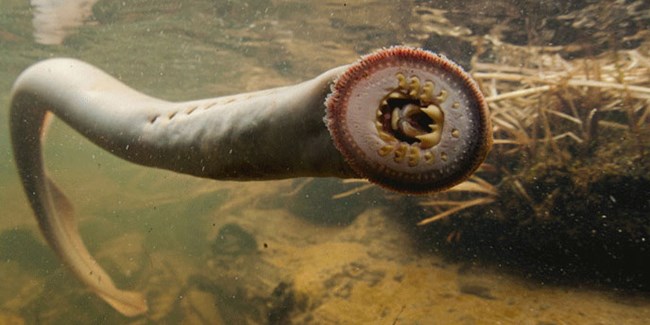
This ancient creature belongs to the jawless group of fish. Adults reach just fourteen centimetres in length. Their bodies are dark blue or green on top, fading to white underneath. They lack paired fins entirely. Instead of jaws, they possess a circular sucking disc lined with blunt teeth. A single nostril sits on their head. Seven gill openings appear behind each eye. The dorsal fins sit close together, distinguishing them from river lampreys.
Where it lives
These animals live across northern Europe. Populations exist in Portugal, southern France, and Italy. They also inhabit Sardinia and parts of the Balkans. Records show them in the upper Volga River. They prefer small streams but survive in larger rivers too. They never leave freshwater environments. This strict habitat choice separates them from anadromous relatives.
How it lives
Adults do not feed at all during their final stage. They rely on energy stored from their larval years. Larvae bury themselves in soft sediment. Only their mouths stick out to filter detritus. They remain blind for three to five years. Predators likely include larger fish and birds. Adults die shortly after reproducing. The species does not migrate to the ocean.
Breeding and life cycle
Males and females build nests in spring or summer. They remove rocks with their mouths to create pits. Fanning tails clear smaller particles away. Pairs intertwine to deposit sperm and eggs simultaneously. Females release thousands of eggs into these gravel beds. Eggs hatch quickly. Young larvae then bury themselves in mud to begin their filter-feeding phase.
Fish and people
This species holds little commercial value. It is not farmed for food. Anglers rarely target it specifically. It serves as a subject for biological research. Scientists study its unique life cycle. Its presence indicates healthy freshwater ecosystems. Local cultures may recognize it as part of the natural heritage.
Status and threats
The species is widespread across Europe. No major threats have caused population declines. It remains listed as least concern. Pollution and habitat destruction pose potential risks. Dams can block access to spawning grounds. Conservation efforts focus on maintaining clean waterways.

Questions people ask about European brook lamprey
Is the European brook lamprey dangerous?
No, it is not dangerous to humans. It lacks parasitic habits and does not attack people. Adults do not feed at all, so they cannot bite. Larvae live buried in sediment and pose no threat.
How long does it take to mature?
Young lampreys spend three to five years as larvae. They then metamorphose into adults over about a year. This process completes before they spawn the following spring. Total development takes several years from egg to adult.
Do they migrate to the sea?
No, they stay in freshwater their whole lives. Unlike some relatives, they do not enter the ocean. Adults do not feed and die after breeding in rivers and streams.
What do they eat as adults?
Adults do not eat anything. Their digestive tract degenerates before maturity. They survive on energy reserves built up during their larval stage. Teeth develop only for nest building, not feeding.
Good reading and sources
- Brook lamprey on WikipediaEncyclopedia
- More photos on Wikimedia CommonsPhotos
- Wikidata recordOpen data
The facts on this page come from the Wikipedia article "Brook lamprey", written by its contributors and used under the CC BY-SA 4.0 licence, and from its Wikidata record (CC0). EveryFish rewrote the text in its own words, with AI assistance, and compares every page with the article to make sure no passage is copied. It may be reused under the same CC BY-SA 4.0 licence with a link back.
It may contain mistakes, and figures change over time. Nothing here is investment or buying advice. If something is wrong, tell us. Last refreshed 2026-11-15.
Like European brook lamprey
All ancient fish 🇸🇳 SenegalNile bichir
An ancient African fish with lungs and armour-like scales.Ancient · Rivers and lakes
 🇸🇳 Senegal and 3 moreWest African lungfish
Air-breathing freshwater fish from AfricaAncient · Rivers and lakes
 🇲🇽 Mexico and 2 moreTropical gar
A small freshwater predator from Central America known for its armored scales and air-breathing ability.Ancient · Rivers and lakes
 🇦🇴 Angola and 3 moreMarbled lungfish
African lungfish with the largest known animal genome, found in East and Central Africa.Ancient · Rivers and lakes
More from Petromyzontidae
All of them WorldLamprey
Jawless fish with a sucking mouth found in temperate waters worldwide.Ancient · Rivers and lakes
🇫🇮 Finland and 4 moreEuropean river lamprey
A parasitic freshwater and marine fish found across Europe.Ancient · Rivers and lakes
 🇺🇸 United States and 4 moreSea lamprey
A jawless, parasitic fish native to the Northern Hemisphere that attacks other fish.Ancient · Rivers and lakes · 1758
 🇺🇸 United States and 1 morePacific lamprey
An anadromous parasitic jawless fish found along the Pacific Rim.Ancient · Rivers and lakes · 1872