
Nile bichir
An ancient African fish with lungs and armour-like scales.
The Nile bichir is a primitive ray-finned fish found in African rivers. It breathes air using true lungs and wears hard ganoid scales for protection. This species grows up to 75 cm and hunts prey in shallow waters.
- Possesses true lungs and must breathe air
- Covered in hard armour-like ganoid scales
- Grows up to 75 cm in length
- Uses suction to feed on prey
- Male has specialised anal fin for mating
What it is
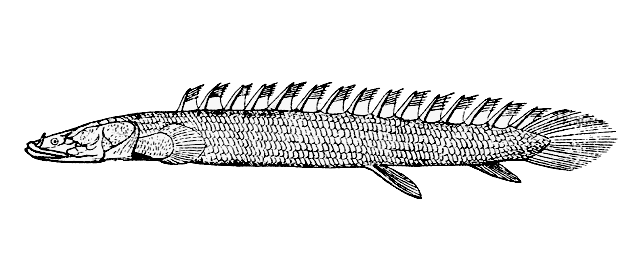
The Nile bichir is an elongated fish with an eel-like body shape. Its upper side is dark grey, marked with vertical bands that fade as the animal matures. The name refers to its many dorsal finlets, which range from five to eighteen in number. These finlets consist of a spine and connected rays. The fish moves with flexible undulatory motions, sweeping its long tail while keeping balance with its pectoral fins. It possesses hard, armour-like ganoid scales and true lungs, traits considered ancestral among ray-finned fishes.
Where it lives
This species has a wide distribution across Africa. It inhabits the Nile River and its tributaries, extending to the Congo Basin and West African nations such as Senegal. Nile bichirs prefer deeper depressions in muddy riverbeds. They are active swimmers but often stay near the bottom. They travel mostly at night through swamps, rivers, and lakes. Their range covers tropical freshwater systems where they can access both water and atmospheric air.
How it lives
Nile bichirs hunt in vegetated shallow areas using suction feeding. They lack protrusible jaws, so they generate vacuum force through body flexibility and muscular movement. Cartilaginous labial folds form a funnel to draw prey in. Their diet includes aquatic and terrestrial invertebrates, fish, and amphibians. They can consume prey up to half their own size. Strong gastric muscles compress dangerous spines on prey to protect the stomach. The fish relies heavily on smell to navigate and find food in murky waters.
Breeding and life cycle
Spawning occurs in densely vegetated areas, often on flooding plains. The fish reaches sexual maturity within a year. Eggs are large, adhesive, and have a single micropyle. Males and females have distinct anal fins used in courtship. The male fin forms a cup-shaped organ that directs sperm to the female vent as eggs are released. This method ensures fertilisation success despite small male gonads. Juveniles grow quickly until reaching a species-specific size, after which growth slows.
Fish and people
The Nile bichir is kept in aquariums due to its unique primitive features. In Egypt, the subspecies Polypterus bichir bichir is regionally extinct. Human activities such as fishing and habitat alteration impact populations. However, harvesting affects them less than other threats. Limited knowledge makes it difficult to determine if wild populations are stable or declining. The fish is valued for study because its lung development shares mechanisms with tetrapods.
Status and threats
The International Union for Conservation of Nature lists this species as Least Concern. This status was reaffirmed in January 2020. Despite this, human impacts pose risks. Groundwater extraction, pollution, drought, and temperature extremes threaten freshwater fish in North Africa. Habitat use changes also affect survival. While fishing pressure exists, it is not the primary driver of decline compared to environmental degradation.


Questions people ask about Nile bichir
Can the Nile bichir breathe underwater?
It has gills but also true lungs. In poorly oxygenated water, it is an obligate air-breather. Without access to the surface to take in atmospheric air, the fish can drown.
What does the Nile bichir eat?
It hunts invertebrates, fish, and amphibians. It uses suction feeding to draw prey into its mouth. It can swallow fish up to half its own size whole.
How big does this fish get?
The Nile bichir can grow up to 750 mm in length. This measurement runs from the snout tip to the end of the caudal peduncle, excluding the tail fin.
Good reading and sources
- Polypterus bichir on WikipediaEncyclopedia
- More photos on Wikimedia CommonsPhotos
- Wikidata recordOpen data
The facts on this page come from the Wikipedia article "Polypterus bichir", written by its contributors and used under the CC BY-SA 4.0 licence, and from its Wikidata record (CC0). EveryFish rewrote the text in its own words, with AI assistance, and compares every page with the article to make sure no passage is copied. It may be reused under the same CC BY-SA 4.0 licence with a link back.
It may contain mistakes, and figures change over time. Nothing here is investment or buying advice. If something is wrong, tell us. Last refreshed 2026-11-15.
Like Nile bichir
All ancient fish 🇧🇯 Benin and 4 moreSaddled bichir
A large African freshwater fish with primitive lungs and multiple dorsal finlets.Ancient · Rivers and lakes · 1845
 🇲🇽 Mexico and 2 moreTropical gar
A small freshwater predator from Central America known for its armored scales and air-breathing ability.Ancient · Rivers and lakes
 🇺🇸 United States and 1 moreAtlantic sturgeon
A large anadromous fish native to the western Atlantic Ocean and its river systems.Ancient · Rivers and lakes
 WorldBichir
Ancient African ray-finned fish with multiple dorsal finlets and lung-like air breathing organs.Ancient · Rivers and lakes