
Bichir
Ancient African ray-finned fish with multiple dorsal finlets and lung-like air breathing organs.
Bichirs belong to the family Polypteridae, an ancient lineage of ray-finned fishes found in tropical Africa. They are popular in aquariums for their prehistoric appearance and unique physiology, including paired lungs that allow them to breathe air in low-oxygen waters.
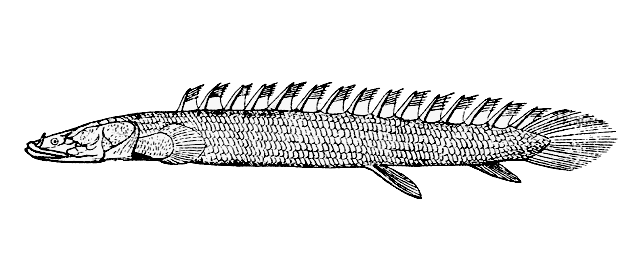
- Seven to eighteen dorsal finlets replace a single dorsal fin.
- Paired lungs allow breathing air in low-oxygen water.
- Nocturnal predators feeding on vertebrates and insects.
- Popular aquarium fish known as dragon bichir.
- Diverged from other ray-finned fishes 330 million years ago.
What it is
Bichirs and reedfish form the family Polypteridae, a group of archaic ray-finned fishes. They possess a series of seven to eighteen dorsal finlets rather than one single dorsal fin. Each finlet has double-edged tips and spines, while other fins use soft rays. Their bodies are covered in thick, rhombic ganoid scales. The jaw structure resembles tetrapods more than teleost fishes. They have fleshy pectoral fins similar to lobe-finned fishes. A pair of slit-like spiracles sits on top of their heads. These structures help them breathe air. Two gular plates are present below the head. Paired ventral lungs act as unchambered sacs. The right lung extends along the body cavity. The smaller left lung reaches the stomach. Four pairs of gill arches complete their anatomy.
Where it lives
All species occur in freshwater habitats across tropical Africa. They inhabit the Nile River system. Their preferred environments include swampy areas. Shallow floodplains provide suitable shelter. Estuaries also support these populations. The group likely diverged from other ray-finned fishes at least 330 million years ago. Fossil relatives like Scanilepiformes appeared later. The oldest known polypterids date back around 100 million years. Fossils have been found in South America and Africa during the early Late Cretaceous period. Extinct genera such as Bawitius and Serenoichthys existed in Egypt and other regions.
How it lives
These fish are nocturnal hunters. They feed on small vertebrates, crustaceans, and insects. Bloodworm larvae serve as common food in captivity. Polypterids possess extraordinary olfactory ability. They prefer lying on the bottom in tanks. Swimming occurs mainly when large plants are present. Despite being predatory, they remain peaceful toward larger tankmates. Pleco catfish may harm them by eating their slime coat. In the wild, they navigate murky waters using scent. Their primitive traits aid survival in oxygen-poor environments. Predators likely target juveniles or smaller individuals.
Breeding and life cycle
Reproduction involves the female laying eggs. She deposits between 100 and 300 eggs. Spawning happens over several days. Males fertilize the eggs externally. Young fish develop within the egg casing initially. Growth rates vary depending on environmental conditions. Captive specimens can live for decades. Lifespans range from ten to over thirty years. Breeding frequency depends on habitat quality and food availability.
Fish and people
Polypterids are popular subjects for public aquaria. Large hobbyists also keep them in home tanks. Pet shops sometimes market them as dragon bichir or dragon fin. This naming highlights their dragon-like appearance. Heavily planted tanks mimic their natural habitat. They coexist well with species large enough to avoid predation. Smaller fish may become prey. Aquarists must avoid plecos due to slime coat damage. Their unique biology attracts scientific interest. Cultural significance is not detailed in the provided text.
Status and threats
Habitat loss in tropical Africa could impact populations. Dams affecting river systems might influence migration. Climate change effects remain unaddressed. Data deficiency prevents accurate assessment. Further research is needed to determine population trends. Current information focuses on biology rather than conservation efforts.



Questions people ask about Bichir
What makes bichirs different from other fish?
They have multiple dorsal finlets instead of one, plus paired lungs for breathing air. Their jaws resemble tetrapods, and their scales are thick and rhombic. These traits make them ancient survivors.
Can bichirs survive out of water?
They cannot survive long out of water. However, they breathe air using lungs when water lacks oxygen. Spiracles help them access surface air in shallow or stagnant ponds.
Are bichirs dangerous to humans?
No, they are not dangerous to humans. They are predatory toward smaller fish but peaceful otherwise. Their spines are not venomous. They pose no threat to people handling them carefully.
How big do bichirs grow?
Sizes range from 25 cm to over 100 cm depending on species. Most stay under one meter. Growth depends on genetics and environment. Captive specimens often reach full adult size.
What do bichirs eat in captivity?
They eat bloodworms, small vertebrates, crustaceans, and insects. Aquarium diets should include protein-rich foods. Feeding at night mimics their natural hunting behavior. Avoid overfeeding to maintain water quality.
Good reading and sources
The facts on this page come from the Wikipedia article "Bichir", written by its contributors and used under the CC BY-SA 4.0 licence, and from its Wikidata record (CC0). EveryFish rewrote the text in its own words, with AI assistance, and compares every page with the article to make sure no passage is copied. It may be reused under the same CC BY-SA 4.0 licence with a link back.
It may contain mistakes, and figures change over time. Nothing here is investment or buying advice. If something is wrong, tell us. Last refreshed 2026-11-15.
Like Bichir
All ancient fish 🇧🇷 Brazil and 1 moreArapaima
Large freshwater fish from the Amazon basin known for its size and air-breathing ability.Ancient · Rivers and lakes
 🇺🇸 United States and 1 moreAtlantic sturgeon
A large anadromous fish native to the western Atlantic Ocean and its river systems.Ancient · Rivers and lakes
 🇸🇳 SenegalNile bichir
An ancient African fish with lungs and armour-like scales.Ancient · Rivers and lakes
 🇸🇳 Senegal and 3 moreSenegal bichir
Ancient African fish that breathes air and walks on landAncient · Rivers and lakes