
Copper shark
Temperate requiem shark with bronze skin and hooked teeth
The copper shark is a large requiem species found in temperate waters worldwide. It grows slowly and matures late, making it vulnerable to fishing pressure despite its wide distribution across the Atlantic, Pacific, and Indian Oceans.
- Reaches 3.3 m in length and weighs up to 305 kg
- Prefers temperate waters above 12 degrees Celsius
- Hunts cooperatively in large groups during sardine runs
- Females mature late at 19 to 20 years of age
- Listed as Vulnerable due to slow growth and fishing
What it is
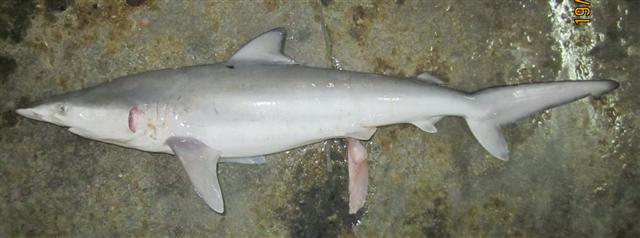
This requiem shark has a slender, streamlined body with a bronze or olive-grey upper side that fades to white below. Its snout is long and pointed, featuring distinctive narrow, hook-shaped upper teeth. The first dorsal fin is tall and pointed, while the second is small. A key identifier is the lack of a prominent ridge between the two dorsal fins. Adults can reach 3.3 metres in length and weigh over 300 kilograms. The colour often shows a metallic sheen, sometimes with a pink cast, but lacks obvious fin markings.
Where it lives
Unlike most relatives, this species prefers temperate waters above 12 degrees Celsius. Populations are scattered across the northeastern and southwestern Atlantic, southern Africa, and parts of the Pacific including Australia, New Zealand, and the Americas. It inhabits diverse environments from shallow estuaries and river mouths to offshore depths of 100 metres. Juveniles stay in shallow inshore waters, while adults migrate seasonally between subtropical wintering grounds and higher latitude coastal areas in spring and summer.
How it lives
Fast and active, these sharks hunt alone, in pairs, or in large loose schools. They feed primarily on cephalopods like squid and octopus, as well as bony fish and other sharks. Off South Africa, they follow the annual sardine run, consuming vast numbers of pilchards. Large groups may cooperate to herd prey into tight balls before feeding. They are preyed upon by larger sharks and killer whales. Parasites include various tapeworms, leeches, and flukes. They do not typically attack marine mammals but may scavenge on dead dolphins.
Breeding and life cycle
Females give birth to live young after a gestation period of 12 to 21 months. Embryos develop via a placental connection formed from the yolk sac. Litters contain 7 to 24 pups. Mating occurs in offshore waters during spring and early summer in the Southern Hemisphere. Females use shallow coastal bays and inlets as nurseries to protect young from predation. Growth is extremely slow, with males reaching maturity at 13 to 19 years and females at 19 to 20 years. They reproduce only every other year.
Fish and people
Commercial and recreational fisheries value this shark for its meat. It ranks tenth in unprovoked attacks on humans, though recorded incidents are low with only one fatal attack noted. The name whaler comes from 19th-century crews observing them around harpooned whales. In New Zealand and Australia, it is a common catch. Its slow growth and late maturity make populations sensitive to overfishing. Traditional uses include food, but no specific cultural rituals are detailed beyond general consumption.
Status and threats
The International Union for Conservation of Nature lists the species as Vulnerable. Population sizes are unknown, but numbers have declined in some areas. The primary threat is its susceptibility to depletion due to low reproductive rates and slow growth. Fishing pressure from commercial and recreational sectors contributes to this decline. Conservation efforts are hindered by the difficulty in distinguishing it from similar species like the dusky shark, leading to potential misidentification in catch records.



Questions people ask about Copper shark
Is the copper shark dangerous to humans?
Attacks are infrequent. The species ranks tenth in unprovoked attacks, with only 15 non-fatal and one fatal incident recorded. It is not considered highly aggressive towards people compared to other large sharks.
What does the copper shark eat?
It feeds on cephalopods like squid and octopus, bony fishes such as sardines and tuna, and other cartilaginous fishes. Off South Africa, southern African pilchards make up the majority of its diet during winter migrations.
How fast do copper sharks grow?
They grow extremely slowly. Males do not reach sexual maturity until they are 13 to 19 years old, and females mature even later at 19 to 20 years. This slow life history makes them vulnerable to population declines.
Where can you find copper sharks?
They are found in temperate waters worldwide, including the Atlantic, Pacific, and Indo-Pacific oceans. Common locations include waters off South Africa, Australia, New Zealand, Argentina, and California, often in coastal bays and estuaries.
Good reading and sources
The facts on this page come from the Wikipedia article "Copper shark", written by its contributors and used under the CC BY-SA 4.0 licence, and from its Wikidata record (CC0). EveryFish rewrote the text in its own words, with AI assistance, and compares every page with the article to make sure no passage is copied. It may be reused under the same CC BY-SA 4.0 licence with a link back.
It may contain mistakes, and figures change over time. Nothing here is investment or buying advice. If something is wrong, tell us. Last refreshed 2026-11-15.
Like Copper shark
All sharks WorldBigeye thresher
Deep-diving shark with huge eyes and a long tail.Shark · Open ocean · 1840
 WorldSpinner shark
A fast requiem shark known for spinning leaps out of water.Shark · Coasts and shelves · 1839
 WorldMilk shark
A small coastal requiem shark found in tropical waters worldwide.Shark · Coasts and shelves · 1837
 WorldPorbeagle
A fast, cold-water mackerel shark found in the Atlantic and Southern Hemisphere.Shark · Coasts and shelves · 1788
More from Carcharhinidae
All of them WorldLemon shark
A social, yellow-skinned requiem shark of shallow tropical waters.Shark · Coasts and shelves · 1868
 🇺🇸 United States and 4 moreCaribbean reef shark
Large requiem shark of western Atlantic coral reefsShark · Coasts and shelves · 1876
 WorldGrey reef shark
Common Indo-Pacific reef predator known for threat displaysShark · Coasts and shelves · 1856
 WorldRequiem shark
A family of migratory, live-bearing sharks found in warm seas worldwide.Shark · Coasts and shelves · 1896