
Channel catfish
A widespread North American freshwater catfish, prized for food and sport.
The channel catfish (Ictalurus punctatus) is a native species of North America. It is the most abundant catfish in the region and supports a major aquaculture industry. The fish is also widely introduced elsewhere, often becoming invasive.
- Official state fish of Kansas, Missouri, Nebraska, and Tennessee.
- Record specimen weighed fifty-eight pounds caught in South Carolina.
- Taste buds cover the entire body, concentrated on the barbels.
- Produces sound by rubbing pectoral spines against the girdle.
- Makes up ninety percent of US farmed catfish production.
What it is
This catfish features four pairs of whisker-like barbels around its mouth and spines on its dorsal and pectoral fins. Adults typically measure at least thirty centimetres long, though records show specimens reaching over one hundred and forty centimetres. The skin is covered in taste buds, allowing it to sense chemicals in murky water. It has a streamlined body adapted for life in rivers and lakes across North America.
Where it lives
Native to nearly all of the United States west of the Appalachians and east of the Rockies, following the Mississippi Basin. It extends into southern Canada including the Great Lakes and parts of northern Mexico. Humans have introduced it to Europe, Asia, South America, and rivers outside its native range, where it is often considered invasive.
How it lives
It hunts using an acute sense of smell and taste, detecting amino acids in parts per hundred million. It feeds by suction, swallowing prey whole rather than chewing. Diet includes crayfish, snails, insects, small fish, and plant matter. It communicates via chemical signals and sounds made by rubbing pectoral spines against the girdle, which can startle predators or signal dominance.
Breeding and life cycle
Channel catfish are cavity nesters. They lay their eggs in hollows, crevices, or under debris to protect them from strong currents. This behaviour helps ensure the survival of the young in flowing water environments. The species has persisted for millions of years with this reproductive strategy.
Fish and people
It is the official state fish of Kansas, Missouri, Nebraska, and Tennessee. In the United States, it is the most fished catfish species, with millions of anglers targeting it annually. It is a primary species for aquaculture, making up ninety percent of farmed catfish in the country. Its meat is valued as a food source, particularly in the southern states.
Status and threats
As a native species in North America, it is not threatened. However, populations introduced to other continents like Europe, Asia, and South America are often classified as invasive. These non-native groups can disrupt local ecosystems. Conservation efforts focus on managing these introduced populations rather than protecting the native species.


Questions people ask about Channel catfish
Is the channel catfish dangerous to humans?
No. A common misconception is that its barbels sting. They do not. The spines on its fins can cause injury if handled improperly, but this is no more dangerous than a mosquito sting.
How does the channel catfish find food?
It relies heavily on taste and smell rather than sight. It has taste buds all over its body and sensitive nostrils that detect amino acids in muddy or dark water, allowing it to locate prey easily.
Why is it called a swimming tongue?
Because it possesses taste buds distributed over its entire skin surface and inside its mouth cavity. This allows it to taste water and food constantly as it moves through its environment.
Where does the channel catfish live?
It thrives in freshwater rivers, lakes, reservoirs, and ponds. It is native to eastern and northern North America but has been introduced to many other regions worldwide.
Good reading and sources
- Channel catfish on WikipediaEncyclopedia
- More photos on Wikimedia CommonsPhotos
- Wikidata recordOpen data
The facts on this page come from the Wikipedia article "Channel catfish", written by its contributors and used under the CC BY-SA 4.0 licence, and from its Wikidata record (CC0). EveryFish rewrote the text in its own words, with AI assistance, and compares every page with the article to make sure no passage is copied. It may be reused under the same CC BY-SA 4.0 licence with a link back.
It may contain mistakes, and figures change over time. Nothing here is investment or buying advice. If something is wrong, tell us. Last refreshed 2026-11-15.
Like Channel catfish
All catfishes 🇺🇸 United States and 1 moreYellow bullhead
A medium-sized North American catfish known for its bright yellow belly and scavenging habits.Catfish · Rivers and lakes · 1819
 🇺🇸 United StatesBrown bullhead
A hardy North American catfish known for surviving poor water conditions.Catfish · Rivers and lakes · 1819
 🇧🇷 Brazil and 4 moreRedtail catfish
A large South American catfish known for its red tail and popularity in the aquarium trade.Catfish · Rivers and lakes
 🇺🇸 United StatesBlack bullhead
A small, hardy North American catfish that tolerates poor water conditions and feeds at night.Catfish · Rivers and lakes
More from Ictaluridae
All of them 🇺🇸 United StatesWidemouth blindcat
A pale, eyeless catfish from Texas aquifersCatfish · Rivers and lakes
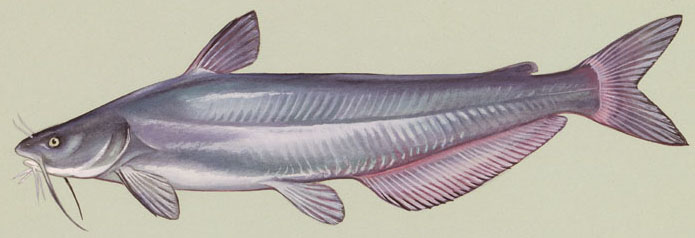 🇺🇸 United StatesBlue catfish
A large North American catfish known for its size and invasive spread in eastern US waters.Catfish · Rivers and lakes
 🇺🇸 United States and 2 moreFlathead catfish
A large North American freshwater predator known for its broad head and carnivorous diet.Catfish · Rivers and lakes