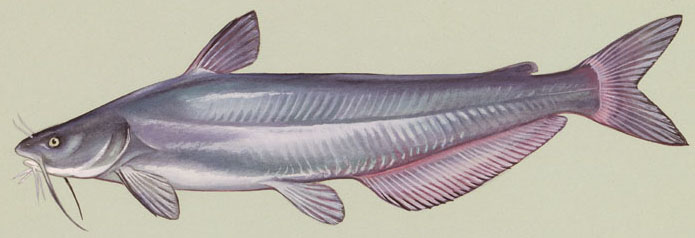
Blue catfish
A large North American catfish known for its size and invasive spread in eastern US waters.
The blue catfish is the largest catfish species in North America, native to major river systems like the Mississippi. It has been introduced to other regions where it thrives, sometimes becoming an invasive problem due to its predatory nature.
- Largest catfish in North America, reaching 170 cm and 65 kg.
- Native to Mississippi River basin and Gulf Coast.
- Introduced to Virginia and Chesapeake Bay since 1970s.
- Tolerates brackish water and colonizes coastal waterways.
- Spawns annually, producing thousands of eggs per female.
What it is
This heavy-bodied fish displays a blueish-grey hue and features a distinct dorsal hump. It possesses barbels around the mouth, a deeply forked tail, and a protruding upper jaw. Adults typically measure between 64 and 117 centimetres, though they can reach 170 centimetres. The species is often confused with channel catfish, but differs by having 30 to 36 anal fin rays compared to 25 to 29 in its relative. It is the largest catfish species found on the North American continent.
Where it lives
Native ranges include the Mississippi River drainage, covering the Missouri, Ohio, Tennessee, and Arkansas Rivers. Its distribution extends south along the Gulf Coast to Belize and Guatemala, including the Rio Grande and Des Moines River. Introduced populations exist in South Carolina reservoirs, Virginia rivers, Illinois lakes, and Florida waters. It tolerates brackish conditions, allowing colonization of coastal inland waterways and estuaries like the Chesapeake Bay.
How it lives
An opportunistic omnivore, this predator consumes available aquatic food sources including fish, insects, crawfish, crabs, mussels, worms, and frogs. It may feed on injured baitfish washed through dam spillways or turbines. In some regions, it preys on adult Asian carp. Despite being a top predator, studies in Virginia indicate diets often consist largely of invasive Hydrilla plants and Asian clams, with occasional consumption of blue crabs.
Breeding and life cycle
Spawning occurs once yearly from May through June. Females are highly productive, generating two thousand to four thousand eggs for every pound of body weight. A twenty-pound female can release over forty thousand eggs. This high reproductive output contributes to rapid population growth in introduced areas, leading to dominance in freshwater and oligohaline tidal rivers.
Fish and people
Anglers pursue this species for sport, with records set in the Mississippi River and Kerr Lake. Weights exceeding sixty kilograms have been documented. The fish is also consumed as food. In areas like Maryland, educational programmes encourage eating invasive blue catfish to help control their populations. While considered problematic in Virginia due to low mortality and large size, predation on native anadromous fish like shad remains minimal according to research.
Status and threats
The species is listed as least concern globally. However, it is classified as invasive in specific regions such as the Albemarle Sound and Chesapeake Bay. Introduction in Virginia during the 1970s led to population explosions, with capture rates far exceeding those in native ranges. Conservation efforts focus on managing these non-native populations rather than protecting the species itself, which remains stable in its original habitat.


Questions people ask about Blue catfish
How can I tell a blue catfish from a channel catfish?
Count the rays on the anal fin. Blue catfish have thirty to thirty-six rays, while channel catfish have twenty-five to twenty-nine. Blue catfish also typically show a dorsal hump and a deeper fork in the tail.
Is the blue catfish dangerous to humans?
No, it is not dangerous to humans. It is a large predator of fish and invertebrates. While it can be strong when caught on a line, it poses no threat to people.
Why is it considered invasive in Virginia?
It was introduced in the 1970s and thrived due to tolerance for various climates and brackish water. High reproduction rates and low mortality led to population explosions that dominate local ecosystems.
What does a blue catfish eat?
It is an omnivorous predator eating fish, insects, crustaceans, mussels, worms, and frogs. In Chesapeake Bay, it also consumes significant amounts of invasive Hydrilla plants and Asian clams.
Good reading and sources
The facts on this page come from the Wikipedia article "Blue catfish", written by its contributors and used under the CC BY-SA 4.0 licence, and from its Wikidata record (CC0). EveryFish rewrote the text in its own words, with AI assistance, and compares every page with the article to make sure no passage is copied. It may be reused under the same CC BY-SA 4.0 licence with a link back.
It may contain mistakes, and figures change over time. Nothing here is investment or buying advice. If something is wrong, tell us. Last refreshed 2026-11-15.
Like Blue catfish
All catfishes 🇺🇸 United StatesBlack bullhead
A small, hardy North American catfish that tolerates poor water conditions and feeds at night.Catfish · Rivers and lakes
 🇺🇸 United States and 2 moreFlathead catfish
A large North American freshwater predator known for its broad head and carnivorous diet.Catfish · Rivers and lakes
 🇧🇷 Brazil and 4 moreRedtail catfish
A large South American catfish known for its red tail and popularity in the aquarium trade.Catfish · Rivers and lakes
 🇧🇷 BrazilPiraíba
A massive Amazonian catfish known for its long barbels and role as an apex predator.Catfish · Rivers and lakes
More from Ictaluridae
All of them 🇺🇸 United StatesWidemouth blindcat
A pale, eyeless catfish from Texas aquifersCatfish · Rivers and lakes
 🇺🇸 United StatesBrown bullhead
A hardy North American catfish known for surviving poor water conditions.Catfish · Rivers and lakes · 1819
 🇺🇸 United States and 1 moreYellow bullhead
A medium-sized North American catfish known for its bright yellow belly and scavenging habits.Catfish · Rivers and lakes · 1819