
Catla
Large freshwater carp farmed across South Asia for food.
This large cyprinid fish thrives in South Asian rivers and lakes. Farmers raise it extensively in ponds alongside other carp species. It serves as a vital protein source for millions, with annual production reaching millions of tonnes.
- Grows up to 182 cm long and weighs 38.6 kg
- Annual farmed production reached 2.8 million tonnes in 2012
- Feeds on plankton in surface and midwater zones
- Reaches sexual maturity at two years of age
What it is
The catla is a substantial freshwater fish belonging to the carp family. It features a notably broad head and a lower jaw that protrudes forward, giving its mouth an upturned appearance. The body displays large greyish scales along the back, contrasting with a pale white belly. Adults can grow quite large, reaching lengths of over one and a half metres and weighing nearly forty kilograms. This distinctive shape helps distinguish it from other regional species, although it shares some visual traits with the giant barb found further east.
Where it lives
This species originates from the river systems and lakes of South Asia. Its natural home includes waters in northern India, Bangladesh, Myanmar, Nepal, and Pakistan. Beyond these native ranges, farmers have introduced it to other areas within the region for cultivation. It thrives in freshwater environments, occupying both surface and middle water columns. The fish is well adapted to the warm climates of these tropical and subtropical zones, where it forms a key part of local aquatic ecosystems and agricultural practices.
How it lives
Feeding habits change as the fish grows. Young catla consume both microscopic plant matter and tiny animals floating in the water. As they mature, adults focus primarily on zooplankton, filtering these small organisms through specialized gill structures. They do not feed on the bottom but remain in the upper and middle layers of the water. This surface-oriented behaviour makes them suitable for mixed farming systems, as they do not compete directly with bottom-feeding species for food resources.
Breeding and life cycle
Sexual maturity arrives relatively quickly for such a large fish. Individuals typically become capable of reproduction at around two years of age. By this time, they usually weigh approximately two kilograms. In controlled farming environments, artificial breeding techniques have been successfully applied. Researchers in Vietnam demonstrated effective artificial fertilization methods in the late 1980s, allowing for consistent production outside the natural spawning seasons and regions.
Fish and people
Farmers value this carp highly for aquaculture. It is often raised in polyculture ponds alongside roho labeo and mrigal carp. Production volumes have risen significantly, with millions of tonnes harvested annually. Consumers prefer fish weighing between one and two kilograms, which are sold fresh on ice in local markets. The species holds cultural significance in Bengal and neighbouring regions, where it is known by various local names. It remains a staple protein source for many communities across South Asia.

Questions people ask about Catla
What does the catla eat?
Young fish consume both phytoplankton and zooplankton. Adults switch to feeding primarily on zooplankton, using large gill rakers to filter these tiny organisms from the water column.
How large can a catla grow?
This species can reach substantial sizes. Records show individuals growing up to 182 centimetres in length and weighing as much as 38.6 kilograms when fully mature.
Where is the catla farmed?
It is a key aquaculture species in South Asia, particularly in India, Bangladesh, and Nepal. Farmers also raise it in Vietnam, where artificial breeding was successfully established in 1986.
Good reading and sources
The facts on this page come from the Wikipedia article "Catla", written by its contributors and used under the CC BY-SA 4.0 licence, and from its Wikidata record (CC0). EveryFish rewrote the text in its own words, with AI assistance, and compares every page with the article to make sure no passage is copied. It may be reused under the same CC BY-SA 4.0 licence with a link back.
It may contain mistakes, and figures change over time. Nothing here is investment or buying advice. If something is wrong, tell us. Last refreshed 2026-11-15.
Like Catla
All carps and minnows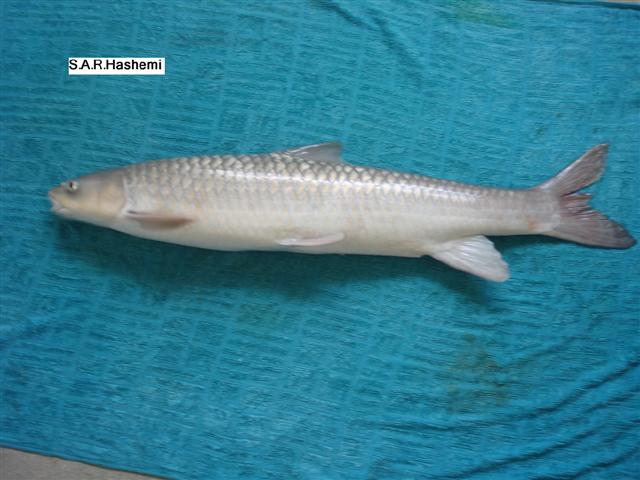 🇮🇷 Iran and 1 moreShabout
A large freshwater carp native to the Tigris-Euphrates basin in Western Asia.Carp · Rivers and lakes
 🇯🇵 JapanNigorobuna
Wild carp from Lake Biwa used for fermented sushi.Carp · Rivers and lakes
 🇮🇳 India and 4 moreRohu
A large silver carp from South Asian rivers, farmed for food and prized as a game fish.Carp · Rivers and lakes
 🇺🇸 United States and 1 moreGolden shiner
A North American minnow used widely as bait and in pond culture.Carp · Rivers and lakes
More from Cyprinidae
All of them 🇮🇳 India and 4 moreCommon snowtrout
A cold-water cyprinid from Himalayan rivers.Carp · Rivers and lakes
🇵🇰 Pakistan and 3 moreGolden barb
Small Asian cyprinid found in rivers and aquariumsCarp · Rivers and lakes
 🇲🇾 Malaysia and 1 moreHarlequin rasbora
A small, colourful freshwater fish popular in home aquariums for its distinctive black body marking.Carp · Rivers and lakes
 🇹🇭 Thailand and 2 moreSiamese mud carp
Freshwater cyprinid native to Mekong and Chao Phraya riversCarp · Rivers and lakes