
Black sea bass
Western Atlantic reef fish prized for its white flesh
The black sea bass is a marine ray-finned fish found along the eastern coast of North America. It supports significant commercial and recreational fisheries due to its firm, delicate meat. This slow-growing species changes sex from female to male as it matures.
- Changes sex from female to male as it matures
- Found from Nova Scotia to the Gulf of Mexico
- Prized for firm, white, flaky flesh
- Lives near rocky bottoms and shipwrecks
- Spawns between January and July
What it is
This marine ray-finned fish belongs to the sea bass subfamily within the Serranidae family, which also contains groupers. Adults typically reach thirty centimetres in length, though they can grow to sixty-six centimetres and weigh over four kilograms. The body is oblong and compressed sideways. A large mouth contains bands of teeth on the jaws and a triangular patch on the roof. The dorsal fin features ten spines with deeply notched membranes between them. Colouration ranges from smoky grey to blue-black on the back, fading to a lighter underside. Pale spots on each scale create longitudinal stripes along the flanks.
Where it lives
Its distribution covers the western Atlantic Ocean. The range extends from Nova Scotia southward along the North American eastern seaboard. It reaches as far south as the Florida Keys and enters the Gulf of Mexico. In the Gulf, its western limit lies just west of the Mississippi Delta near Louisiana. These fish inhabit rocky substrates and areas near rock jetties in shallow waters. They are also recorded in deeper offshore zones down to one hundred and thirty metres. Juveniles prefer protected estuarine waters, often hiding around man-made structures, wrecks, or shell beds.
How it lives
This predatory species feeds on a broad variety of prey including crabs, shrimps, barnacles, and worms. It also consumes tunicates, small fish, and bivalves. Larger fish hunt the black sea bass, with known predators including monkfish, spotted hake, and summer flounder. Striped bass, bluefish, and weakfish also prey on them, as do little skates, spiny dogfish, and certain sharks. The fish spends most of its time near the bottom, aggregating around rocks or wrecks. It often rests in a head-down or head-up position. The dorsal fin remains folded but spreads out as an aggressive signal to others.
Breeding and life cycle
The species is a protogynous hermaphrodite, meaning most individuals start life as females and later change to males. This shift likely occurs when large females detect a shortage of males in their spawning group. Sexual maturity arrives between one and three years of age. Spawning takes place from January through July. Smaller females release around thirty thousand eggs, while larger ones may produce half a million. The pelagic eggs measure about one millimetre in diameter and hatch after seventy-five hours in sixteen degree Celsius water. Larvae remain pelagic until reaching thirteen millimetres, then settle into estuarine habitats.
Fish and people
Fishermen value this species for both commercial and recreational purposes. Its lean, white flesh has a firm texture that breaks into small flakes with a delicate flavour. Due to their modest size, they are often cooked whole. Catch methods include otter trawls, hook and line gear, and pots or traps. Although they show promise for aquaculture with high growth rates in sheltered environments, they are not yet farmed commercially. Management involves catch limits, permits, and closed seasons. Two distinct populations are managed separately north and south of Cape Hatteras by various US fisheries councils.


Questions people ask about Black sea bass
Where does the black sea bass live?
It inhabits the western Atlantic Ocean, ranging from Nova Scotia south to the Florida Keys and into the Gulf of Mexico. It prefers rocky substrates, jetties, and wrecks in shallow to moderately deep waters.
What does black sea bass taste like?
The flesh is lean, white, and firm with a delicate flavour. It breaks into small flakes when cooked. Because most caught fish are small, they are frequently prepared and served whole.
Do black sea bass change gender?
Yes, they are protogynous hermaphrodites. Most begin life as females and transition to males later, often in response to a lack of males in their spawning group. Males can live up to twelve years.
Good reading and sources
- Black sea bass on WikipediaEncyclopedia
- More photos on Wikimedia CommonsPhotos
- Wikidata recordOpen data
The facts on this page come from the Wikipedia article "Black sea bass", written by its contributors and used under the CC BY-SA 4.0 licence, and from its Wikidata record (CC0). EveryFish rewrote the text in its own words, with AI assistance, and compares every page with the article to make sure no passage is copied. It may be reused under the same CC BY-SA 4.0 licence with a link back.
It may contain mistakes, and figures change over time. Nothing here is investment or buying advice. If something is wrong, tell us. Last refreshed 2026-11-15.
Like Black sea bass
All perches, basses and snappers WorldSpangled emperor
A large, colourful reef fish found across the Indo-West Pacific.Perch-like · Coasts and shelves · 1775
 WorldBluestripe snapper
Bright yellow reef fish with four blue stripesPerch-like · Coasts and shelves · 1775
 WorldGolden snapper
A large Indo-Pacific snapper with distinctive rusty scale spots.Perch-like · Coasts and shelves · 1792
 🇦🇺 Australia and 4 moreLeopard coral grouper
A spotted reef predator prized for food across the Pacific.Perch-like · Coasts and shelves · 1802
More from Serranidae
All of them WorldGiant grouper
A massive Indo-Pacific reef fish and one of the largest bony species on Earth.Reef fish · Coasts and shelves · 1790
 WorldOrange-spotted grouper
A large Indo-Pacific marine fish prized for its flesh and known for changing sex.Other · Coasts and shelves · 1822
 Southeast AsiaHumpback grouper
A spotted marine fish with a distinctive humped head profile.Perch-like · Coral reefs · 1828
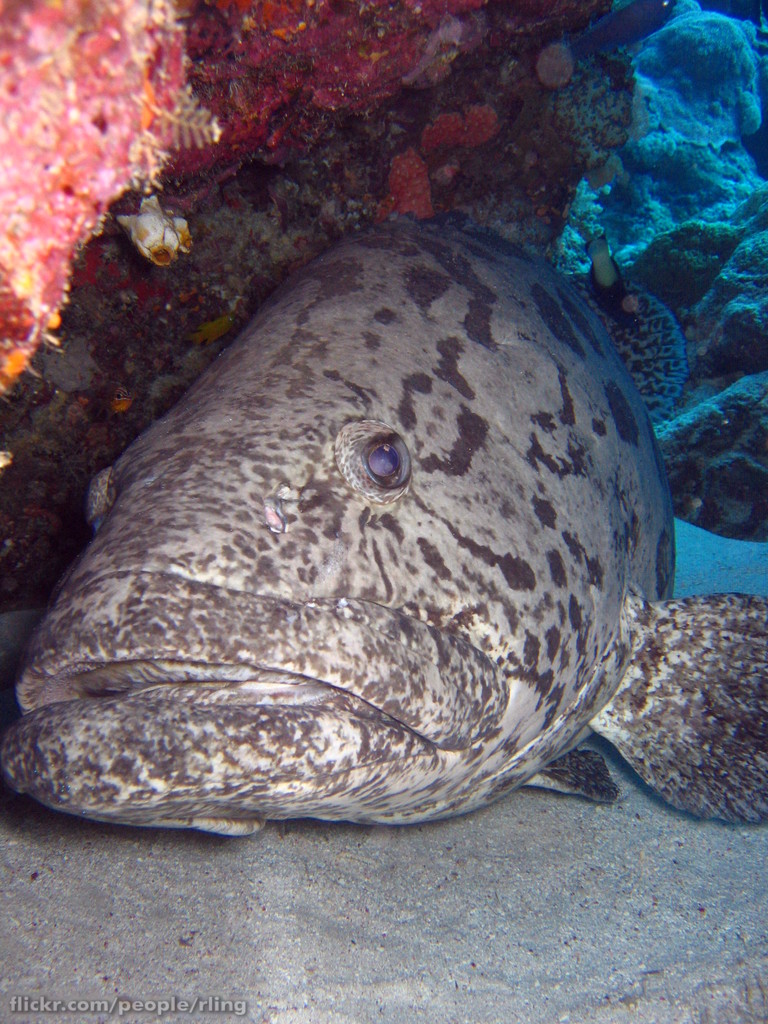 WorldPotato grouper
Large Indo-Pacific reef grouper with dark blotches.Perch-like · Coral reefs · 1959