
Golden snapper
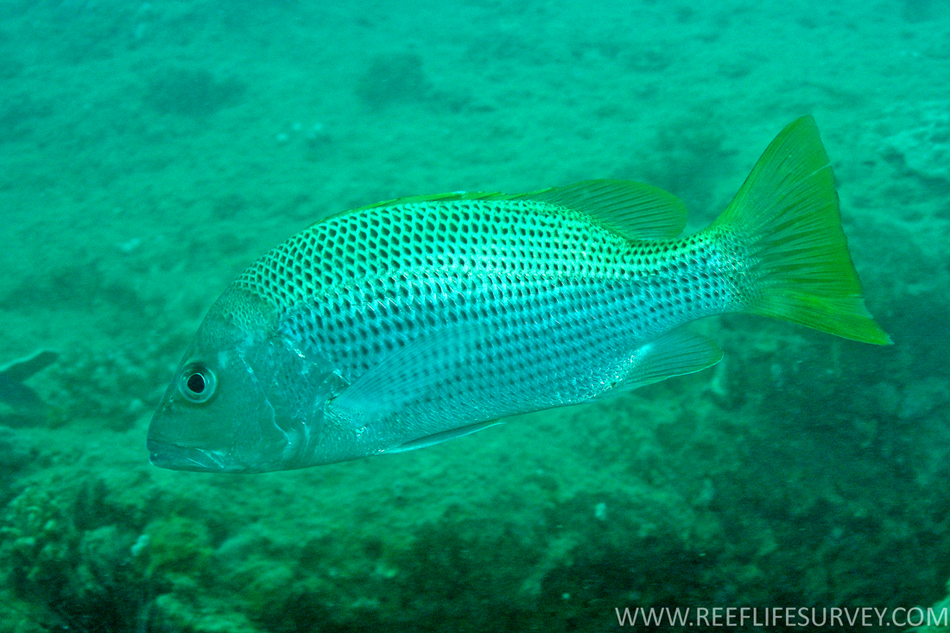
A large Indo-Pacific snapper with distinctive rusty scale spots.
The Golden snapper is a marine fish found across the Indian and Pacific Oceans. It inhabits coral reefs and mangroves, growing up to 97 cm. Fishers catch it for food and sport, valuing its size and taste.
- Grows up to 97 cm and weighs 10.5 kg
- Juveniles live in mangroves, adults on reefs
- Distinctive rusty spot on each scale
- Popular game fish in Australian waters
- Found from Red Sea to Fiji and Japan
What it is
This species is a marine ray-finned fish within the snapper family. It has a moderately deep body with a steep forehead. The colour is yellow with bronze or silvery sheens, fading to white on the belly. Each scale features a rusty spot, creating horizontal lines along the sides. A black blotch often sits below the dorsal fin, though adults may lack it. The dorsal fin holds ten spines and soft rays, while the tail is flat or slightly notched.
Where it lives
Its distribution spans the Indo-Pacific region. Populations exist from the southern Red Sea and eastern Africa down to South Africa. The range extends across the Indian Ocean into the Pacific, reaching Fiji. Northern limits include the Ryukyu Islands of Japan, while southern boundaries reach northern Australia. These fish inhabit depths from shallow waters to eighty metres. Juveniles shelter in mangroves, whereas adults prefer coral reefs and deeper offshore areas.
How it lives
As a predator, it feeds on other fishes and bottom-dwelling invertebrates. Crustaceans and cephalopods form part of its diet. Large adults often school in turbid waters near hard substrates. They are more common over deep reefs than in shallow zones. In Australian waters, this snapper is a dominant large species in nearshore reef communities. They move between silty coastal areas and sandy offshore grounds.
Breeding and life cycle
Reproductive activity has been recorded in the Andaman Sea during September. Specific details on egg laying and larval development are not provided in the available data. The species uses mangrove environments for juvenile protection before moving to reefs as they mature.
Fish and people
Fishers target this species using handlines, traps, and bottom trawls. Markets across its range sell the catch fresh or dried and salted. Recreational anglers in Australia value it as a popular game fish. Its size and presence in accessible waters make it a frequent target for sport fishing activities.

Questions people ask about Golden snapper
Where does the Golden snapper live?
It lives in the Indian and Pacific Oceans, from East Africa to Fiji. Juveniles stay in mangroves, while adults inhabit coral reefs and deeper waters up to 80 metres deep.
What does the Golden snapper eat?
It is a predatory fish that eats other fishes, crustaceans, and cephalopods. It hunts these prey items in both shallow and deep reef environments.
How big does the Golden snapper get?
The maximum recorded length is 97 cm, with a weight of up to 10.5 kg. However, a length of 50 cm is more typical for most individuals caught.
Good reading and sources
- Lutjanus johnii on WikipediaEncyclopedia
- More photos on Wikimedia CommonsPhotos
- Wikidata recordOpen data
The facts on this page come from the Wikipedia article "Lutjanus johnii", written by its contributors and used under the CC BY-SA 4.0 licence, and from its Wikidata record (CC0). EveryFish rewrote the text in its own words, with AI assistance, and compares every page with the article to make sure no passage is copied. It may be reused under the same CC BY-SA 4.0 licence with a link back.
It may contain mistakes, and figures change over time. Nothing here is investment or buying advice. If something is wrong, tell us. Last refreshed 2026-11-15.
Like Golden snapper
All perches, basses and snappers WorldSpangled emperor
A large, colourful reef fish found across the Indo-West Pacific.Perch-like · Coasts and shelves · 1775
 🇺🇸 United States and 4 moreMutton snapper
A colourful Atlantic reef fish prized for its meat.Perch-like · Coasts and shelves · 1828
 WorldBluefin trevally
Large tropical marine predator with electric blue finsPerch-like · Coasts and shelves · 1833
 WorldGreasy grouper
Indo-Pacific reef fish with slow growth and high commercial valuePerch-like · Coasts and shelves
More from Lutjanidae
All of them WorldMalabar blood snapper
A red reef snapper from the Indo-Pacific.Perch-like · Coasts and shelves · 1801
 WorldBluestripe snapper
Bright yellow reef fish with four blue stripesPerch-like · Coasts and shelves · 1775
 WorldMangrove red snapper
Large Indo-Pacific snapper found in mangroves and reefsPerch-like · Rivers and lakes · 1775
 WorldEmperor red snapper
Large Indo-Pacific reef snapper with distinctive juvenile bands.Perch-like · Coasts and shelves · 1816