
Spangled emperor
A large, colourful reef fish found across the Indo-West Pacific.
The spangled emperor is a marine ray-finned fish in the family Lethrinidae. It inhabits coral reefs and sandy bottoms from East Africa to Japan. Fishers value it for its firm, tasty flesh, though heavy fishing has reduced numbers in some areas.
- Grows up to 87 cm in length
- Found from East Africa to Japan
- Eats molluscs and crustaceans
- Major commercial fish in New Caledonia
- Host to eleven parasite species in New Caledonia
What it is
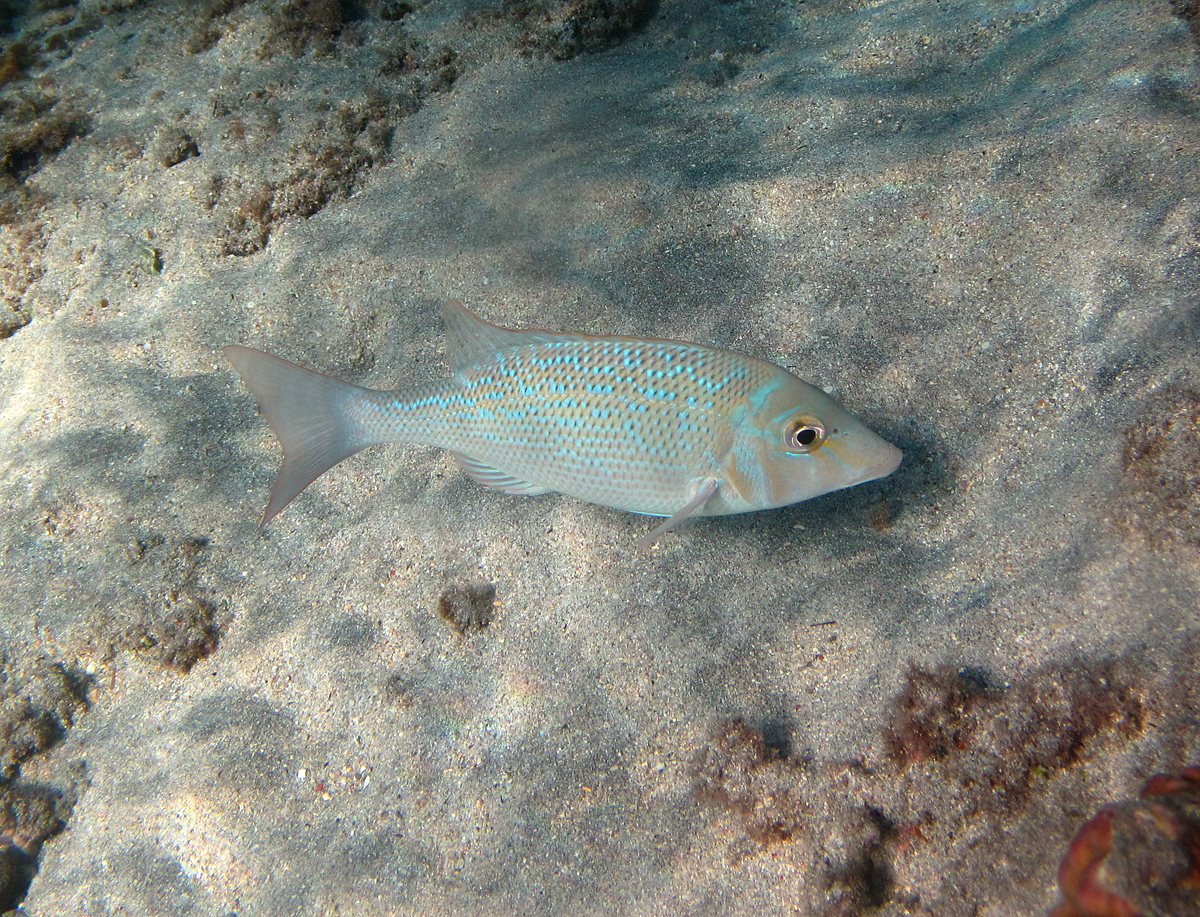
This species is a member of the emperor bream family. It grows to about 70 cm on average, with large specimens reaching 87 cm. The body is yellow, bronze or yellowish-brown, with a lighter belly. Scattered blue markings cover the flanks, and the cheeks are scaleless. Fins are whitish or yellow, with a yellow edge on the dorsal fin. Irregular dark bars sometimes appear on the sides.
Where it lives
Its range stretches from East Africa to southern Japan. Populations live in Australian coastal waters, the Red Sea, the Persian Gulf and New Caledonia. It occupies depths between 10 and 75 metres, though some records suggest deeper water. The fish prefers coral and rocky reefs, seagrass beds and mangrove swamps. It also swims over sandy substrates.
How it lives
Juveniles often form large schools. Adults are non-migratory and stay near structures like reefs. They feed primarily on hard-shelled prey such as molluscs, echinoderms and crustaceans. Polychaete worms and other fish make up a smaller part of their diet. This predator uses its strong teeth to crush shells.
Fish and people
Recreational anglers prize this fish for its fighting ability and taste. It is a major commercial species in New Caledonia. In the Persian Gulf, local fishers call it Sheri or Sherry. Approximately 3000 tonnes are caught annually in that region. The flesh is considered delicious and is widely consumed.
Status and threats
Overfishing has significantly reduced populations in the Persian Gulf due to expanded fishing fleets. Despite this pressure, offshore stocks remain at levels of lower concern. Current catches are viewed as near sustainable in many areas, though local declines are evident where fishing intensity is highest.


Questions people ask about Spangled emperor
What does the spangled emperor eat?
It feeds mainly on molluscs, echinoderms and crustaceans. It also consumes polychaete worms and occasionally other fish. Its strong teeth allow it to crush hard shells.
Where can I find this fish?
It lives in the Indo-West Pacific region. Specific locations include East Africa, the Red Sea, the Persian Gulf, Australia, southern Japan and New Caledonia. It prefers reefs and sandy bottoms.
Is the spangled emperor good to eat?
Yes, it is highly regarded for its flavour. Recreational fishers seek it out, and it supports commercial fisheries in places like New Caledonia and the Persian Gulf.
Good reading and sources
- Lethrinus nebulosus on WikipediaEncyclopedia
- More photos on Wikimedia CommonsPhotos
- Wikidata recordOpen data
The facts on this page come from the Wikipedia article "Lethrinus nebulosus", written by its contributors and used under the CC BY-SA 4.0 licence, and from its Wikidata record (CC0). EveryFish rewrote the text in its own words, with AI assistance, and compares every page with the article to make sure no passage is copied. It may be reused under the same CC BY-SA 4.0 licence with a link back.
It may contain mistakes, and figures change over time. Nothing here is investment or buying advice. If something is wrong, tell us. Last refreshed 2026-11-15.
Like Spangled emperor
All perches, basses and snappers WorldGolden snapper
A large Indo-Pacific snapper with distinctive rusty scale spots.Perch-like · Coasts and shelves · 1792
 🇺🇸 United States and 4 moreMutton snapper
A colourful Atlantic reef fish prized for its meat.Perch-like · Coasts and shelves · 1828
 WorldBluefin trevally
Large tropical marine predator with electric blue finsPerch-like · Coasts and shelves · 1833
 WorldGreasy grouper
Indo-Pacific reef fish with slow growth and high commercial valuePerch-like · Coasts and shelves