
Burton's mouthbrooder
East African cichlid with reversible social roles and acoustic courtship.
Burton's mouthbrooder is a small cichlid from Lake Tanganyika and nearby waters. Males switch between dominant and subordinate states based on social cues. Females carry eggs in their mouths. Scientists study this fish to understand brain plasticity and social behaviour.
- Males switch between dominant and subordinate roles reversibly.
- Females carry and fertilise eggs in their mouths.
- Courtship uses acoustic signals and body quivers.
- Found in Lake Tanganyika and surrounding waterways.
- Used as a model for genomic and behavioural research.
What it is
Burton's mouthbrooder is a cichlid fish found in East Africa. It belongs to the haplochromine lineage, which includes many species from Lake Victoria and Lake Malawi. This fish lives in diverse freshwater habitats such as rivers, swamps, and lakes. It is notable for its complex social structures and reproductive strategies. Researchers use it as a model organism to study development and genomics due to its evolutionary position.
Where it lives
This species inhabits the Lake Tanganyika basin and surrounding waterways. Its range covers parts of Burundi, Rwanda, Tanzania, and Zambia. It thrives in various freshwater environments including permanent and intermittent rivers. It also lives in swamps, freshwater marshes, and inland deltas. These varied habitats support its widespread presence in the region.
How it lives
Males exhibit two reversible social roles. Dominant males are territorial, brightly coloured, and aggressive. Subordinate males resemble females and have regressed reproductive organs. Social status shifts cause changes in brain function and hormone levels. Cortisol and testosterone play key roles in these transitions. Females choose mates based on their own reproductive state and male displays.
Breeding and life cycle
The species practices lekking, where dominant males display to attract females. Courtship involves body quivers and increased urination to release pheromones. Females lay eggs and collect them in their mouths. They fertilise the eggs by pecking at spots on the male's anal fin. Mothers incubate the young for about two weeks before releasing them. Noise pollution can disrupt this process.
Fish and people
Scientists value this fish for research into social behaviour and physiology. It helps explain how social environment affects brain and body systems. Studies focus on its reversible male phenotypes and acoustic communication. It serves as a comparative model for genomic research among cichlids.
Status and threats
The fish faces potential threats from environmental changes like noise pollution. Such disturbances can alter mating behaviours and reduce reproductive success. Habitat degradation in rivers and wetlands could also impact populations. Further assessment is needed to determine specific conservation needs.
Questions people ask about Burton's mouthbrooder
How do male Burton's mouthbrooders change their social status?
Males switch between dominant and subordinate states based on social cues. A larger rival can force a dominant male to become subordinate. This change involves shifts in colour, aggression, and hormone levels like cortisol and testosterone.
How does reproduction work in this species?
Females lay eggs and hold them in their mouths for fertilisation. They peck at egg spots on the male's anal fin to trigger sperm release. The mother incubates the young for about two weeks before releasing them.
Why is this fish important for science?
It is a model organism for studying social behaviour and brain plasticity. Its reversible social roles help scientists understand how environment affects physiology. It also aids comparative genomic research among cichlid species.
Good reading and sources
- Astatotilapia burtoni on WikipediaEncyclopedia
- More photos on Wikimedia CommonsPhotos
- Wikidata recordOpen data
The facts on this page come from the Wikipedia article "Astatotilapia burtoni", written by its contributors and used under the CC BY-SA 4.0 licence, and from its Wikidata record (CC0). EveryFish rewrote the text in its own words, with AI assistance, and compares every page with the article to make sure no passage is copied. It may be reused under the same CC BY-SA 4.0 licence with a link back.
It may contain mistakes, and figures change over time. Nothing here is investment or buying advice. If something is wrong, tell us. Last refreshed 2026-11-15.
Like Burton's mouthbrooder
All cichlids Sub-Saharan AfricaZebra mbuna
Small rock-dwelling cichlid from Lake MalawiCichlid · Rivers and lakes
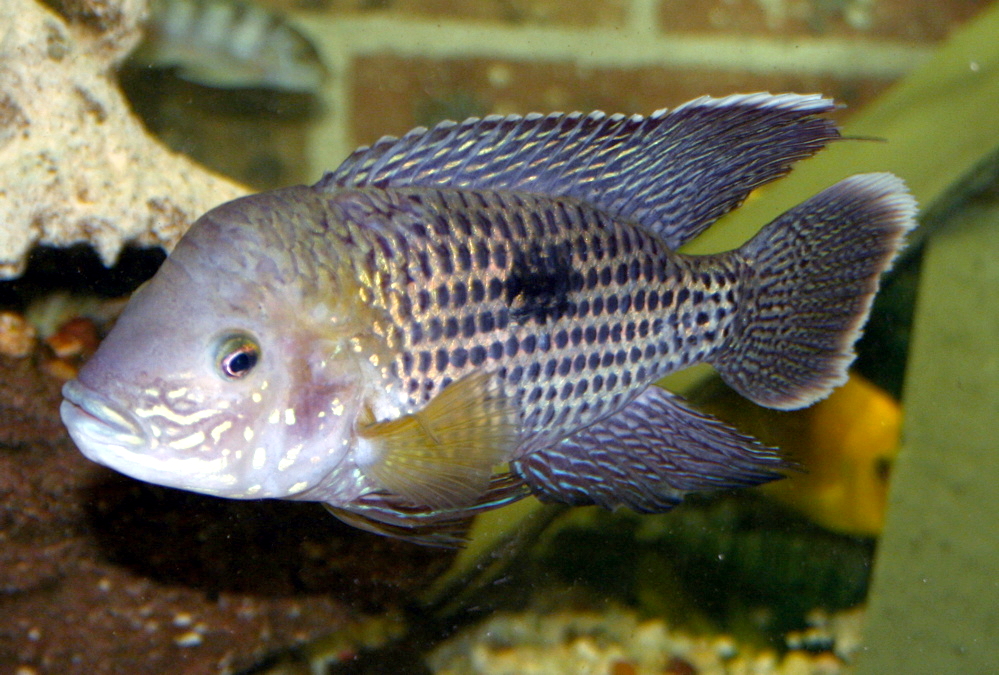 🇵🇪 Peru and 1 moreGreen terror
A large, aggressive South American cichlid kept in aquariums.Cichlid · Rivers and lakes
 Sub-Saharan AfricaPrincess cichlid
A cooperative schooling cichlid from Lake Tanganyika.Cichlid · Rivers and lakes
 🇧🇷 BrazilPterophyllum
A genus of laterally compressed freshwater cichlids known as angelfish.Cichlid · Rivers and lakes · 1824
More from Cichlidae
All of them 🇹🇿 Tanzania and 2 moreSingida tilapia
A cichlid fish native to the Lake Victoria basin in East Africa.Cichlid · Rivers and lakes
 WorldAuratus cichlid
Small, colourful cichlid from Lake MalawiCichlid · Rivers and lakes
 🇭🇳 Honduras and 3 moreJaguar cichlid
Large predatory cichlid from Central American lakesCichlid · Rivers and lakes
 🇧🇷 Brazil and 2 morePeacock bass
Large predatory cichlids from South American rivers known for sport fishing and invasive impact.Cichlid · Rivers and lakes