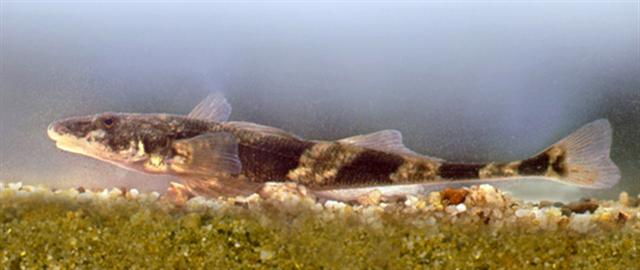
Zingel
A fast-water perch from southeastern Europe.
The zingel is a freshwater fish in the perch family found in swift rivers across southeastern Europe. It grows up to 48 cm and spawns on sandy riverbeds in spring, playing a role in local aquatic ecosystems.
- Grows up to 48 cm in length
- Lacks scales on its cheeks
- Spawns on sandy bottoms in spring
- Found in Danube and Dniestr basins
- First described by Linnaeus in 1766
What it is
This ray-finned fish belongs to the perch family and serves as the type species for its genus. Adults reach between 15 and 30 centimetres, with some individuals growing up to 48 centimetres. The body features two distinct dorsal fins. The first fin holds 13 to 15 spines, while the second contains 18 to 20 soft rays. A key identifying trait is the lack of scales on the cheeks. These fish inhabit swift currents in major river systems.
Where it lives
The species lives exclusively in the drainage areas of the Danube and Dniestr rivers. Its range covers much of southeastern and central Europe. Records exist from Germany, Austria, Czechia, Poland, Slovakia, Hungary, Slovenia, Croatia, Bosnia and Herzegovina, Serbia, Montenegro, North Macedonia, Bulgaria, Romania, Moldova, and Ukraine. It prefers the main channels of large rivers where water moves quickly, typically staying at lower elevations than its relative, the streber.
How it lives
Adults thrive in rapid currents within large river courses. They feed on a variety of small aquatic life, including insects, crustaceans, and the eggs of other fish. Smaller fish also form part of their diet. This predatory behaviour supports their energy needs in high-flow environments. They are generally found at lower altitudes compared to similar species in the same genus, avoiding the higher elevation habitats preferred by the streber.
Breeding and life cycle
Reproduction occurs in early spring, specifically during March and April. Females seek out sandy substrates to release their eggs. Each female produces approximately 5,000 eggs that stick to gravel and sand. The spawning process involves dense groups where one female mates with multiple males. This aggregation ensures fertilisation in the fast-moving water where the adhesive eggs remain anchored to the riverbed.
Questions people ask about Zingel
Where does the zingel live?
It inhabits fast-flowing sections of large rivers in the Danube and Dniestr drainage basins. Its range extends across many countries in southeastern and central Europe, including Germany, Austria, and Romania.
What does the zingel eat?
Its diet consists mainly of aquatic insects and crustaceans. It also consumes fish eggs and smaller fish, acting as a predator in its riverine habitat.
How can you identify a zingel?
Look for two separate dorsal fins, with the first having 13 to 15 spines. A distinct feature is the absence of scales on the cheeks. Adults typically measure between 15 and 30 cm.
Good reading and sources
- Zingel zingel on WikipediaEncyclopedia
- More photos on Wikimedia CommonsPhotos
- Wikidata recordOpen data
The facts on this page come from the Wikipedia article "Zingel zingel", written by its contributors and used under the CC BY-SA 4.0 licence, and from its Wikidata record (CC0). EveryFish rewrote the text in its own words, with AI assistance, and compares every page with the article to make sure no passage is copied. It may be reused under the same CC BY-SA 4.0 licence with a link back.
It may contain mistakes, and figures change over time. Nothing here is investment or buying advice. If something is wrong, tell us. Last refreshed 2026-11-15.
Like Zingel
All perches, basses and snappers 🇷🇺 Russia and 1 moreRuffe
A small, aggressive freshwater fish native to Eurasia that has become a major invasive pest in North America.Perch-like · Rivers and lakes · 1758
 🇺🇸 United States and 2 morePumpkinseed
A small freshwater fish native to eastern North America, known for its bright colours and red ear flap.Perch-like · Rivers and lakes · 1793
 🇺🇸 United States and 1 moreSauger
A freshwater perch species native to North American rivers.Perch-like · Rivers and lakes · 1834
 🇺🇸 United States and 2 moreBluegill
A common North American sunfish known for its blue gill covers and popularity with anglers.Perch-like · Rivers and lakes · 1854