
Yellow tang
Bright yellow Pacific reef fish kept in marine aquariums.
The yellow tang is a vividly coloured marine ray-finned fish native to the Hawaiian Islands. It belongs to the surgeonfish family and is widely traded for home tanks. Conservation efforts have protected its wild stocks from overharvesting.
- Grows up to 20 cm with a defensive white tail spine.
- Spawns around the full moon with external fertilization.
- Larvae drift over 100 miles to reseed distant reefs.
- Prices quadrupled after Hawaii banned wild collection.
- Captive breeding achieved successfully in 2015.
What it is
This species displays a striking bright yellow hue that fades slightly at night, revealing a brownish patch and white band. Adults reach twenty centimetres in length and possess a distinctive white spine on their tail base for defence. The body features five dorsal spines and soft rays, with a moderately protruding snout and small spatulate teeth. Males and females appear similar, though males exhibit shimmering colour changes during mating. They inhabit tropical waters between twenty-four and twenty-eight degrees Celsius.
Where it lives
Native to the Pacific Ocean, particularly around the Hawaiian Islands, Ryukyu, Mariana, Marshall, Marcus, and Wake islands. Their range extends west towards Japan. Occasional sightings have occurred off Florida, in the Mediterranean near Spain, and along Mexico's Riviera Maya, often linked to aquarium releases. They prefer shallow reef environments at depths ranging from two to forty-six metres.
How it lives
These fish typically live alone or in small groups within reef systems. They are primarily herbivorous, grazing on filamentous turf algae and uncalcified benthic plants, occasionally consuming zooplankton. In the wild, they provide cleaning services to marine turtles by removing algae from shells. Natural predators include larger fish, sharks, crabs, and octopuses. They can be aggressive and are susceptible to marine ich parasites.
Breeding and life cycle
Spawning occurs year-round but peaks around the full moon, indicating lunar influence. Fertilization is external, with eggs scattered into open water without parental guarding. Larvae drift with ocean currents for over one hundred miles before settling on distant reefs. This larval drift helps replenish populations across wide areas, connecting isolated reef communities through genetic exchange.
Fish and people
Highly sought after for saltwater aquariums, this species was heavily harvested from Hawaiian waters. Prior to bans, up to seventy percent of trade specimens came from Hawaii, causing stock collapses. Nine marine protected areas were established to aid recovery. Captive breeding techniques succeeded in 2015. Prices surged after collection restrictions, rising from around sixty-five dollars to over four hundred dollars.
Status and threats
Listed as least concern due to effective management strategies. Over seventy percent of its natural range is now protected from fishing. Marine reserves allow larvae to drift and replenish fished areas. Captive breeding reduces pressure on wild populations. Historical overharvesting led to significant declines, but conservation measures and understanding of larval connectivity have supported population recovery.


Questions people ask about Yellow tang
What does a yellow tang eat?
In the wild, they graze on filamentous turf algae and other marine plant material, occasionally eating zooplankton. In captivity, they are often fed meat-based foods, though experts note a balanced diet including plant matter is essential for their health.
How big do yellow tangs get?
Adults typically grow to twenty centimetres in length. They are usually introduced to aquariums in the five-to-ten-centimetre range, though some specimens may reach fifteen centimetres before sale.
Why are yellow tangs so expensive?
Prices rose sharply after Hawaii implemented a ban on collecting wild yellow tangs for the aquarium trade. Previously sold for around sixty-five dollars, costs exceeded four hundred dollars following the restriction to protect declining stocks.
Do yellow tangs guard their eggs?
No, they are substratum egg scatterers. Eggs are released into open water where fertilization occurs externally. Parents provide no care after hatching, leaving larvae to drift with currents until they settle on new reefs.
Good reading and sources
The facts on this page come from the Wikipedia article "Yellow tang", written by its contributors and used under the CC BY-SA 4.0 licence, and from its Wikidata record (CC0). EveryFish rewrote the text in its own words, with AI assistance, and compares every page with the article to make sure no passage is copied. It may be reused under the same CC BY-SA 4.0 licence with a link back.
It may contain mistakes, and figures change over time. Nothing here is investment or buying advice. If something is wrong, tell us. Last refreshed 2026-11-15.
Like Yellow tang
All reef fish WorldButterflyfish
A global family of colourful tropical reef fish known for their bright patterns and coral diets.Reef fish · Coasts and shelves · 1815
 🇧🇷 Brazil and 1 moreFrench angelfish
A slow-growing Caribbean reef fish known for its sponge diet.Reef fish · Coasts and shelves · 1799
 🇺🇸 United StatesGaribaldi
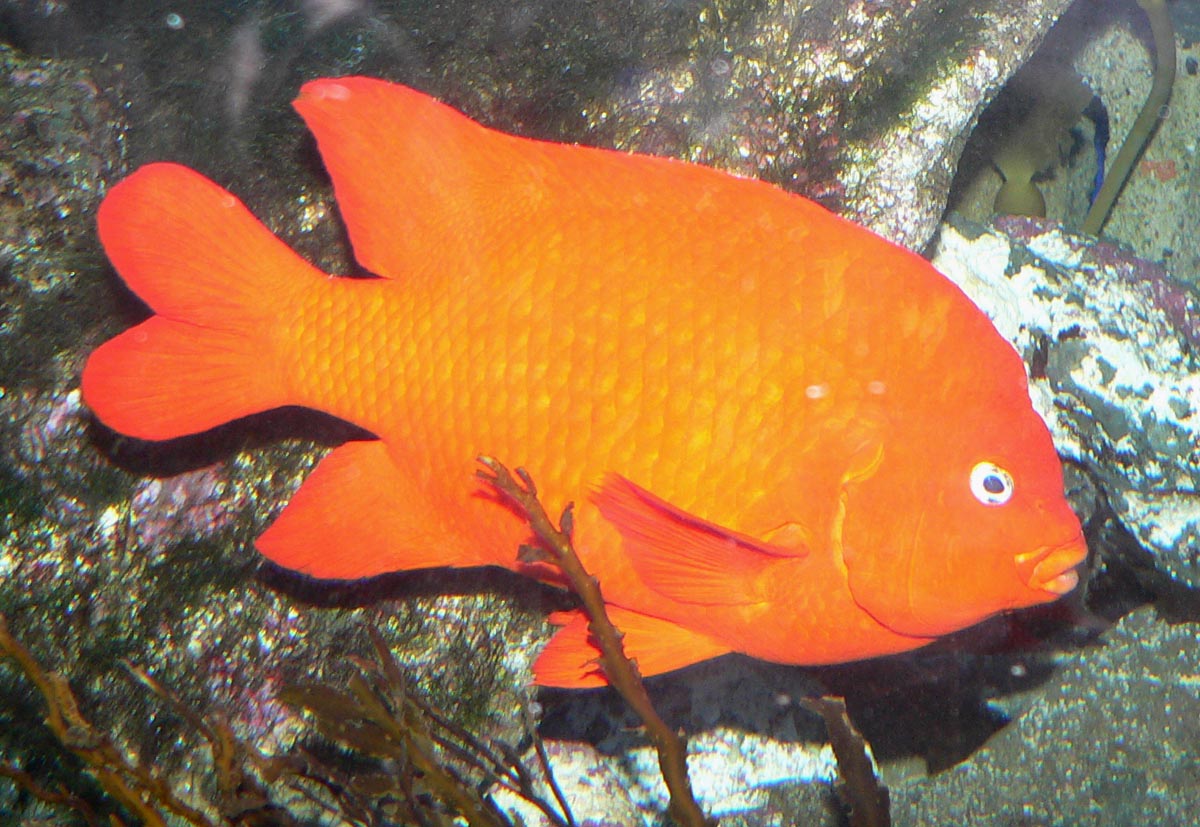
Bright orange damselfish and official marine state fish of California.Reef fish · Coasts and shelves · 1860
 WorldEmperor angelfish
A striking reef fish with bold blue and yellow stripes.Reef fish · Coral reefs · 1787
More from Acanthuridae
All of them WorldPowder blue tang
A bright blue reef fish from the Indian Ocean.Reef fish · Coasts and shelves · 1833
 OceaniaAchilles tang
A black reef fish with an orange tail spot.Reef fish · Coral reefs · 1803
 WorldClown unicornfish
A reef-dwelling surgeonfish with orange tail spines and a black face mask.Reef fish · Coral reefs · 1801
 WorldConvict tang
Striped marine surgeonfish found across the Indo-Pacific.Reef fish · Coasts and shelves · 1758