
Viper dogfish
A rare deep-sea shark with fang-like teeth and light-producing organs.
The viper dogfish is a slender black shark found in the northwestern Pacific Ocean. It inhabits deep slopes and migrates vertically to feed on fish using unique jaw mechanics.
- Slender black shark reaching 54 cm in length.
- Unique jaw protrusion mechanism for capturing large prey.
- Bioluminescent photophores concentrated on the ventral surface.
- Found in the northwestern Pacific Ocean off Japan and Hawaii.
- Listed as Least Concern by the IUCN Red List.
What it is
This slender black shark reaches fifty-four centimetres in length. Its body is cylindrical with a flattened head and short blunt snout. The most striking features are its narrow triangular jaws and widely spaced fang-like teeth. These teeth interlock when the mouth closes. The skin bears faceted dermal denticles and numerous light-emitting photophores along the belly. Two spined dorsal fins sit between the pectoral and pelvic fins. The largest recorded female weighs less than one kilogram.
Where it lives
Specimens appear in the northwestern Pacific Ocean near southern Japan and the Bonin Islands. One record exists from the Northwestern Hawaiian Islands. They inhabit upper continental slopes and seamounts. During daylight hours they stay near the bottom at depths of two hundred seventy to three hundred sixty metres. At night they rise to waters shallower than one hundred fifty metres. This daily vertical movement suggests a link to feeding patterns.
How it lives
The shark feeds mainly on bony fishes such as lanternfishes and some crustaceans. It captures prey by rapidly protruding its jaws to impale them with its teeth. This mechanism allows it to swallow fish nearly forty percent of its own length. Predators include bigeye tuna and sickle pomfret. Unlike other dogfish sharks it lacks a suborbital muscle for biting. Instead it uses the hyomandibular bone to swing its jaws forward.
Breeding and life cycle
This species gives birth to live young through viviparity. Developing embryos receive nourishment from yolk sacs during gestation. Adult females possess two functional ovaries and uteri. Recorded specimens contained up to twenty-six mature ova. Litter sizes are likely fewer than twenty-six pups. Males reach sexual maturity around forty-three centimetres while females mature at approximately fifty-two centimetres.
Fish and people
The viper dogfish holds no economic value for commercial fisheries. It is rarely caught incidentally in purse seines and bottom trawls targeting other species. The impact of this incidental capture on its population remains unknown. Conservation assessments list the species as Least Concern due to its stable status despite limited data.
Status and threats
The International Union for Conservation of Nature lists this shark as Least Concern. No specific threats like overfishing or pollution have been identified as major risks. The primary concern is the lack of data regarding population numbers. Incidental catches in deep-sea fishing gear occur but remain infrequent. Further research is needed to fully understand its conservation needs.

Questions people ask about Viper dogfish
What makes the viper dogfish's feeding style unique?
Unlike other dogfish sharks that cut meat, this species protrudes its jaws to impale prey with fang-like teeth. It lacks the suborbital muscle used by relatives, instead using the hyomandibular bone to swing its jaws forward for a larger gape.
Where does the viper dogfish live?
It inhabits the northwestern Pacific Ocean, specifically off southern Japan, the Bonin Islands, and the Northwestern Hawaiian Islands. It lives on upper continental slopes and seamounts at depths ranging from two hundred seventy to three hundred sixty metres.
How does the viper dogfish migrate?
The species performs diel vertical migration. It stays near the bottom in deeper water during the day at depths of two hundred seventy to three hundred sixty metres. At night it rises to shallower waters less than one hundred fifty metres deep.
Is the viper dogfish dangerous to humans?
No, it has no economic value and is not considered dangerous. It is very rarely caught in commercial fisheries and poses no threat to swimmers or divers due to its deep-water habitat and small size.
Good reading and sources
- Viper dogfish on WikipediaEncyclopedia
- More photos on Wikimedia CommonsPhotos
- Wikidata recordOpen data
The facts on this page come from the Wikipedia article "Viper dogfish", written by its contributors and used under the CC BY-SA 4.0 licence, and from its Wikidata record (CC0). EveryFish rewrote the text in its own words, with AI assistance, and compares every page with the article to make sure no passage is copied. It may be reused under the same CC BY-SA 4.0 licence with a link back.
It may contain mistakes, and figures change over time. Nothing here is investment or buying advice. If something is wrong, tell us. Last refreshed 2026-11-15.
Like Viper dogfish
All sharks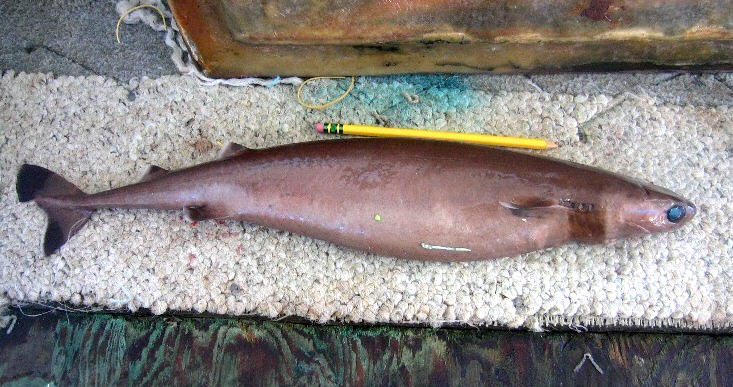 WorldCookiecutter shark
A small deep-sea shark that bites round plugs from larger animals.Shark · Open ocean · 1824
 🇨🇴 Colombia and 1 moreDwarf lanternshark
The world's smallest shark, a bioluminescent dogfish from the Caribbean deep slope.Shark · Deep sea · 1985
 WorldGoblin shark
Rare deep-sea shark with protrusible jaws and pink skinShark · Open ocean · 1898
 🇯🇵 Japan and 3 moreFrilled shark
An ancient, eel-like deep-sea shark with six pairs of gill slits and needle teeth.Shark · Open ocean · 1884
