Goblin shark
Rare deep-sea shark with protrusible jaws and pink skin
The goblin shark is a rare deep-sea species and the sole living member of its ancient family. It inhabits continental slopes globally, using unique snapping jaws to catch prey in the dark depths.
- Only living member of the 125-million-year-old Mitsukurinidae family
- Jaws can protrude forward to snatch prey at high speed
- Pink skin results from visible blood vessels beneath translucent tissue
- Confirmed sightings at depths of 2,000 metres in the ocean
- Assessed as Least Concern due to wide range and low capture rates
What it is
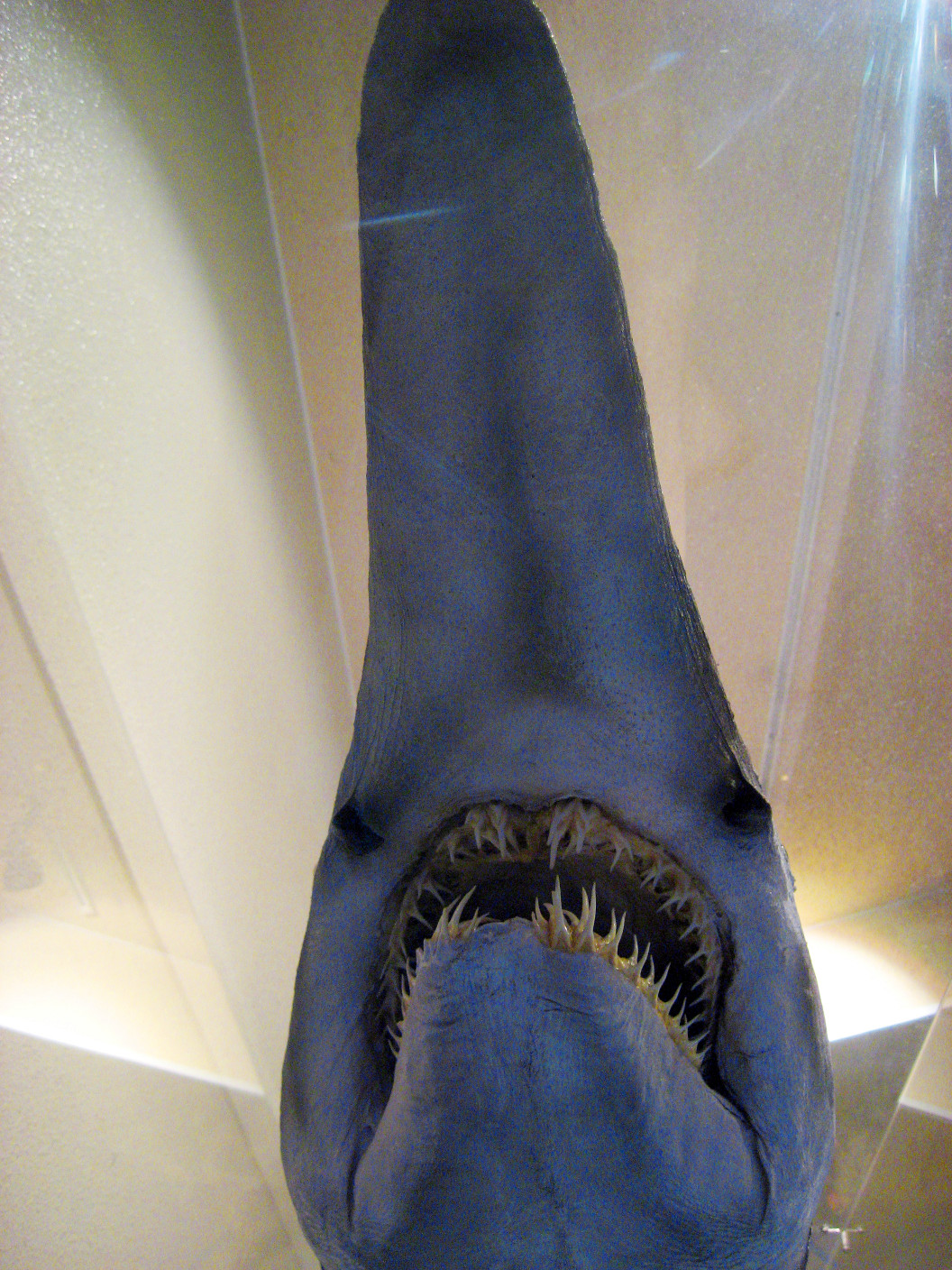
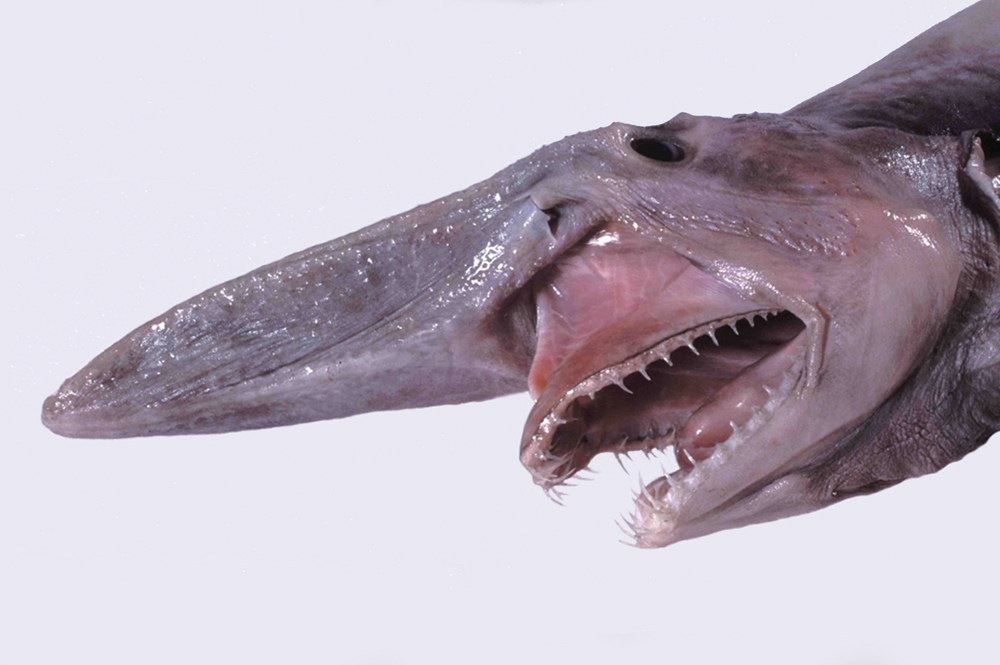
This rare shark is the only extant representative of the family Mitsukurinidae. It features a distinctive elongated, flat snout and soft, semi-translucent pink skin caused by visible blood vessels. The body is slender and flabby with small, rounded fins. Its most striking feature is the set of highly protrusible jaws, which extend forward to snap at prey. Adults typically measure between three and four metres, though larger specimens have been recorded.
Where it lives
The species has a wide global distribution across the Atlantic, Indo-Pacific, and Pacific oceans. Records exist from the Gulf of Mexico, Brazil, West Africa, Japan, Australia, and New Zealand. It primarily inhabits the upper continental slope, submarine canyons, and seamounts. While usually found between 270 and 960 metres, adults dwell deeper than juveniles. Recent footage confirms sightings at depths of 2,000 metres, suggesting a deeper range than previously thought.
How it lives
Anatomical traits such as weak muscles and a reduced skeleton suggest a sluggish lifestyle. The shark uses ampullae of Lorenzini on its snout to detect electric fields from prey. It feeds on deep-sea fish, squid, and crustaceans near the sea floor and in midwater. As an ambush predator, it drifts neutrally buoyant before launching its jaws. Blue sharks may prey on it, and it hosts specific parasites like tapeworms and copepods.
Breeding and life cycle
Reproductive behaviour remains poorly understood, and mating has never been observed. Like other mackerel sharks, it is likely viviparous, with embryos nourished by undeveloped eggs. A pregnant female caught in Taiwan carried six pups. Males reach sexual maturity at approximately 2.6 metres in length. Researchers estimate that males mature around 16 years of age and may live up to 60 years.
Fish and people
This shark poses no danger to humans due to its deep habitat. It is not targeted by fisheries but appears as occasional bycatch in deepwater nets and longlines. In Japan, small numbers are caught annually. The meat is sometimes dried or salted, and jaws are valued by collectors. Specimens rarely survive in captivity, lasting only days or weeks. Its economic significance is minimal, though liver oil was historically used.
Status and threats
The International Union for Conservation of Nature assesses the species as Least Concern. This rating reflects its wide distribution and the fact that most of its population resides in unfished deep environments. Although caught incidentally, the low incidence of capture suggests it is not currently threatened by human activity. However, isolated events of high bycatch have occurred, such as off Taiwan in 2003.


Questions people ask about Goblin shark
Why is it called the goblin shark?
The common name is a translation of the Japanese word tenguzame. A tengu is a mythical creature often depicted with a long nose and red face, resembling the shark's snout and colour.
How does the goblin shark catch its food?
It uses specialized elastic ligaments to catapult its jaws forward rapidly. This allows it to snatch prey like fish and squid from a distance while drifting slowly in the deep sea.
Is the goblin shark dangerous to humans?
No, it lives in deep waters far beyond typical human activity. There are no records of it posing a threat to people, and it is rarely encountered outside of deep-sea fishing operations.
How large do goblin sharks grow?
Adults typically reach lengths of three to four metres. However, some specimens suggest they can grow much larger, with estimates reaching up to seven metres for the biggest individuals.
Good reading and sources
The facts on this page come from the Wikipedia article "Goblin shark", written by its contributors and used under the CC BY-SA 4.0 licence, and from its Wikidata record (CC0). EveryFish rewrote the text in its own words, with AI assistance, and compares every page with the article to make sure no passage is copied. It may be reused under the same CC BY-SA 4.0 licence with a link back.
It may contain mistakes, and figures change over time. Nothing here is investment or buying advice. If something is wrong, tell us. Last refreshed 2026-11-15.
Like Goblin shark
All sharks 🇯🇵 Japan and 3 moreFrilled shark
An ancient, eel-like deep-sea shark with six pairs of gill slits and needle teeth.Shark · Open ocean · 1884
 🇺🇸 United States and 2 moreSwell shark
A catshark that inflates its body for defenceShark · Coasts and shelves · 1880
 WorldStoplight loosejaw
Deep-sea dragonfish that hunts with invisible red light.Shark · Deep sea · 1848
 WorldCookiecutter shark
A small deep-sea shark that bites round plugs from larger animals.Shark · Open ocean · 1824