Cookiecutter shark
A small deep-sea shark that bites round plugs from larger animals.
The cookiecutter shark is a small, bioluminescent species found in warm oceans worldwide. It uses light to camouflage itself and mimics prey to bite circular chunks from whales, fish, and submarines. Despite its parasitic feeding habits, it poses little threat to humans and remains common.
- Bites round plugs from whales, fish, and even submarines.
- Uses green bioluminescence to hide from predators below.
- Migrates up to 3 km vertically every day.
- Sheds lower teeth in entire rows and swallows them.
- Females grow larger than males, reaching 56 cm.
What it is
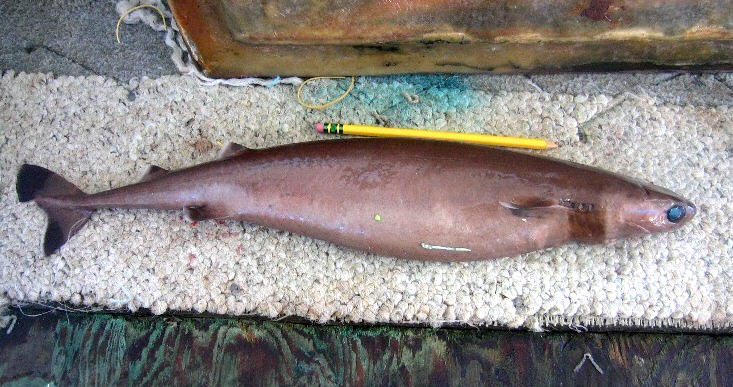
This small squaliform shark has a cylindrical, cigar-shaped body with a blunt snout. It reaches a maximum length of 56 cm for females and 42 cm for males. The skin is chocolate brown, featuring a dark collar around the throat and gills. Its underside is covered in tiny light-emitting organs called photophores, which glow green. The mouth has fleshy lips for suction and two distinct sets of teeth. Upper teeth are small and narrow, while lower teeth form a sharp, saw-like cutting edge. Two spineless dorsal fins sit far back on the body, and the tail fin is broad with a deep notch.
Where it lives
The species inhabits warm oceanic basins across the globe, mostly between 20 degrees north and south latitude. It prefers surface temperatures between 18 and 26 degrees Celsius. Records exist from the Atlantic off Brazil and South Africa, the Indo-Pacific near Australia and Japan, and the Pacific near Hawaii and the Galápagos. It performs daily vertical migrations, staying at depths of 1 to 3.7 km during the day and rising closer to the surface at night. It is often found near islands, possibly due to prey availability or reproductive needs.
How it lives
This ambush predator hovers in the water column, aided by a large, oil-rich liver that provides buoyancy. It uses counter-illumination to blend with downwelling light, hiding its silhouette from below. The dark collar may mimic a small fish to lure larger predators. When prey approaches, the shark attaches via suction and rotates its body to cut out a round plug of flesh. It feeds on tuna, whales, dolphins, and squid. It also consumes smaller prey whole. The shark sheds its lower teeth in entire rows and swallows them to recycle calcium. It often travels in schools.
Breeding and life cycle
Females give birth to live young through aplacental viviparity, where embryos rely on yolk sacs. Litters typically contain six to twelve pups. Newborns measure about 14 to 15 cm in length. Males reach sexual maturity at 36 cm, while females mature at 39 cm. The gestation period appears long, as near-term embryos retain well-developed yolk sacs. There is no evidence of sex segregation in populations, with size variations linked more to latitude than gender.
Fish and people
Ancient Samoan legends described wounds on skipjack tuna as sacrifices, long before the shark was identified. In modern times, bite marks have been found on submarines, undersea cables, and human bodies. A few attacks on underwater photographers and shipwreck survivors have been recorded, leaving clean, deep craters. Despite these incidents, the shark is not considered dangerous to humans due to its small size. It has no commercial value and is rarely encountered by fisheries.
Status and threats
The International Union for Conservation of Nature lists this species as Least Concern. Its wide distribution across global oceans helps maintain stable populations. It faces no significant threats from commercial fishing because it lacks market value. The shark’s ability to inhabit deep waters and migrate vertically also reduces its exposure to surface-level human activities and pollution.


Questions people ask about Cookiecutter shark
Why is it called the cookiecutter shark?
The name comes from its unique feeding method. It bites into larger animals and twists its body to cut out a round, neat plug of flesh, resembling a shape made by a cookie cutter. These crater-like wounds are found on many marine species.
Is the cookiecutter shark dangerous to humans?
It is not generally considered dangerous due to its small size. However, there are documented cases of it biting underwater photographers and shipwreck survivors. These incidents are rare because the shark lives in deep, offshore waters seldom visited by people.
How does the cookiecutter shark use light?
It has light-producing organs on its belly that glow green. This counter-illumination matches the light from above, hiding its silhouette from predators below. The dark collar on its throat may act as a lure, mimicking a small fish to attract prey.
What does the cookiecutter shark eat?
It feeds on a wide variety of marine life. It takes plugs of flesh from large animals like whales, dolphins, tuna, and sharks. It also swallows smaller prey whole, such as squid and bristlemouths. Its diet includes both active hunters and slow-moving mammals.
Good reading and sources
- Cookiecutter shark on WikipediaEncyclopedia
- More photos on Wikimedia CommonsPhotos
- Wikidata recordOpen data
The facts on this page come from the Wikipedia article "Cookiecutter shark", written by its contributors and used under the CC BY-SA 4.0 licence, and from its Wikidata record (CC0). EveryFish rewrote the text in its own words, with AI assistance, and compares every page with the article to make sure no passage is copied. It may be reused under the same CC BY-SA 4.0 licence with a link back.
It may contain mistakes, and figures change over time. Nothing here is investment or buying advice. If something is wrong, tell us. Last refreshed 2026-11-15.
Like Cookiecutter shark
All sharks WorldSpinner shark
A fast requiem shark known for spinning leaps out of water.Shark · Coasts and shelves · 1839
 WorldSilky shark
A fast, migratory requiem shark found in tropical oceans worldwide.Shark · Open ocean · 1839
 WorldBigeye thresher
Deep-diving shark with huge eyes and a long tail.Shark · Open ocean · 1840
 WorldPorbeagle
A fast, cold-water mackerel shark found in the Atlantic and Southern Hemisphere.Shark · Coasts and shelves · 1788

