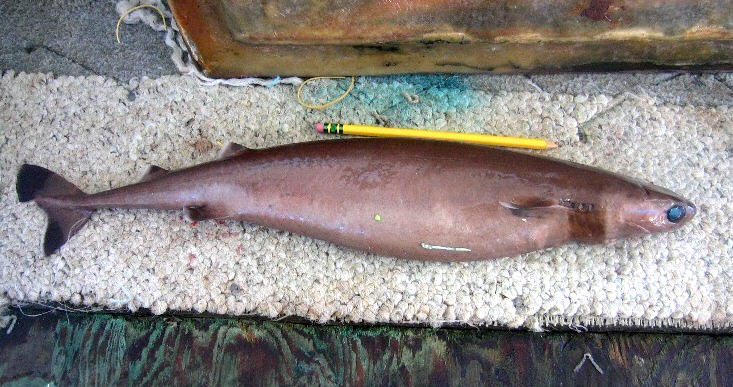
Kitefin shark
A deep-sea squaliform shark known for its bioluminescence and large oil-filled liver.
The kitefin shark is a species of dogfish found in tropical and warm-temperature waters worldwide. It lives on the continental slopes and is notable for being the largest known bioluminescent vertebrate.
- Largest known bioluminescent vertebrate.
- Liver oil fishery off Azores collapsed in 1990s.
- Can bite chunks out of animals larger than itself.
- IUCN status is Vulnerable due to slow reproduction.
- Found in deep waters from 200 to 600 meters.
What it is
The kitefin shark possesses a slender body with a short, blunt snout and thick lips. Its eyes are large, and it has highly differentiated teeth: small upper spikes and large, serrated lower blades. The skin is dark brown or gray, often with faint spots, and fins have white trailing edges. This shark is the largest known bioluminescent vertebrate, using light organs on its belly to illuminate prey or camouflage itself against the surface light.
Where it lives
This species has a widespread but patchy distribution in tropical and warm-temperate oceans. It occurs in the Atlantic from the North Sea to Cameroon and the Gulf of Mexico, as well as around Madeira and the Azores. In the Pacific, it is found near Japan, Australia, New Zealand, and Hawaii. It is absent from the eastern Pacific and northern Indian Oceans. Individuals inhabit depths between 200 and 600 meters, though they can dive deeper.
How it lives
Kitefin sharks are solitary predators that swim slowly, aided by a large liver filled with low-density oil for buoyancy. They feed on bony fish, smaller sharks, squid, and crustaceans. Their strong jaws allow them to bite chunks out of larger animals, similar to cookiecutter sharks. Larger sharks and sperm whales prey upon them. Sex ratios vary by region, with males sometimes outnumbering females significantly in certain areas.
Breeding and life cycle
Reproduction is aplacental viviparous, where embryos develop inside the uterus on yolk reserves. Breeding peaks in spring and autumn in the Mediterranean. Litters contain ten to sixteen pups, born at thirty to forty-five centimeters long. Gestation may last two years. Females mature at lengths around one meter, while males mature slightly smaller.
Fish and people
Commercial fisheries target this shark for meat, skin, and liver oil, primarily in Portugal and Japan. The skin is used for leather goods, and the oil has industrial applications. A fishery off the Azores collapsed in the 1990s due to overfishing and falling oil prices. Bycatch in trawl and gillnet fisheries globally contributes to population declines, raising conservation concerns.
Status and threats
The International Union for Conservation of Nature lists the kitefin shark as Vulnerable. Slow growth and low reproductive rates make it susceptible to overfishing. The collapse of the Azores stock serves as a key example of deep-sea shark vulnerability. Populations in the northeastern Atlantic have declined significantly, prompting calls for better management of deep-water fishing practices.


Questions people ask about Kitefin shark
Why does the kitefin shark glow?
It uses photophores on its belly to produce light. This likely helps it see prey on the sea floor or provides counter-illumination camouflage against the surface light.
How big do kitefin sharks get?
They typically measure one to fourteen meters long. The maximum recorded length is approximately one point eight meters, weighing around eighteen kilograms.
Is the kitefin shark dangerous to humans?
No. It lives in deep water beyond typical human swimming zones. Its teeth have occasionally been found lodged in underwater cables, but it poses no threat to people.
What is the conservation status of this shark?
The IUCN classifies it as Vulnerable. Overfishing for liver oil and meat, combined with slow reproductive rates, has caused significant population declines in some regions.
Good reading and sources
- Kitefin shark on WikipediaEncyclopedia
- More photos on Wikimedia CommonsPhotos
- Wikidata recordOpen data
The facts on this page come from the Wikipedia article "Kitefin shark", written by its contributors and used under the CC BY-SA 4.0 licence, and from its Wikidata record (CC0). EveryFish rewrote the text in its own words, with AI assistance, and compares every page with the article to make sure no passage is copied. It may be reused under the same CC BY-SA 4.0 licence with a link back.
It may contain mistakes, and figures change over time. Nothing here is investment or buying advice. If something is wrong, tell us. Last refreshed 2026-11-15.
Like Kitefin shark
All sharks WorldPorbeagle
A fast, cold-water mackerel shark found in the Atlantic and Southern Hemisphere.Shark · Coasts and shelves · 1788
 WorldSmooth hammerhead
Temperate hammerhead shark with a curved head marginShark · Coasts and shelves · 1758
 WorldAngelshark
Flat-bodied sharks that bury themselves in sandy seabeds to ambush prey.Shark · Coasts and shelves · 1758
 WorldBlacktip reef shark
Small coral reef shark with distinct black fin tipsShark · Coasts and shelves · 1824