
Velvet belly lanternshark
Small bioluminescent shark of the deep Atlantic
The velvet belly lanternshark is a small deepwater dogfish found across the northeastern Atlantic. It uses light-emitting organs on its belly to hide from predators. Though common, it faces threats from deep-sea fishing nets.
- Grows to a maximum length of 60 cm
- Uses belly lights to camouflage against predators
- Found at depths up to 2,490 metres
- Gives birth to litters of 6 to 20 pups
- Assessed as Near Threatened by the IUCN
What it is
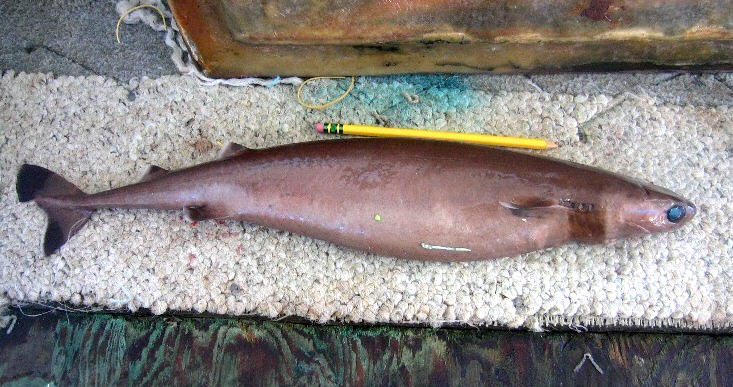
This small shark has a stout body with a broad, flattened snout. Its skin is brown on top and turns sharply to black on the belly, resembling velvet. Two dorsal fins sit on its back, each armed with a spine. The second fin is larger than the first. It lacks an anal fin. The tail is slender with a low upper lobe. Tiny light organs called photophores cover its underside and flanks in a unique pattern. These emit a blue-green glow visible from several metres away.
Where it lives
It lives in the eastern Atlantic Ocean, from Iceland and Norway down to Gabon. Reports also place it off South Africa. It inhabits the Mediterranean Sea, the Azores, and Cape Verde. This species prefers the outer continental shelves and upper slopes. It swims over mud or clay bottoms. While it can range from 20 to 2,490 metres deep, it is most common between 200 and 500 metres. In some areas like the Rockall Trough, it stays deeper, between 500 and 750 metres.
How it lives
Velvet bellies are generalist predators. Young sharks eat krill and small fish. Adults switch to squid and shrimp as they grow. They have a large liver filled with oil, which helps them float. Special cells in their blood help remove heavy metals found in deep water. They often carry many parasites, including tapeworms and barnacles. Larger sharks and skates hunt them. They may swim alone or in small groups. Older individuals tend to live in deeper water than juveniles.
Breeding and life cycle
Females give birth to live young after eggs hatch inside the uterus. The reproductive cycle lasts two to three years. Mating likely happens in summer, with births in late winter or early spring. Litters contain six to 20 pups. Newborns are about 12 to 14 cm long. They are born with the ability to produce light. Males mature at around four years old, while females take slightly longer. Females can live up to 22 years.
Fish and people
Fishermen catch this shark accidentally in nets targeting shrimp and lobsters. It has little commercial value and is usually thrown back, often dying in the process. Sometimes it is dried, salted, or turned into fishmeal. A ban on deep bottom trawling in the Mediterranean offers some protection. Conservationists worry because the shark reproduces slowly. This makes it hard for populations to recover from heavy fishing pressure.


Questions people ask about Velvet belly lanternshark
Why does the velvet belly lanternshark glow?
The shark has light-emitting organs on its belly. This glow matches the light from above, hiding its silhouette from predators below. This camouflage technique is called counter-illumination. The light may also help sharks recognise each other.
What do velvet belly lanternsharks eat?
Young sharks mainly eat krill and small bony fish. As they grow larger, their diet shifts to include squid and shrimp. They are generalist predators and will eat various crustaceans and cephalopods found in the deep sea.
Are velvet belly lanternsharks dangerous to humans?
No, they are very small, usually under 45 cm long. They live in deep water far from swimmers. Their bite force is weak, around 1 Newton. They pose no threat to people and are rarely seen outside of fishing nets.
How long do velvet belly lanternsharks live?
They have a slow growth rate. Males can live up to 18 years, while females may reach 22 years. They mature sexually at around four years of age. This slow life history makes them vulnerable to population declines.
Good reading and sources
- Velvet belly lanternshark on WikipediaEncyclopedia
- More photos on Wikimedia CommonsPhotos
- Wikidata recordOpen data
The facts on this page come from the Wikipedia article "Velvet belly lanternshark", written by its contributors and used under the CC BY-SA 4.0 licence, and from its Wikidata record (CC0). EveryFish rewrote the text in its own words, with AI assistance, and compares every page with the article to make sure no passage is copied. It may be reused under the same CC BY-SA 4.0 licence with a link back.
It may contain mistakes, and figures change over time. Nothing here is investment or buying advice. If something is wrong, tell us. Last refreshed 2026-11-15.
Like Velvet belly lanternshark
All sharks WorldPacific sleeper shark
Large deep-sea shark of the North PacificShark · Open ocean
 WorldBramble shark
A deep-sea shark with thorn-like skin scales.Shark · Open ocean · 1788
 WorldCookiecutter shark
A small deep-sea shark that bites round plugs from larger animals.Shark · Open ocean · 1824
 🇿🇦 South Africa and 4 moreWhale shark
The largest living fish species, a gentle giant of tropical oceans.Shark · Open ocean · 1829

