
Bramble shark
A deep-sea shark with thorn-like skin scales.
The bramble shark is a rare, slow-moving deep-water species found in tropical and temperate oceans. It is identified by its stout body and large, fused dermal denticles. Listed as Endangered globally due to historical overfishing and low reproductive rates.
- Grows up to 3.1 metres long and weighs 200 kg.
- Skin covered in large, thorn-like dermal denticles.
- Listed as Endangered by the IUCN.
- Liver oil used in medicine and canoe preservation.
- Found in deep waters of 400 to 900 metres.
What it is
This shark has a thick, cylindrical body and a blunt snout shorter than its mouth width. Its most distinct feature is the coverage of large, thorn-like dermal denticles scattered across its skin. These scales can fuse into multi-pointed plates. The animal lacks an anal fin and has two small dorsal fins set far back on its body. It appears purplish brown or black above, with a paler underside. Adults grow up to 3.1 metres long and can weigh 200 kilograms.
Where it lives
Records exist from tropical and temperate zones globally, excluding the eastern Pacific Ocean. Populations are noted in the eastern Atlantic, western Indian Ocean, and parts of the Indo-Pacific. Specific sightings include waters off New Zealand, Australia, Japan, and the British Isles. It typically lives near the sea floor on continental slopes at depths between 400 and 900 metres. Occasionally, it enters shallower waters around 18 metres or dives deeper than 1,200 metres.
How it lives
The species moves slowly and feeds on smaller sharks, bony fish, and crabs. Its large pharynx suggests it captures prey using suction rather than active chasing. Known prey items include spiny dogfish, ling, and lizardfishes. It is harmless to humans despite its intimidating appearance. The shark spends most of its time close to the bottom, though it may migrate to shallower depths in European waters during summer months.
Breeding and life cycle
Females reproduce via aplacental viviparity, meaning embryos develop inside the uterus without a placental connection. Each litter contains between 15 and 52 pups. Newborns measure approximately 40 to 50 centimetres in length. Sexual maturity sizes differ by sex, with males maturing at around 1.5 metres and females at 2.1 metres. Embryos possess underdeveloped spines within skin pits before birth.
Fish and people
Fishers catch this shark incidentally using bottom trawls and lines. It has little commercial value but is processed into fishmeal in the eastern Atlantic. Its liver oil is rich in vitamins and squalene. In South Africa, the oil is valued as a medicine. In India, it is traditionally used to coat canoes against beetles. Historical data indicates significant population declines in the northeastern Atlantic since the 18th century due to fishing pressure.
Status and threats
The International Union for Conservation of Nature lists the species as Endangered. Numbers have dropped markedly in northern Europe and the Mediterranean. This decline is attributed to overfishing and the species' slow growth rate. In New Zealand, it is classified as At Risk and Naturally Uncommon. Conservation efforts are hindered by limited data on its global population dynamics.


Questions people ask about Bramble shark
Is the bramble shark dangerous to humans?
No, this species is not known to pose any danger to people. It is a slow-moving deep-sea dweller that feeds on smaller fish and crustaceans. Encounters are rare due to its habitat preferences.
What does the bramble shark eat?
Its diet consists mainly of smaller sharks, such as the spiny dogfish, along with bony fishes like ling and catfish. It also consumes crabs. The shark likely uses suction to capture these prey items.
Why is the bramble shark endangered?
Population numbers have declined significantly due to overfishing. As a deep-sea species with slow growth and late maturity, it cannot recover quickly from fishing pressure. It is often caught as bycatch in commercial trawls.
Where can you find bramble sharks?
They inhabit tropical and temperate waters worldwide, except for the eastern Pacific. Common locations include the eastern Atlantic, western Indian Ocean, and waters off New Zealand and Australia. They prefer depths of 400 to 900 metres.
Good reading and sources
- Bramble shark on WikipediaEncyclopedia
- More photos on Wikimedia CommonsPhotos
- Wikidata recordOpen data
The facts on this page come from the Wikipedia article "Bramble shark", written by its contributors and used under the CC BY-SA 4.0 licence, and from its Wikidata record (CC0). EveryFish rewrote the text in its own words, with AI assistance, and compares every page with the article to make sure no passage is copied. It may be reused under the same CC BY-SA 4.0 licence with a link back.
It may contain mistakes, and figures change over time. Nothing here is investment or buying advice. If something is wrong, tell us. Last refreshed 2026-11-15.
Like Bramble shark
All sharks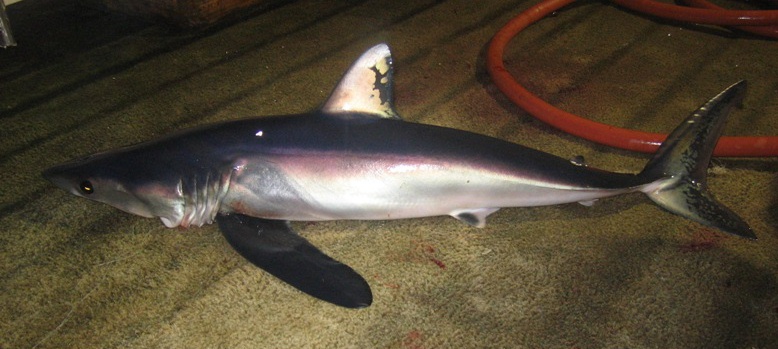 WorldLongfin mako shark
A rare, deep-water mackerel shark with long pectoral finsShark · Open ocean · 1966
 WorldKitefin shark
A deep-sea squaliform shark known for its bioluminescence and large oil-filled liver.Shark · Deep sea · 1788
 WorldPorbeagle
A fast, cold-water mackerel shark found in the Atlantic and Southern Hemisphere.Shark · Coasts and shelves · 1788
 WorldBasking shark
The second-largest living fish, a slow-moving filter feeder found in temperate oceans worldwide.Shark · Coasts and shelves · 1765