
Torinae
A subfamily of large freshwater carps known as mahseers, found across Asia and Africa.
Torinae is a group of ray-finned fish in the carp family. They live in rivers and lakes from Africa to China. Many are prized for sport fishing and food.
- Golden mahseer reaches 2.75 m length and 54 kg weight.
- Term 'mahseer' likely derives from Hindi or Sanskrit roots.
- Fish possess pharyngeal teeth instead of jaw teeth.
- Some Indonesian names translate to 'God-Fish'.
- Used in ancient Indian heraldry and religious symbols.
What it is
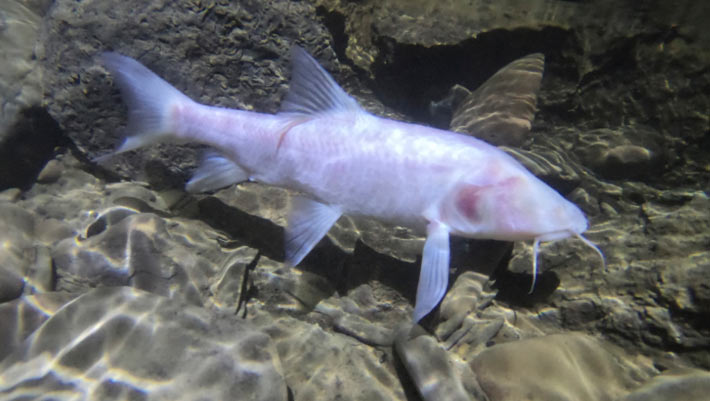
This subfamily contains large freshwater fish belonging to the carp family. They typically have big scales and a smooth dorsal fin ray. The largest species, the golden mahseer, can reach over two meters long and weigh more than fifty kilograms. Most members lack teeth in their jaws but use specialized throat teeth to crush hard-shelled prey like snails. Males may show brighter colors or head bumps during breeding seasons. Some species live in deep cave systems, while others prefer fast-flowing mountain streams.
Where it lives
These fish inhabit the paleotropics across multiple continents. Their natural range stretches from Africa and the Middle East through South Asia and Southeast Asia. Populations extend northward into Nepal and parts of China. They occupy diverse aquatic environments including slow rivers, deep lakes, and turbulent rapids with rocky substrates. Two specific species have adapted to life inside dark caves in Thailand and India.
How it lives
They act as generalist feeders, consuming algae, insects, small fish, and decaying plant matter. Juveniles eat more animal protein than adults. Larger species often migrate upstream to spawn when water temperatures change or monsoon rains swell the rivers. Larvae stay near the bottom initially before swimming freely and eating tiny plankton. They grow slowly and can live for many years. Predators include larger fish and birds.
Breeding and life cycle
Reproduction usually happens during flood seasons when water levels rise. Females release eggs that hatch into larvae which cling to the riverbed for about a week. Once their yolk sacs are empty, the young fry begin active swimming and feeding on zooplankton. Some species spawn multiple times within a single year. Environmental cues like temperature shifts trigger these events.
Fish and people
Mahseers are highly valued game fish due to their fighting strength. They also serve as important food sources and are farmed commercially in places like Malaysia and Indonesia. Wild specimens command high prices in local markets. Historically, they held sacred status in Hindu culture and appeared in ancient art and literature. British anglers in India popularized them as sporting trophies in the nineteenth century. Local communities have used their scales and bones for tools and decoration.
Status and threats
Many populations face severe declines due to habitat destruction, pollution, and excessive fishing pressure. Introduced competitive species further threaten native stocks. Conservation efforts include aquaculture programs to boost wild numbers and experimental breeding hybrids. Translocation projects have sometimes harmed local ecosystems by displacing native fish. Several species are now classified as threatened or vulnerable.


Questions people ask about Torinae
What does the name mahseer mean?
The term originates from Indian languages, possibly meaning big-scaled fish or great mouth. It serves as a generic label for large cyprinids with prominent barbels and heavy scales across South Asia.
Are mahseers dangerous to humans?
They are not physically aggressive toward people. However, flesh from jungle-dwelling individuals can become toxic if the fish consumes certain poisonous fruits, causing delirious effects in consumers.
Why are they called God-Fish?
In Java, some local names translate directly to God-Fish. This reflects their revered status in tribal societies and Hindu traditions where they symbolize divine protection and spiritual importance.
How do they reproduce?
Spawning relies on environmental triggers like rising water temperatures and monsoon floods. Eggs hatch into benthic larvae that later transition to free-swimming fry feeding on microscopic organisms.
Good reading and sources
The facts on this page come from the Wikipedia article "Torinae", written by its contributors and used under the CC BY-SA 4.0 licence, and from its Wikidata record (CC0). EveryFish rewrote the text in its own words, with AI assistance, and compares every page with the article to make sure no passage is copied. It may be reused under the same CC BY-SA 4.0 licence with a link back.
It may contain mistakes, and figures change over time. Nothing here is investment or buying advice. If something is wrong, tell us. Last refreshed 2026-11-15.
Like Torinae
All carps and minnows 🇨🇳 ChinaPrzewalskii's naked carp
Endemic cyprinid of China's Qinghai Lake basinCarp · Rivers and lakes
 🇹🇭 Thailand and 2 moreSiamese mud carp
Freshwater cyprinid native to Mekong and Chao Phraya riversCarp · Rivers and lakes
 🇮🇳 India and 4 moreRohu
A large silver carp from South Asian rivers, farmed for food and prized as a game fish.Carp · Rivers and lakes
 🇿🇦 South Africa and 2 moreLargemouth yellowfish
Large freshwater barb from southern African rivers.Carp · Rivers and lakes
More from Cyprinidae
All of them 🇲🇾 Malaysia and 1 moreHarlequin rasbora
A small, colourful freshwater fish popular in home aquariums for its distinctive black body marking.Carp · Rivers and lakes
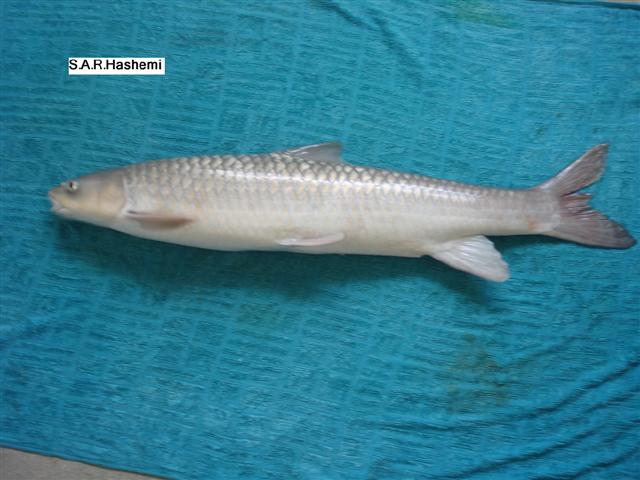 🇮🇷 Iran and 1 moreShabout
A large freshwater carp native to the Tigris-Euphrates basin in Western Asia.Carp · Rivers and lakes
 🇮🇳 India and 4 moreCommon snowtrout
A cold-water cyprinid from Himalayan rivers.Carp · Rivers and lakes