
Common chub
Stocky freshwater fish found across Europe and northern Eurasia.
The common chub is a widespread freshwater fish in the Leuciscidae family. It inhabits rivers, lakes and canals from Britain to Scandinavia and the Black Sea basin. Anglers prize it for its readiness to feed, while large adults become wary predators of smaller fish and frogs.
- Can live up to 22 years in the wild
- Reaches maximum lengths of 64 to 82 cm
- Feeds on berries, voles and young water birds
- Ingests microplastic fibres from clothing waste
- Spawns in fast-flowing water over gravel beds
What it is
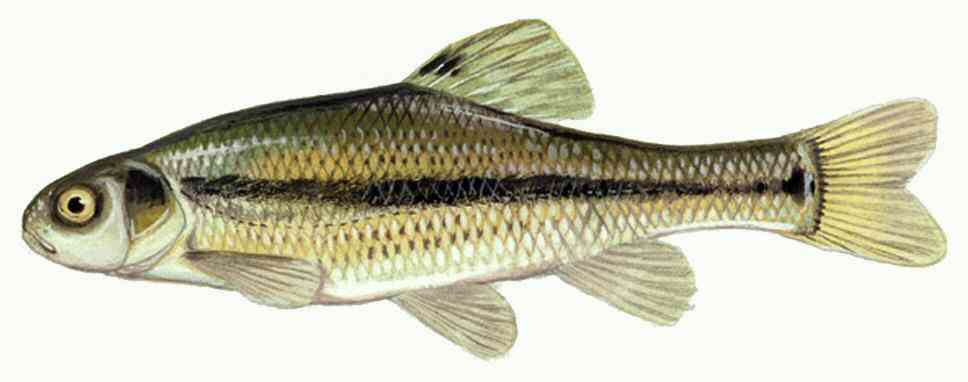
The common chub is a stocky ray-finned fish with a large rounded head and cylindrical body. Its scales are greenish-brown with black edges on the back, fading to gold on the sides and pale on the belly. The tail is dark brown or black, while the dorsal fin appears grey-green and other fins show orange-red hues. It possesses three spines and seven to nine soft rays in the dorsal fin. Most individuals measure around 30 cm, though they can reach up to 82 cm in length.
Where it lives
This species occupies much of northern Eurasia. It lives in river systems draining into the North, Baltic, northern Black, White, Barents and Caspian Seas. In western Europe, it ranges from the Adour drainage in France to southern Sweden and Finland. It is native to Great Britain but absent from Ireland and Italy as a native species, although introduced populations exist in both countries. In Italy, it remains marginal and has not formed strong established groups.
How it lives
Adults are solitary hunters, while juveniles form social shoals in shallow shoreline habitats. Young fish eat aquatic and terrestrial invertebrates. Larger adults prey on freshwater shrimp, small fish like roach and minnows, frogs, crayfish, voles and young water birds. They also consume berries from overhanging trees and continue feeding in midwinter if opportunities arise. Studies show they ingest microplastic fibres and accumulate metals such as copper in their tissues.
Breeding and life cycle
Spawning occurs between May and September when water temperatures hit 14 °C. Fish migrate to fast-flowing riffles with gravel substrates. Males gather and follow ripe females, often splashing in shallow water. Females release pale yellow sticky eggs that adhere to stones and weeds. They may spawn multiple times per season with different males. Males mature at two to four years, while females take four to six years. Age is determined by growth rings on scales.
Fish and people
Anglers value chub for their willingness to bite in varied conditions. Small fish are easy to catch using maggots, sweetcorn or luncheon meat with float or feeder tactics. Large specimens over 2 kg are wary and require stealth, often fished near overhanging branches at dawn or dusk. Lure and fly fishing imitate small prey or insects. The British record stands at 4.2 kg, while the European record is 5.72 kg. No specific cultural or food traditions are noted beyond sport.
Status and threats
The species faces pollution threats, including microplastic ingestion and metal contamination in muscles and gills. Young fish show particularly high levels of contaminants. The fish remains abundant in many river systems despite these environmental pressures.


Questions people ask about Common chub
What do common chub eat?
Juveniles eat aquatic and terrestrial animals. Adults prey on shrimp, small fish, frogs, crayfish, voles and young birds. They also consume berries like blackberries and elderberry, as well as fishmeal pellets.
How big do common chub grow?
Most fish are around 30 cm long. They can grow to a standard length of 60 cm, with maximum recorded lengths between 64 and 82 cm. Large specimens often weigh over 2 kg.
When do chub spawn?
Spawning takes place from May to September when water temperatures reach 14 °C. They lay sticky yellow eggs in fast-flowing water over gravel substrates, often in shallow riffles.
Are chub easy to catch?
Small chub are freely biting and easy for inexperienced anglers. Large chub become wary and are easily spooked by noise, requiring stealthy approaches and subtle tackle setups.
Good reading and sources
The facts on this page come from the Wikipedia article "Squalius cephalus", written by its contributors and used under the CC BY-SA 4.0 licence, and from its Wikidata record (CC0). EveryFish rewrote the text in its own words, with AI assistance, and compares every page with the article to make sure no passage is copied. It may be reused under the same CC BY-SA 4.0 licence with a link back.
It may contain mistakes, and figures change over time. Nothing here is investment or buying advice. If something is wrong, tell us. Last refreshed 2026-11-15.
Like Common chub
All carps and minnows 🇺🇸 United States and 1 moreCreek chubs
Small North American minnows with a distinctive dorsal spotCarp · Rivers and lakes
 🇵🇰 Pakistan and 1 moreGolden mahseer
Large cyprinid fish from Himalayan riversCarp · Rivers and lakes
 🇮🇳 India and 4 moreRohu
A large silver carp from South Asian rivers, farmed for food and prized as a game fish.Carp · Rivers and lakes
 WorldMinnow
Small freshwater fish from the Cyprinidae family used as bait and food.Carp · Rivers and lakes
More from Leuciscidae
All of them 🇷🇺 RussiaCaspian roach
A brackish water fish from the Caspian Sea region, widely consumed as a dried snack.Carp · Estuaries and mangroves
 🇷🇺 Russia and 4 moreSabre carp
A silvery surface feeder from Eastern Europe and Asia.Carp · Rivers and lakes
 🇨🇦 Canada and 1 moreLake chub
A small cold-water minnow native to Canada and the northern US.Carp · Rivers and lakes
 EuropeCommon rudd
A red-finned freshwater fish native to Europe and Asia.Carp · Rivers and lakes