
Smelt
Small fish of the northern hemisphere known for spring runs and culinary traditions.
Smelts are small fish in the family Osmeridae found across the North Atlantic and Pacific. They support local economies through fishing festivals and traditional foods like fried whole fish or dried oil-rich varieties.
- Most species stay under 20 cm in length.
- European females can reach 40 cm.
- Eulachon oil burns like a candle when dried.
- Ice fishing uses dip nets on frozen lakes.
- Festivals occur in Finland, Korea, and US towns.
What it is
Smelts belong to the family Osmeridae, comprising small fish typically measuring less than twenty centimetres. Some European females grow larger, reaching up to forty centimetres. These fish possess slender bodies adapted for life in cold waters. They inhabit the North Atlantic and North Pacific oceans, as well as freshwater rivers and lakes in Europe, North America, and Northeast Asia. Most species are anadromous, meaning they live in the sea but migrate to fresh water to breed. A few exceptions, such as the surf smelt, remain in saltwater throughout their lives.
Where it lives
These fish are widespread across the northern hemisphere. They populate the coastal regions of the North Atlantic and North Pacific. Inland populations thrive in the Great Lakes of North America and various European waterways. Some species, like the Delta smelt in California, have declined significantly due to habitat changes. The eulachon is found in the Northeast Pacific and its adjacent rivers. Their range extends from tropical-adjacent coasts to polar-adjacent cold seas, favouring temperatures around four degrees Celsius during spawning runs.
How it lives
Smelts often form large schools, particularly during spring migrations along saltwater coastlines. They travel into streams to spawn, a behaviour shared with salmon. Predators include birds and larger fish. In western United States waters, populations have dropped sharply, prompting legal protections. Sportsmen target them using hand-held dip nets or by ice fishing. They are spotted using lights on frozen surfaces before being scooped from the water. Their diet consists of small aquatic organisms found in these cold, oxygen-rich environments.
Breeding and life cycle
Many species are anadromous, spending most of their adult lives in the ocean. They return to freshwater streams to reproduce when water temperatures rise slightly in spring. Females lay eggs in gravel beds within these streams. Some species, like the surf smelt, do not migrate and breed entirely in marine environments. The timing of this run varies by region, often coinciding with early spring thaw. Larvae develop in freshwater before migrating back to the sea to mature.
Fish and people
Smelts are valued for food and cultural events worldwide. In North America, they are often fried whole with fins and bones intact. Indigenous peoples in Canada historically relied on them for protein and omega fats. The eulachon, or candlefish, was dried for its high oil content, which could burn like wax. In Japan, shishamo is grilled, while masago refers to capelin roe used in sushi. Chinese dim sum serves deep-fried varieties known as 'many egg fish'. In South Korea, bing-eo is eaten alive or fried. Festivals in Finland, Lithuania, and the United States celebrate these annual runs with fry-ups and parades.
Status and threats
Conservation status varies by species and location. The Delta smelt in California is protected under the Endangered Species Act due to population declines. Eulachon populations also face protection from harvest in certain areas. Overfishing and habitat alteration threaten some groups. However, many populations remain stable enough to support recreational fishing and commercial harvests. Legal frameworks aim to balance economic use with ecological preservation, particularly in regions where smelt runs have historically dried up.


Questions people ask about Smelt
What does anadromous mean for smelt?
It means they live in the sea but migrate to freshwater streams to breed. This behaviour mirrors that of salmon, allowing them to spawn in safe river environments before returning to ocean waters.
How are smelts traditionally prepared in Japan?
In Japan, the species Sprinchus lanceolatus is called shishamo and is usually grilled. Capelin roe, known as masago, is yellow-orange and commonly used in sushi dishes for texture and flavour.
Why is the eulachon called candlefish?
The eulachon contains so much oil during spawning that when dried, it can be lit and burned like a candle. This nickname highlights its high fat content and historical importance as a preserved food source.
Where can you find smelt festivals?
Festivals happen in places like Inje in South Korea, Paltamo in Finland, Palanga in Lithuania, and various US towns including Lewiston, New York, and Port Washington, Wisconsin, celebrating the spring run.
Are smelts dangerous to humans?
No, smelts are not venomous or dangerous. They are small fish often caught by hand or net. They are considered safe to eat, with low mercury levels, making them a popular dietary choice in many cultures.
Good reading and sources
The facts on this page come from the Wikipedia article "Smelt (fish)", written by its contributors and used under the CC BY-SA 4.0 licence, and from its Wikidata record (CC0). EveryFish rewrote the text in its own words, with AI assistance, and compares every page with the article to make sure no passage is copied. It may be reused under the same CC BY-SA 4.0 licence with a link back.
It may contain mistakes, and figures change over time. Nothing here is investment or buying advice. If something is wrong, tell us. Last refreshed 2026-11-15.
Like Smelt
All other fish 🇳🇿 New ZealandNew Zealand grayling
Extinct amphidromous fish endemic to New Zealand rivers and seas.Other · Rivers and lakes
 🇯🇵 Japan and 2 moreAyu sweetfish
Small amphidromous fish prized for its sweet flesh in East Asia.Other · Rivers and lakes · 1846
 🇳🇿 New Zealand and 3 moreCommon galaxias
A small migratory fish of the Southern Hemisphere.Other · Rivers and lakes
 🇺🇸 United States and 1 moreEulachon
A small anadromous smelt known for its high fat content and cultural importance in Pacific North America.Other · Rivers and lakes
More from Osmeridae
All of them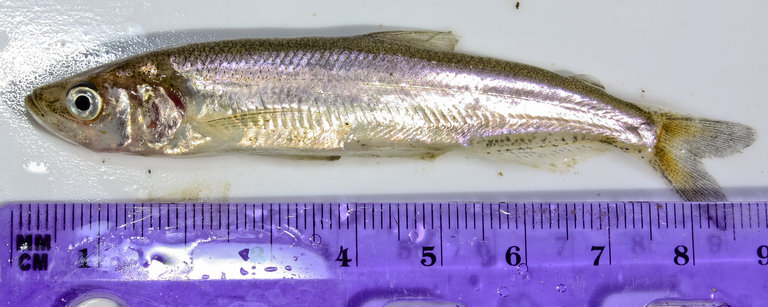 🇺🇸 United States and 1 moreLongfin smelt
Small anadromous fish of the North Pacific coastOther · Rivers and lakes
 🇩🇪 Germany and 4 moreEuropean smelt
Small coastal fish with a cucumber scentOther · Rivers and lakes
WorldCapelin
Small forage fish of the smelt family found in northern oceans.Other · Open ocean
 🇺🇸 United StatesDelta smelt
A tiny, endangered fish native to California's Sacramento-San Joaquin River Delta.Other · Rivers and lakes · 1963