
European smelt
Small coastal fish with a cucumber scent
The European smelt is a slender fish native to Western Europe. It lives in coastal waters and lakes, known for its distinct smell. People eat it whole as a regional delicacy in countries like Germany.
- Smells distinctly of fresh cucumbers
- Bones are soft enough to eat whole
- Females lay over 50,000 eggs each
- Protected in specific Scottish river sites
- Tolerates a wide range of water salinity
What it is
This small fish has a long, slim body with a pointed head. Its back is olive green while the belly is white, marked by a silver stripe on the sides. The dorsal fin sits behind the pectoral fins. Adults usually measure around 16.5 cm, though some reach 45 cm. It gets its common name from a strong scent similar to fresh cucumbers.
Where it lives
It inhabits western European coasts, including the Baltic Sea and areas as far south as north-west Spain. The fish lives in large lakes, estuaries, and rivers such as the Elbe. In Scotland, it remains only in the Cree, Forth, and Tay rivers. It tolerates various salinity levels but prefers clean, oligotrophic lake waters.
How it lives
These opportunistic hunters feed on small zooplankton like copepods. As they grow, they switch to larger crustaceans and occasionally eat other fish, including their own young. They serve as key prey for seabirds, common bream, and European eels. The smelt acts as a host for parasites that affect eels.
Breeding and life cycle
Populations include landlocked and anadromous forms. Landlocked fish spawn in lake shallows during spring. Migratory groups move to rivers to lay eggs on sandy bottoms less than three metres deep. A single female produces over 50,000 eggs. Hatching succeeds best in cold, low-salinity water.
Fish and people
Cooked whole due to soft bones, it is a regional specialty in Germany and Russia. Methods include frying in butter, smoking, or pickling. Swedish traditions feature smelt pancakes. Once vital for the poor in Sweden, its commercial value declined with pollution but persists elsewhere. It is also used for animal feed and bait.
Status and threats
Listed as Least Concern globally. Local threats include dredging, migration barriers, and pollution. Overfishing for bait poses risks. In Scotland, it is protected under wildlife laws within specific scientific sites. Populations in the Volga basin are declining due to warming waters and invasive sprat.


Questions people ask about European smelt
Why is it called cucumber smelt?
The fish releases a distinctive odour that closely resembles the scent of fresh cucumbers. This unique smell is a key identifying feature of the species.
Do you need to remove the bones before eating?
No removal is necessary. The bones are very soft, allowing the fish to be cooked and eaten whole, including the head. Frying is a common preparation method.
Where can you find European smelt in Scotland?
They are currently found only in the rivers Cree, Forth, and Tay. Although previously recorded in fifteen rivers, their range in Scotland has significantly reduced.
Good reading and sources
- European smelt on WikipediaEncyclopedia
- More photos on Wikimedia CommonsPhotos
- Wikidata recordOpen data
The facts on this page come from the Wikipedia article "European smelt", written by its contributors and used under the CC BY-SA 4.0 licence, and from its Wikidata record (CC0). EveryFish rewrote the text in its own words, with AI assistance, and compares every page with the article to make sure no passage is copied. It may be reused under the same CC BY-SA 4.0 licence with a link back.
It may contain mistakes, and figures change over time. Nothing here is investment or buying advice. If something is wrong, tell us. Last refreshed 2026-11-15.
Like European smelt
All other fish North AmericaAtlantic croaker
Noisy marine fish of the western Atlantic coastOther · Coasts and shelves
 🇹🇷 Turkey and 4 moreAnchovy
Small, oily forage fish found in oceans and some rivers worldwide.Herring · Coasts and shelves
 🇵🇭 Philippines and 4 moreMilkfish
The sole living species of the family Chanidae, found across the Indo-Pacific.Other · Coasts and shelves
 🇺🇸 United States and 2 moreGar
Ancient armored fish with lung-like swim bladders found in North American waters.Ancient · Rivers and lakes · 1758
More from Osmeridae
All of them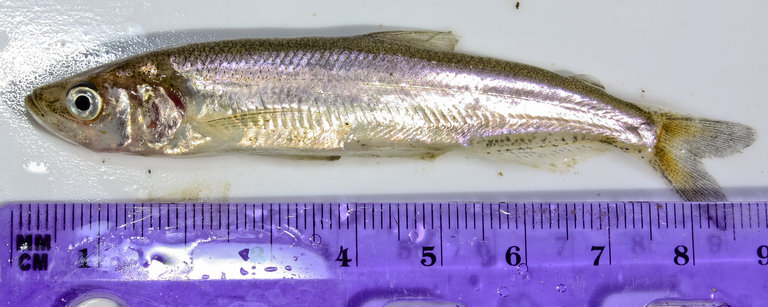 🇺🇸 United States and 1 moreLongfin smelt
Small anadromous fish of the North Pacific coastOther · Rivers and lakes
 🇺🇸 United States and 1 moreEulachon
A small anadromous smelt known for its high fat content and cultural importance in Pacific North America.Other · Rivers and lakes
 🇺🇸 United StatesDelta smelt
A tiny, endangered fish native to California's Sacramento-San Joaquin River Delta.Other · Rivers and lakes · 1963