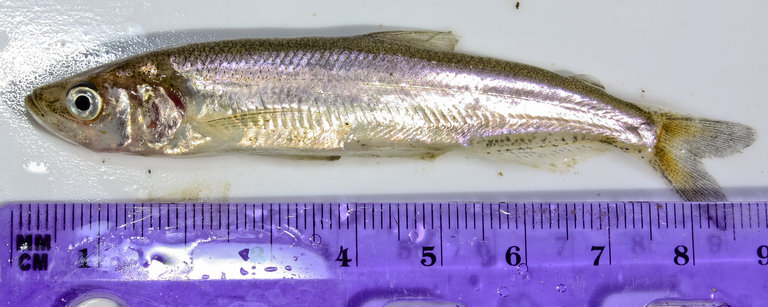
Longfin smelt
Small anadromous fish of the North Pacific coast
The longfin smelt is a small, silver fish native to the Pacific coast of North America. It lives in estuaries and migrates short distances up rivers to spawn at night. While the species is widespread, specific populations face threats from water diversion and habitat loss.
- Pectoral fins extend nearly to the pelvic fins
- Spawns strictly at night to avoid predators
- Two landlocked populations exist in lakes
- San Francisco population listed as endangered in 2024
- Diet shifts from copepods to mysids as it ages
What it is
The longfin smelt is a small fish with a streamlined, laterally compressed body. It typically reaches lengths of no more than 20 centimetres. Its colouration is silver-white on the belly and sides, shifting to olive-green or pinkish-brown on the back. The fish gets its name from its distinctive pectoral fins, which are long enough to reach nearly to the base of the pelvic fins. It possesses soft-rayed fins, a forked tail, and an adipose fin. Males and females look similar, though males often have a more angular anal fin and slightly longer fins overall.
Where it lives
This species is native to the Pacific coast of North America. Its distribution extends from the San Francisco Bay in California north to the Gulf of Alaska. It primarily inhabits bays, estuaries, and deltas where fresh and salt water mix. Two landlocked populations exist in Lake Washington in Seattle and Harrison Lake in British Columbia. The fish tolerates a wide range of salinity levels, allowing it to move between marine, brackish, and freshwater environments. It prefers shallow waters near river mouths but occupies various depths in the water column.
How it lives
Longfin smelts form large schools and live for about two years. Their diet changes as they mature. Young fish feed mainly on copepods, while older juveniles and adults consume mostly mysid shrimp. They feed actively at night, moving deeper during the day to avoid sunlight and predators. In Lake Washington, they are eaten by trout and pikeminnows. Coastal populations face predation from striped bass, perch, and steelhead. Introduced silversides also prey on their larvae. The fish adjust their feeding habits based on local prey availability and seasonal changes.
Breeding and life cycle
These fish are anadromous, meaning they migrate from estuaries into coastal rivers to reproduce. The journey upstream is short, often just a few kilometres. Spawning takes place strictly at night to avoid predators and sunlight sensitivity. They release eggs and sperm into the water column over sand, pebbles, or plants. The sticky eggs attach to the substrate and hatch after about 40 days. Larvae are then carried by currents back to the estuary. Most adults die after spawning, though some females may survive for another year. The spawning season runs from October to June.
Fish and people
The species has become a focus of conservation debate in California. The population in the San Francisco Bay-Delta was listed as endangered in July 2024 due to sharp declines since the 1980s. This status aims to restore freshwater flows that had been diverted for agriculture. Up to 65 per cent of natural flow was previously used for human purposes. The listing faced political challenge, with a House resolution passing in May 2025 to repeal it. Scientists argue that removing protection could lead to local extinction. Introduced clams have also reduced food resources for the smelt.
Questions people ask about Longfin smelt
Why is it called the longfin smelt?
The name comes from its pectoral fins, which are unusually long for a smelt. These fins extend almost to the base of the pelvic fins, distinguishing it from related species.
Where do longfin smelts live?
They are found along the Pacific coast of North America, from California to Alaska. They live in estuaries and bays but migrate into rivers to spawn. Some populations live entirely in lakes.
What do longfin smelts eat?
Juveniles feed mainly on copepods and midges. As they grow, their diet shifts to mysid shrimp, which makes up the majority of their food intake for the rest of their lives.
Are longfin smelts endangered?
The species is listed as Least Concern globally. However, the population in the San Francisco Bay-Delta is listed as endangered due to water diversion and habitat loss.
Good reading and sources
- Longfin smelt on WikipediaEncyclopedia
- More photos on Wikimedia CommonsPhotos
- Wikidata recordOpen data
The facts on this page come from the Wikipedia article "Longfin smelt", written by its contributors and used under the CC BY-SA 4.0 licence, and from its Wikidata record (CC0). EveryFish rewrote the text in its own words, with AI assistance, and compares every page with the article to make sure no passage is copied. It may be reused under the same CC BY-SA 4.0 licence with a link back.
It may contain mistakes, and figures change over time. Nothing here is investment or buying advice. If something is wrong, tell us. Last refreshed 2026-11-15.
Like Longfin smelt
All other fish WorldThree-spined stickleback
Small northern fish known for rapid evolution and complex breeding.Other · Rivers and lakes
 🇺🇸 United States and 2 moreGar
Ancient armored fish with lung-like swim bladders found in North American waters.Ancient · Rivers and lakes · 1758
 WorldNile perch
Large freshwater predator native to Africa, now invasive in many lakes.Other · Rivers and lakes
 🇵🇭 Philippines and 4 moreMilkfish
The sole living species of the family Chanidae, found across the Indo-Pacific.Other · Coasts and shelves
