
Sergeant major
Striped Atlantic damselfish found on reefs and in tidal pools.
The sergeant major is a striped damselfish native to the Atlantic Ocean. It lives in shoals on coral reefs and in tidal pools, feeding on plankton and algae. Males guard egg masses on rocks, turning blue during protection. This species appears in the aquarium trade but is hard to breed.
- Grows to a maximum length of 22.9 cm
- Males guard eggs for about a week
- Feeds on spinner dolphin waste and vomit
- Forms shoals of several hundred individuals
- Found in tidal pools and coral reefs
What it is
This damselfish displays five vertical black or dark blue stripes on a white body with a yellow top. A faint sixth stripe may appear near the tail. Adults reach up to 22.9 cm, though 15 cm is more common. The largest recorded individual weighed 200 g. Adult males often show bluish tones with less distinct stripes. A dark spot marks the area around the pectoral fins. The name comes from these bars, which resemble military insignia.
Where it lives
Populations inhabit the Atlantic Ocean. In the west, they range from the northeastern United States south to Uruguay, including the Gulf of Mexico, Bahamas, and Caribbean islands. Eastern Atlantic records include Portugal, the Azores, Canary Islands, Cape Verde, and western Africa. Presence in the Mediterranean remains unclear due to confusion with similar species. Juveniles frequent tidal pools, while adults prefer coral reefs at depths up to 40 m.
How it lives
Individuals form shoals containing several hundred fish. They feed on zooplankton, invertebrate larvae, algae, crustaceans, and small fish. Unusually, they also consume waste and vomit from spinner dolphins. Cleaner gobies and wrasses remove parasites from their bodies. Sergeant majors also clean green sea turtles alongside other surgeonfish species. Predators include groupers, snappers, and cobia.
Breeding and life cycle
Males construct nests on rocks, reef outcrops, shipwrecks, or pilings. During courtship, males chase females until they release up to 200,000 ovoid eggs. These attach to the substrate via filaments. The male guards the clutch for about a week. During this period, his colour shifts to blue. The eggs turn greenish after a few days.
Fish and people
This species enters the aquarium trade. Hobbyists find them difficult to breed in captivity. Their striking appearance makes them recognizable to divers and snorkellers. The common name reflects their striped pattern, likened to the rank insignia of a military sergeant major.


Questions people ask about Sergeant major
Why is it called the sergeant major?
The fish earns its name from the five vertical black or dark blue stripes on its sides. These bars resemble the insignia worn by a military sergeant major.
What do sergeant majors eat?
They consume zooplankton, algae, crustaceans, and small fish. They also feed on invertebrate larvae and have been known to eat the waste and vomit of spinner dolphins.
Do they make good aquarium pets?
They are available in the aquarium trade but are regarded as difficult to breed in captivity. Their care requires attention to their specific dietary and social needs.
Good reading and sources
- Sergeant major (fish) on WikipediaEncyclopedia
- More photos on Wikimedia CommonsPhotos
- Wikidata recordOpen data
The facts on this page come from the Wikipedia article "Sergeant major (fish)", written by its contributors and used under the CC BY-SA 4.0 licence, and from its Wikidata record (CC0). EveryFish rewrote the text in its own words, with AI assistance, and compares every page with the article to make sure no passage is copied. It may be reused under the same CC BY-SA 4.0 licence with a link back.
It may contain mistakes, and figures change over time. Nothing here is investment or buying advice. If something is wrong, tell us. Last refreshed 2026-11-15.
Like Sergeant major
All reef fish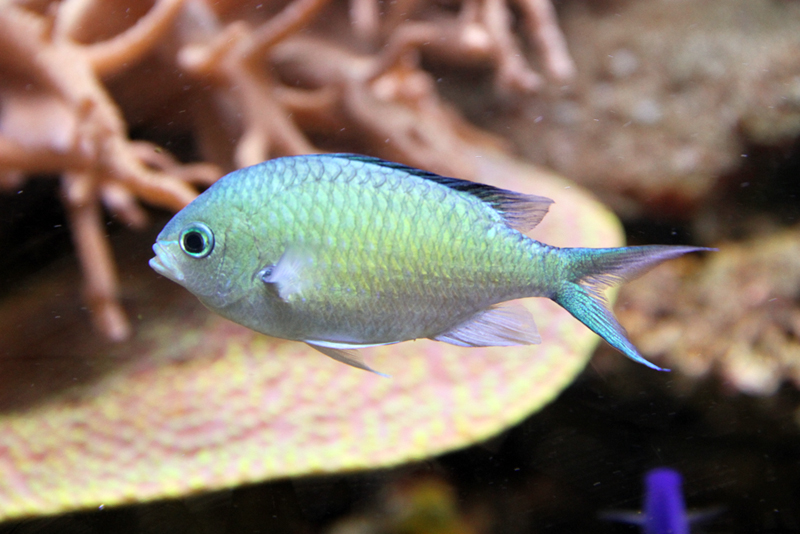 WorldGreen chromis
Small iridescent reef damselfish found across the Indo-Pacific.Reef fish · Coral reefs
 WorldRegal blue tang
Bright blue reef fish with a yellow tail and black markings.Reef fish · Coral reefs
 East AsiaTomato clownfish
A bright orange-red marine fish from the Western Pacific.Reef fish · Coasts and shelves
 WorldBluespotted cornetfish
Long, slender reef fish with a tubular snout and blue spots.Reef fish · Coasts and shelves
More from Pomacentridae
All of them WorldClark's anemonefish
A widely distributed marine clownfish with variable colour patterns.Reef fish · Coasts and shelves
 WorldDamselfish
Small marine fish known for aggressive territorial behaviour and reef farming.Reef fish · Coasts and shelves
 OceaniaMaroon clownfish
Large, aggressive anemonefish with a distinctive cheek spine.Other · Coral reefs
 WorldWhitetail dascyllus
A small Indo-Pacific reef fish with bold black and white stripes.Reef fish · Coasts and shelves