
Clark's anemonefish
A widely distributed marine clownfish with variable colour patterns.
Clark's anemonefish is a small marine species found across the Indian and Pacific oceans. It lives in symbiosis with sea anemones and shows significant colour variation based on location and host.
- Most widely distributed anemonefish species
- Associates with all ten host anemone species
- Females grow larger than males, up to 15 cm
- Shows greatest colour variation of any anemonefish
- Sequential hermaphrodites with strict social hierarchy
What it is
Clark's anemonefish is a small, stocky marine fish with a laterally compressed body. It typically grows to ten centimetres as a male and fifteen centimetres as a female. The fish displays vivid black, white, and yellow stripes, though patterns vary by region. Most individuals are black on the back and orange-yellow underneath, with two vertical white bands. One band sits behind the eye and the other above the anus. The tail fin is often lighter than the rest of the body.
Where it lives
This species has the widest distribution of any anemonefish. It inhabits tropical waters from the Indian Ocean to the Western Pacific, including the Red Sea. They live in sheltered reefs or shallow lagoons at depths between one and sixty metres. The fish requires host anemones for survival and protection. It is found in areas where these specific sea anemones grow, occupying reef biomes across this vast geographic range.
How it lives
These fish form mutualistic relationships with sea anemones. The anemone provides protection from predators and food scraps, while the fish defends the host from parasites and other threats. Clark's anemonefish is the least host-specific species, associating with all ten known hosting anemone types. In groups, a strict hierarchy exists where the largest individual is female. They are generally not aggressive towards humans but maintain dominance within their social group.
Breeding and life cycle
Clownfish are sequential hermaphrodites, developing as males first and potentially becoming females later. Only the dominant pair in a group reproduces through external fertilization. Studies off the Philippines show a preference for breeding in cooler months, with a peak season from November to May. Egg production tends to increase leading up to the new moon and decrease after the full moon. This seasonal pattern is similar to other temperate clownfish species.
Fish and people
The common name honours John Heaviside Clark, a Scottish engraver who illustrated fishes from Ceylon. Due to their bright colours and interesting behaviour, they are popular in the aquarium trade. Their ability to live safely among stinging anemones makes them a subject of scientific interest regarding mutualism. They are observed in various marine collections and are well-known to reef enthusiasts for their distinctive appearance and hardy nature.


Questions people ask about Clark's anemonefish
What makes Clark's anemonefish unique among clownfish?
It is the most widely distributed anemonefish and the least host-specific. It can live in association with all ten species of sea anemones that host clownfish, unlike other species that prefer specific hosts.
How large does this fish grow?
It is a small-sized fish. Males typically grow up to ten centimetres, while females are larger, reaching up to fifteen centimetres in length. The body is stocky and oval to rounded in shape.
Why do the colours vary so much?
Colour variations depend on location, sex, age, and the specific host anemone. For example, fish living with Mertens' carpet sea anemone are often mostly black, while those in Vanuatu are orange-yellow with white bands.
Good reading and sources
- Clark's anemonefish on WikipediaEncyclopedia
- More photos on Wikimedia CommonsPhotos
- Wikidata recordOpen data
The facts on this page come from the Wikipedia article "Clark's anemonefish", written by its contributors and used under the CC BY-SA 4.0 licence, and from its Wikidata record (CC0). EveryFish rewrote the text in its own words, with AI assistance, and compares every page with the article to make sure no passage is copied. It may be reused under the same CC BY-SA 4.0 licence with a link back.
It may contain mistakes, and figures change over time. Nothing here is investment or buying advice. If something is wrong, tell us. Last refreshed 2026-11-15.
Like Clark's anemonefish
All reef fish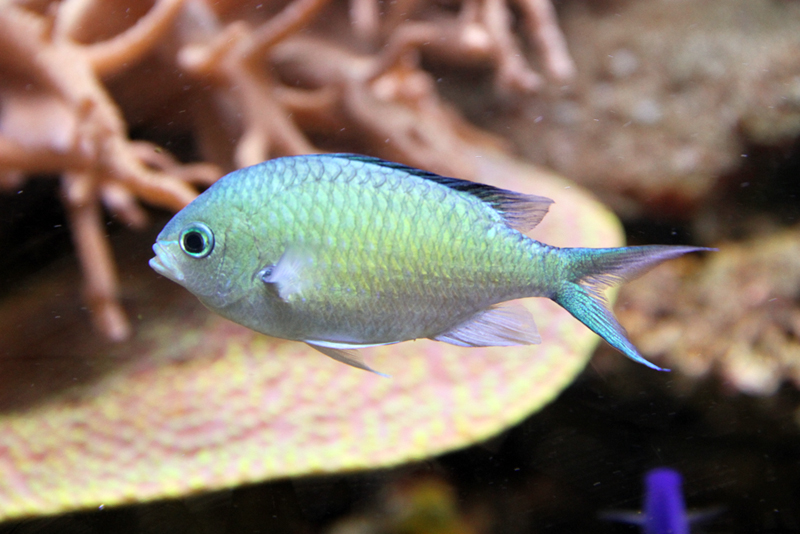 WorldGreen chromis
Small iridescent reef damselfish found across the Indo-Pacific.Reef fish · Coral reefs
 WorldRegal blue tang
Bright blue reef fish with a yellow tail and black markings.Reef fish · Coral reefs
 East AsiaTomato clownfish
A bright orange-red marine fish from the Western Pacific.Reef fish · Coasts and shelves
 WorldBluespotted cornetfish
Long, slender reef fish with a tubular snout and blue spots.Reef fish · Coasts and shelves
More from Pomacentridae
All of them WorldDamselfish
Small marine fish known for aggressive territorial behaviour and reef farming.Reef fish · Coasts and shelves
 WorldThreespot dascyllus
A small black and white reef fish with three distinct spots.Reef fish · Coral reefs
 OceaniaMaroon clownfish
Large, aggressive anemonefish with a distinctive cheek spine.Other · Coral reefs
 WorldWhitetail dascyllus
A small Indo-Pacific reef fish with bold black and white stripes.Reef fish · Coasts and shelves