
Pouched lamprey
Southern hemisphere migratory lamprey with a unique breeding pouch
The pouched lamprey is a jawless fish native to the southern hemisphere. It migrates between fresh water and the sea, parasitising other fish as an adult before returning to rivers to spawn and die.
- Only lamprey species found in New Zealand
- Males develop a pouch under eyes for egg care
- Parasitic adults attach to other fish in the sea
- Traditional Māori food caught with woven traps
- Larval stage lasts about four years in fresh water
What it is
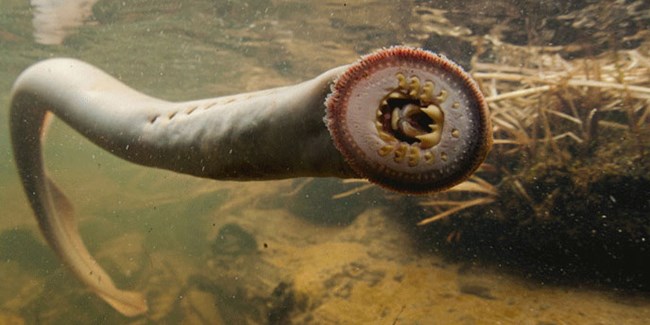
This species belongs to the genus Geotria, the sole member of the family Geotriidae. It has a thin, eel-like body that can reach 60 cm in length. Like all lampreys, it lacks jaws and instead possesses a suction disc mouth. Adults feature two low dorsal fins on the rear half of their bodies. Their eyes are small and situated on the sides of the head. Mature males develop a distinctive baggy pouch beneath their eyes. The skin colour shifts from silver in seawater to brown in fresh water due to chemical changes.
Where it lives
The pouched lamprey is widespread across the southern hemisphere. It inhabits waters in New Zealand, Chile, Argentina, the Falkland Islands, and South Georgia. In Australia, it is found in the southwest and southeast corners. It is the only lamprey species present in New Zealand. The fish lives in both fresh water and the open ocean, migrating between these environments during its life cycle.
How it lives
Larvae, known as ammocoetes, remain in fresh water for approximately four years. They are dull brown during this stage. A six-month metamorphosis follows, turning them silver with blue-green stripes. Their brain visual areas expand significantly during this change. Adults migrate to the sea where they act as parasites. They attach to the gills or sides of other fish and rasp at the tissues. Predators include albatrosses, shags, large fish, and marine mammals.
Breeding and life cycle
Adults return to fresh water to breed after spending time in the sea. They undergo sexual maturation for up to eighteen months before spawning. Males use their facial pouches to massage and oxygenate eggs. Some evidence suggests the pouch may help gather stones for nest building. After spawning, adults may survive for up to 105 days. They have been observed wrapping around egg masses to provide parental care before dying.
Fish and people
This fish is a traditional delicacy for Māori in New Zealand. Historical catching methods involved disturbing them at waterfalls or using woven traps called hīnaki. Large weirs, sometimes over 15 metres wide, were built across rivers like the Whanganui to guide them into traps. European settlers also adopted it as food in the mid-19th century, influenced by European culinary traditions involving lampreys.
Status and threats
Numbers appear to be declining. Hypotheses suggest this drop is linked to degraded water quality in lowland waterways. No specific conservation status is listed in the provided data, but environmental degradation poses a threat to their freshwater habitats.

Questions people ask about Pouched lamprey
Is the pouched lamprey dangerous to humans?
No, it is not dangerous to humans. While it is parasitic, it attaches to other fish in the ocean to feed on their tissues. It does not attack people.
Why do male pouched lampreys have a pouch?
The pouch develops under the eyes of mature males. It is likely used to massage and oxygenate eggs during breeding. It may also help gather stones for building nests.
Where can you find pouched lampreys?
They are native to the southern hemisphere. Populations exist in New Zealand, Chile, Argentina, the Falkland Islands, South Georgia, and parts of Australia.
How long do pouched lampreys live?
The larval stage lasts about four years in fresh water. After metamorphosis and a marine phase, adults live up to 105 days after spawning before they die.
Good reading and sources
- Pouched lamprey on WikipediaEncyclopedia
- More photos on Wikimedia CommonsPhotos
- Wikidata recordOpen data
The facts on this page come from the Wikipedia article "Pouched lamprey", written by its contributors and used under the CC BY-SA 4.0 licence, and from its Wikidata record (CC0). EveryFish rewrote the text in its own words, with AI assistance, and compares every page with the article to make sure no passage is copied. It may be reused under the same CC BY-SA 4.0 licence with a link back.
It may contain mistakes, and figures change over time. Nothing here is investment or buying advice. If something is wrong, tell us. Last refreshed 2026-11-15.
Like Pouched lamprey
All ancient fish 🇫🇮 Finland and 4 moreEuropean river lamprey
A parasitic freshwater and marine fish found across Europe.Ancient · Rivers and lakes
 🇨🇳 ChinaChinese sturgeon
Critically endangered giant migratory fish of the YangtzeAncient · Rivers and lakes
 🇺🇸 United States and 1 moreLake sturgeon
A large, long-lived freshwater fish native to North America.Ancient · Rivers and lakes
 🇺🇸 United States and 1 morePacific lamprey
An anadromous parasitic jawless fish found along the Pacific Rim.Ancient · Rivers and lakes · 1872