
Indo-Pacific sailfish
Fast ocean predator with a large dorsal fin
The Indo-Pacific sailfish is a swift marine hunter found in the Indian and Pacific Oceans. It has spread to the Atlantic and Mediterranean through the Suez Canal. Anglers value it as a challenging sport fish, though commercial fleets often catch it accidentally while targeting tuna.
- Enters Mediterranean via Suez Canal
- Dorsal fin may help regulate heat
- Hunts fast prey like tuna
- Often released by commercial fishers
- Listed as Least Concern globally
What it is
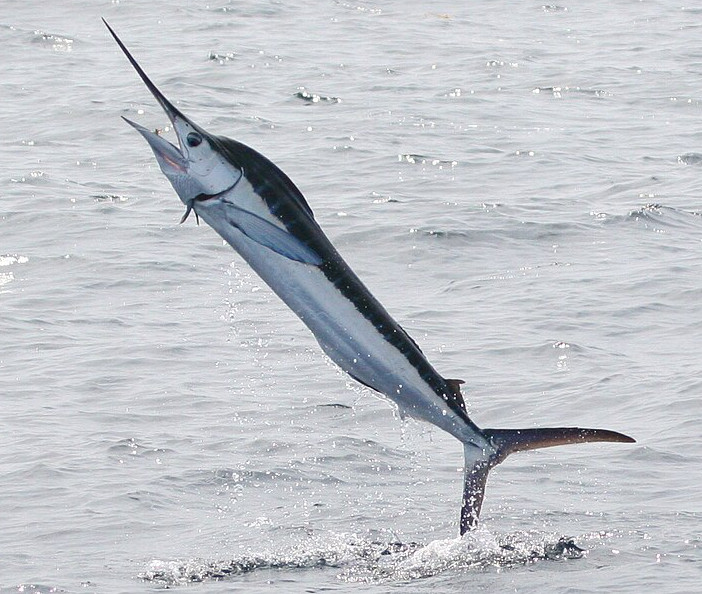
This fish features a dark blue back and brown-blue sides that fade to a silvery white belly. Its most striking feature is the first dorsal fin, which rises like a tall sail marked with black spots. The front of this fin is squared off and peaks in the middle. An elongated upper jaw forms a sharp spear used for hunting. Small embedded scales cover the body, ending bluntly. A curved lateral line runs above the pectoral fin before straightening toward the tail. Narrow pelvic fins extend nearly to the anus.
Where it lives
Native populations thrive in the Indian and Pacific Oceans. The species has also established itself in the Atlantic Ocean. It entered the Mediterranean Sea through the Suez Canal, acting as a Lessepsian migrant. These fish are common in tropical and sub-tropical zones but also range into temperate waters. They inhabit open ocean environments and coastal areas across these vast regions.
How it lives
Marine biologists suggest the large dorsal fin helps regulate body temperature. A network of blood vessels within the sail may aid cooling or heating. The fish often raises this fin near the surface after fast swimming bursts. It hunts some of the quickest prey in the sea, including tuna and mackerel. The sharp bill serves as a primary tool for capturing these fast-moving food sources.
Fish and people
Recreational anglers prize this species as a hard-fighting game fish. Commercial tuna longliners frequently catch it as bycatch rather than a primary target. Fishermen usually release sailfish because they hold less market value than marlin. The species is widespread and common in many fishing grounds. Its speed and agility make it a popular challenge for sport fishing enthusiasts.
Status and threats
The International Union for Conservation of Nature lists the cosmopolitan sailfish as Least Concern. Most authorities recognise only this single species, although some databases split the group into two. The fish remains common and widespread across its global range. No major threats currently endanger its overall population status.


Questions people ask about Indo-Pacific sailfish
Where does the Indo-Pacific sailfish live?
It is native to the Indian and Pacific Oceans. The species has also moved into the Atlantic Ocean and the Mediterranean Sea through the Suez Canal. It prefers tropical and sub-tropical waters but can be found in temperate zones.
Why do sailfish raise their dorsal fins?
Scientists theorize the sail helps with heating and cooling. The fin contains many blood vessels. Raising it at the surface after high-speed bursts may help regulate the fish body temperature during intense activity.
Is the Indo-Pacific sailfish endangered?
No, the IUCN lists the cosmopolitan sailfish as Least Concern. It is common and widespread in tropical and sub-tropical oceans. While caught as bycatch, it is often released and remains abundant in its range.
Good reading and sources
- Indo-Pacific sailfish on WikipediaEncyclopedia
- More photos on Wikimedia CommonsPhotos
- Wikidata recordOpen data
The facts on this page come from the Wikipedia article "Indo-Pacific sailfish", written by its contributors and used under the CC BY-SA 4.0 licence, and from its Wikidata record (CC0). EveryFish rewrote the text in its own words, with AI assistance, and compares every page with the article to make sure no passage is copied. It may be reused under the same CC BY-SA 4.0 licence with a link back.
It may contain mistakes, and figures change over time. Nothing here is investment or buying advice. If something is wrong, tell us. Last refreshed 2026-11-15.
Like Indo-Pacific sailfish
All other fish 🇺🇸 United States and 2 moreLingcod
A large predatory fish of the North American Pacific coast.Other · Coasts and shelves
 WorldGiant trevally
Large marine jack found across the Indo-Pacific, known for size and hunting skill.Other · Coasts and shelves · 1775
 WorldHoundfish
A large pelagic needlefish found in tropical oceans worldwide.Other · Coasts and shelves · 1821
 WorldBigeye trevally
A large marine fish found in tropical oceans, known for its nocturnal hunting and distinctive dark dorsal fin.Other · Coasts and shelves · 1825
More from Istiophoridae
All of them WorldShortbill spearfish
A small marlin with a short bill found in tropical oceans.Other · Open ocean
 WorldStriped marlin
Fast pelagic predator with blue stripesOther · Open ocean
WorldRoundscale spearfish
Atlantic billfish often mistaken for white marlinOther · Open ocean · 1841
 WorldWhite marlin
A fast-swimming billfish of the Atlantic Ocean.Other · Open ocean · 1860