
Lingcod
A large predatory fish of the North American Pacific coast.
The lingcod is a greenling native to the west coast of North America, ranging from Alaska to Mexico. It is a prized food fish known for its aggressive nature and unique blue flesh polymorphism in some individuals.
- Only extant member of the genus Ophiodon
- About 20% of individuals have blue-green flesh
- Males guard egg nests for up to six weeks
- Can grow up to 152 cm and weigh 39 kg
- Native to the North American Pacific coast
What it is
The lingcod is a member of the greenling family, despite its misleading name suggesting a relation to cod or ling. It features a fusiform body designed for quick bursts of speed, with a large head and mouth containing eighteen sharp, canine-like teeth. The skin is covered in cycloid scales, while the head remains unscaled with a small cirrus above the eye. Colours vary from gray and brown to green, often with copper mottling on the back. A prominent white lateral line runs along the side. Notably, about twenty percent of the population exhibits blue-green flesh due to biliverdin pigment, which disappears upon cooking.
Where it lives
This species inhabits the North American Pacific coast, extending from the Shumagin Islands in the Gulf of Alaska down to Baja California in Mexico. They are most abundant off British Columbia and Washington. Lingcod dwell near the ocean bottom, preferring rocky areas at depths between ten and one hundred metres, though they have been recorded as deep as 475 metres. Tagging studies indicate they are largely non-migratory, staying within localized areas. Larvae live near the surface, while juveniles occupy sandy bottoms with eelgrass before moving to deeper rocky reefs as adults.
How it lives
Adult lingcod are aggressive predators that consume almost any prey they can swallow, including rockfish, squid, octopus, crab, and other lingcod. Juveniles feed on small fish, while larvae eat zooplankton and krill. They lack a swim bladder, relying on their body shape for movement. While generally sedentary, females migrate seasonally to spawn in shallower waters. Males remain in their natal habitats, displaying territorial behaviour. This site fidelity helps them return to specific reefs. Predators include seals, sea lions, and humans, particularly when the fish are vulnerable during spawning migrations.
Breeding and life cycle
Spawning occurs annually between January and March, likely at night. Males establish territories in nearshore grounds starting in November, showing high fidelity to specific nesting sites. Females lay up to 500,000 eggs under rocks or in crevices within a male's territory and then depart. The male fertilizes the eggs and guards the nest actively for six weeks until hatching. He may defend up to three nests if they are close together. Larvae are pelagic until late spring, when they settle to the bottom. Females mature at three years, while males mature at two years.
Fish and people
Lingcod is a popular food fish, prized by anglers for its size and fighting ability. It is managed by NOAA Fisheries in the United States and the Alaska Department of Fish and Game. Regulations include minimum size limits to ensure fish spawn before harvest, as well as seasonal closures to protect nesting males and spawning females. Catch limits restrict daily bags for sport fishing. The species is not currently considered overfished. Its unique blue flesh is a notable culinary curiosity, though the colour does not persist after cooking.
Status and threats
Both the Northern and Southern Pacific stocks are assessed as not overfished and not subject to overfishing based on 2021 data. Management strategies focus on preventing overexploitation, as recovery from population declines is difficult for this species. Protective measures include closing fisheries during spawning and nest-guarding periods. Minimum size limits help maintain the breeding population. The International Union for Conservation of Nature status is not explicitly listed in the provided text, but national assessments indicate healthy stock levels under current management regimes.


Questions people ask about Lingcod
Is lingcod actually a type of cod?
No, the lingcod is not a true cod or ling. It belongs to the greenling family Hexagrammidae. The name originated because its appearance somewhat resembles those fish, but it is the only living member of its genus, Ophiodon.
Why is some lingcod meat blue?
Approximately twenty percent of lingcod have blue-green flesh due to the pigment biliverdin. This substance circulates in the lymph and suffuses tissues. The colour is not present after cooking and may be linked to diet or physiological conditions.
How do male lingcod care for their young?
Male lingcod establish territories and guard nests where females have laid eggs. They fertilize the eggs and defend the nest from predators for about six weeks until the eggs hatch, exhibiting significant parental care.
Where can lingcod be found?
Lingcod are native to the North American west coast. Their range extends from the Shumagin Islands in the Gulf of Alaska south to Baja California, Mexico, with high abundance in British Columbia and Washington.
Good reading and sources
The facts on this page come from the Wikipedia article "Lingcod", written by its contributors and used under the CC BY-SA 4.0 licence, and from its Wikidata record (CC0). EveryFish rewrote the text in its own words, with AI assistance, and compares every page with the article to make sure no passage is copied. It may be reused under the same CC BY-SA 4.0 licence with a link back.
It may contain mistakes, and figures change over time. Nothing here is investment or buying advice. If something is wrong, tell us. Last refreshed 2026-11-15.
Like Lingcod
All other fish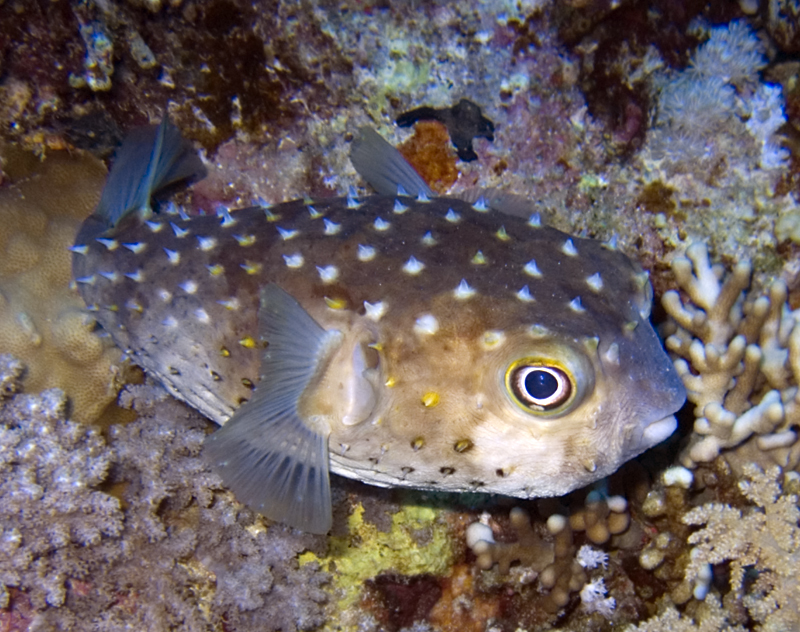 WorldPorcupinefish
Spiny marine fish that inflate into a defensive sphere to deter predators.Other · Coasts and shelves
 WorldStriped marlin
Fast pelagic predator with blue stripesOther · Open ocean
 WorldBlue-spotted grouper
A widely distributed Indo-Pacific grouper known for its blue spots and invasive impact in Hawaii.Other · Coasts and shelves
 🇺🇸 United StatesSpotted seatrout
Estuarine drum fish of the US southeast coastOther · Estuaries and mangroves