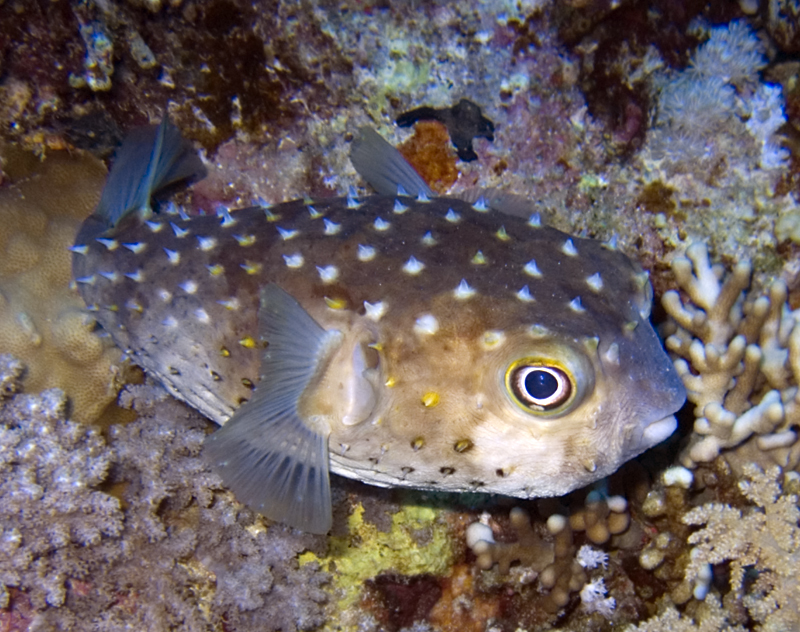
Porcupinefish
Spiny marine fish that inflate into a defensive sphere to deter predators.
Porcupinefishes belong to the family Diodontidae and inhabit shallow seas across the globe. They are well known for their ability to swallow water or air to swell their bodies and display sharp spines as a primary defence mechanism.
- Inflate bodies by swallowing water or air to deter predators
- Sharp spines radiate outward when the fish swells up
- Teeth fuse into a hard beak shape for crushing shells
- Some species hold toxins deadly to other animals
- Found in shallow seas across temperate and tropical zones
What it is
These medium-to-large fish belong to the family Diodontidae within the order Tetraodontiformes. They are frequently referred to as blowfishes or balloonfishes, though they should not be confused with the closely related Tetraodontidae family. The group contains approximately eighteen distinct species. Their most striking feature is the ability to rapidly inflate their bodies by swallowing water or air. This expansion nearly doubles their vertical height and causes their sharp spines to radiate outward, creating a formidable barrier against potential attackers.
Where it lives
Members of this family are distributed across shallow, temperate, and tropical seas around the world. While many reside near coastlines, certain species venture much further out into the open ocean. In these deeper offshore areas, they can gather in massive schools comprising thousands of individuals. Their wide geographical spread allows them to occupy diverse marine environments, from coastal shelves to pelagic zones beyond the continental edge.
How it lives
Porcupinefishes are generally slow-moving creatures. They rely on three main defences: inflation, spines, and chemical toxicity. Some species contain tetrodotoxin, a neurotoxin at least one thousand two hundred times more potent than cyanide, located in organs like the liver and ovaries. This poison originates from bacteria in their diet. Adults face few natural threats, occasionally falling prey to sharks or orcas. Juveniles are hunted by spotted squid, tuna, and dolphins. They use fused teeth resembling a parrot's beak to crush molluscs and sea urchins.
Fish and people
The spot-fin porcupinefish is consumed in various regions globally. Research in Okinawa indicated negligible toxicity in its flesh and organs, yet poisoning cases still occur. In Cebu, Philippines, the fish is an exotic delicacy known locally as tagotongan. Consumption carries risks due to potential tetrodotoxin poisoning. Historically, Charles Darwin recorded observations of these fish in his accounts of the Beagle voyage, noting their unusual upside-down swimming when inflated and instances where they escaped shark stomachs by eating through the predator's tissues.


Questions people ask about Porcupinefish
How do porcupinefish protect themselves from predators?
They swallow water or air to swell their bodies, nearly doubling their size. This action forces their sharp spines to stick outwards, making them difficult to swallow. Combined with toxic organs in some species, these features reduce the number of animals willing to attack them.
Are all porcupinefish poisonous?
Not all species contain high levels of poison, but some have tetrodotoxin in their internal organs like the liver and ovaries. This neurotoxin is produced by bacteria from their diet and is extremely potent. Even species with low toxicity can cause poisoning if prepared incorrectly.
What do porcupinefish eat?
They primarily feed on molluscs and sea urchins. To access this food, they use their unique dental structure where upper and lower teeth fuse together. This creates a strong, parrot-like beak capable of crushing hard shells found on the sea floor.
Can porcupinefish swim effectively when inflated?
Yes, despite their swollen appearance, they can swim while inflated. However, the altered buoyancy requires them to swim upside down to maintain stability. This behaviour was notably observed and recorded by Charles Darwin during his voyages.
Good reading and sources
- Porcupinefish on WikipediaEncyclopedia
- More photos on Wikimedia CommonsPhotos
- Wikidata recordOpen data
The facts on this page come from the Wikipedia article "Porcupinefish", written by its contributors and used under the CC BY-SA 4.0 licence, and from its Wikidata record (CC0). EveryFish rewrote the text in its own words, with AI assistance, and compares every page with the article to make sure no passage is copied. It may be reused under the same CC BY-SA 4.0 licence with a link back.
It may contain mistakes, and figures change over time. Nothing here is investment or buying advice. If something is wrong, tell us. Last refreshed 2026-11-15.
Like Porcupinefish
All other fish WorldAnglerfish
Ray-finned fish using a modified dorsal fin ray as a lure to catch prey.Other · Coasts and shelves · 1829
 WorldThree-spined stickleback
Small northern fish known for rapid evolution and complex breeding.Other · Rivers and lakes
 🇵🇭 Philippines and 4 moreMilkfish
The sole living species of the family Chanidae, found across the Indo-Pacific.Other · Coasts and shelves
 WorldBarreleye
Deep-sea fish with tubular eyes and a light-producing anusOther · Open ocean