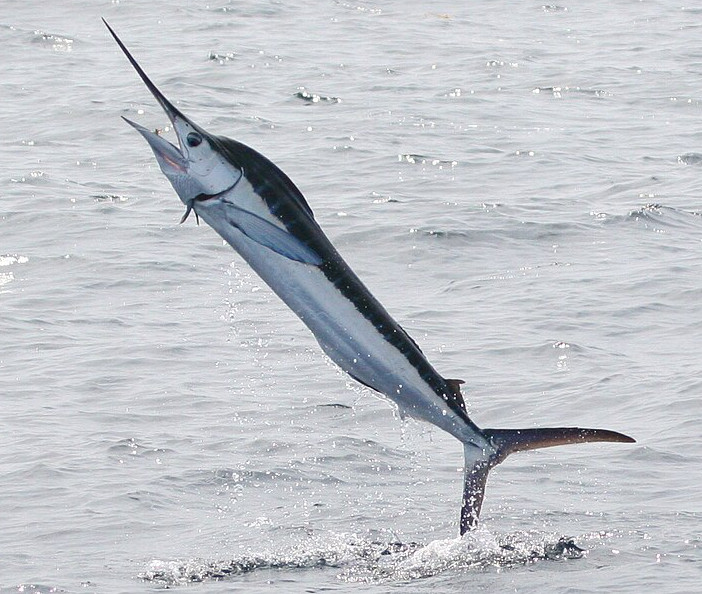
White marlin
A fast-swimming billfish of the Atlantic Ocean.
The white marlin is a mid-sized billfish found in warm Atlantic waters. It is prized by sport anglers but faces conservation challenges due to bycatch and past misidentification with similar species.
- Can migrate over 6,500 km across the Atlantic Ocean.
- Females lay up to 586,000 eggs in warm tropical waters.
- Often misidentified as roundscale spearfish until 2001.
- Must swim constantly to breathe via ram ventilation.
- Up to 32% may die from exhaustion after sport fishing.
What it is
This fish is a streamlined predator built for speed. It features a round, pointed bill and a deeply forked tail. The body shows countershading, with dark blue on top and pale white underneath. A large dorsal fin runs along most of its back, starting tall and rounding off towards the rear. Smaller secondary fins sit behind it. The lateral line is visible as a ridge above the pectoral fin. Adults can grow to nearly three metres in length and weigh over eighty kilograms. Females are typically larger than males.
Where it lives
These fish inhabit the warm surface layers of the Atlantic Ocean. Their range extends from forty-five degrees north to forty-five degrees south. They prefer water temperatures above twenty-two degrees Celsius. While they often stay near the surface, they are found in depths exceeding one hundred metres. Common locations include the Gulf of Mexico, the Caribbean Sea, and near underwater banks or canyons. Records from the Mediterranean Sea and northern France likely represent rare wanderers rather than resident populations.
How it lives
White marlin sit near the top of the marine food chain. They hunt schooling flyingfish, small tuna, dolphinfish, and squid. To catch prey, they may dive in parabolic arcs to depths of two hundred metres. Specialised tissue warms their eyes and brain to help them see in colder, darker water. They sometimes cooperate with other apex predators to corner schools of fish. Although they often swim alone, they must keep moving to breathe, a trait known as ram ventilation. This constant motion supports their high-energy lifestyle.
Breeding and life cycle
Spawning occurs annually in warm, shallow tropical waters near the equator. Key grounds include the Gulf of Mexico, the Mona Passage, and areas near Bermuda and Grand Bahama Island. A single female can release between 190,000 and 586,000 eggs during this period. Growth rates are rapid. Males reach sexual maturity at a lower-jaw fork length of roughly 153 centimetres, while females mature at about 190 centimetres. These fish can live for fifteen years or longer, undertaking long migrations across the ocean basin.
Fish and people
Sport fishing for this species generates significant revenue, particularly in developed nations. Ocean City, Maryland, hosts a major annual tournament that promotes tag-and-release practices. However, handling stress can be fatal, with many fish unable to regain buoyancy after release. Regulations now require keeping the fish in the water during dehooking. Most catches occur as accidental bycatch in commercial longline and gillnet fisheries. Conservation acts in the United States aim to protect the population through education and fishing restrictions.
Status and threats
The species is listed as Endangered. For decades, it was confused with the roundscale spearfish, leading to inaccurate population counts. Genetic testing in 2001 confirmed they are distinct, revealing that white marlin numbers had dropped critically. By 2007, the population was classified as endangered. Threats include high mortality from recreational angling exhaustion and commercial bycatch. Predation by sharks and whales also affects those caught on longlines. Management plans now focus on reducing post-release mortality and protecting spawning grounds.

Questions people ask about White marlin
How can you tell a white marlin from a roundscale spearfish?
Look at the scales and anal opening. White marlin have rigid scales rounded at the posterior end. In roundscale spearfish, the anal opening is further from the anal fin. Genetic testing is the most accurate method, but external examination of these features helps distinguish them without laboratory analysis.
Why do white marlin need to keep swimming?
They are ram ventilators, meaning they rely on forward motion to push water over their gills for oxygen. If they stop moving, they cannot breathe effectively. This biological requirement drives their constant activity and influences how they interact with fishing gear and handlers.
Where is the best place to catch white marlin?
They are found throughout the tropical and subtropical Atlantic, including the Gulf of Mexico and Caribbean Sea. Ocean City, Maryland, is known as the White Marlin Capital of the World and hosts a major annual tournament. Warm surface waters above twenty-two degrees Celsius are their preferred habitat.
Are white marlin safe to eat?
While they are caught for sport and occasionally consumed, the text focuses on their role in sport fishing and conservation. Most catches are released due to regulations aimed at protecting the endangered population. Commercial bycatch is a significant threat, but direct consumption is not highlighted as a primary use compared to recreational angling.
Good reading and sources
The facts on this page come from the Wikipedia article "White marlin", written by its contributors and used under the CC BY-SA 4.0 licence, and from its Wikidata record (CC0). EveryFish rewrote the text in its own words, with AI assistance, and compares every page with the article to make sure no passage is copied. It may be reused under the same CC BY-SA 4.0 licence with a link back.
It may contain mistakes, and figures change over time. Nothing here is investment or buying advice. If something is wrong, tell us. Last refreshed 2026-11-15.
Like White marlin
All other fish WorldRoundscale spearfish
Atlantic billfish often mistaken for white marlinOther · Open ocean · 1841
 🇦🇺 Australia and 1 moreYellowtail amberjack
Large pelagic fish of the Southern Hemisphere oceansOther · Coasts and shelves · 1833
 WorldGreater amberjack
Large predatory jack found in warm seas worldwide.Other · Coasts and shelves · 1810
 WorldStriped marlin
Fast pelagic predator with blue stripesOther · Open ocean

