
Roundscale spearfish
Atlantic billfish often mistaken for white marlin
The roundscale spearfish is a billfish native to the Atlantic Ocean. It was long confused with the white marlin until genetic studies in 2006 confirmed it as a distinct species. This fish lives near the surface and faces threats from bycatch in tuna fisheries.
- Endemic to the Atlantic Ocean
- Often misidentified as white marlin
- Spends most time above 10 metres depth
- Significant bycatch in tuna longline fisheries
- Distinctive soft and rounded body scales
What it is
This marine fish belongs to the billfish family. It has a robust body that is not heavily compressed. The upper side is dark blue, while the flanks show a coppery hue and the belly is silver. Iridescent bars may appear on the body. A moderate hump sits on the nape. The rostrum is long and slender, with a round cross section. Two dorsal fins are present, with the first being taller and rounded at the front. The scales on the sides are soft and rounded, which distinguishes it from similar species. The flesh is redder than that of related spearfish.
Where it lives
The species is endemic to the Atlantic Ocean. Specimens are frequently found near Madeira, Sicily, and the Straits of Gibraltar. They also inhabit waters off southern Portugal. Observations span the entire Atlantic basin from north to south. These fish are known to undertake long migrations across the ocean. They live in the epipelagic zone, spending most of their time at depths shallower than ten metres. The specific nursery areas for larvae and juveniles remain unknown to science.
How it lives
Little is known about their social behaviour. They are solitary migratory predators but may gather where prey is dense. They use their speed and rostrum to stun targets. Their diet likely includes schooling bony fish, squid, octopus and cuttlefish, similar to their relatives. They occupy a high trophic level. The fish possesses a swim bladder with small chambers for buoyancy. Parasites such as Capsala laevis may infect them. Research focuses more on individual movement than group dynamics due to the difficulty of studying these elusive animals.
Breeding and life cycle
Reproductive details are scarce. The species is dioecious, meaning individuals are either male or female. They likely lay eggs in batches in tropical waters. Only one juvenile and one egg have been recorded in scientific literature, both found in the Sargasso Sea south of Bermuda in April. The pelagic eggs contain oil droplets. They hatch into planktonic larvae that grow quickly into juveniles. Based on close relatives, the maximum lifespan is estimated to be between eight and fifteen years.
Fish and people
Commercial fisheries do not target this species directly. It is caught as bycatch in longline tuna and swordfish operations. For years, it was misidentified as white marlin, leading to inaccurate stock data. Studies suggest thirty per cent of recorded white marlin landings were actually roundscale spearfish. Recreational fishing generates significant revenue, with over ten thousand catches annually in the US alone. Although many are released alive, stress from capture causes an estimated twenty per cent post-release mortality. Gear changes like circle hooks may help reduce harm.
Status and threats
The species has no formal conservation status due to a lack of data. Historical landings for the combined white marlin group peaked in 1965 and have since declined. Current total allowed catches are often exceeded, risking stock recovery. Uncertainty in mortality rates and discard reporting complicates management. Assessing two species together may hide threats to one population. The situation appears precarious despite the absence of an official evaluation. Improved gear selectivity and strict release protocols are suggested to mitigate human impact.

Questions people ask about Roundscale spearfish
How can you tell it apart from white marlin?
Examine the scales. Roundscale spearfish have soft, rounded scales with few posterior points. White marlin scales are rigid and pointed. You can also measure the distance from the anal opening to the anal fin, which is greater in this species.
Where does this fish live?
It is found throughout the Atlantic Ocean. Common sightings occur near Madeira, Sicily, and the Straits of Gibraltar. It lives in the epipelagic zone, typically staying in the top ten metres of water.
Is it endangered?
It has not been formally assessed due to a lack of data. However, population trends suggest a worrying situation. Misidentification in catch records makes it difficult to determine exact numbers and manage conservation efforts effectively.
What does it eat?
Scientific literature has not reported specific feeding habits. However, it likely consumes schooling bony fish, squid, octopus and cuttlefish. It uses its speed and bill to stun prey, acting as a high-level predator.
Good reading and sources
The facts on this page come from the Wikipedia article "Roundscale spearfish", written by its contributors and used under the CC BY-SA 4.0 licence, and from its Wikidata record (CC0). EveryFish rewrote the text in its own words, with AI assistance, and compares every page with the article to make sure no passage is copied. It may be reused under the same CC BY-SA 4.0 licence with a link back.
It may contain mistakes, and figures change over time. Nothing here is investment or buying advice. If something is wrong, tell us. Last refreshed 2026-11-15.
Like Roundscale spearfish
All other fish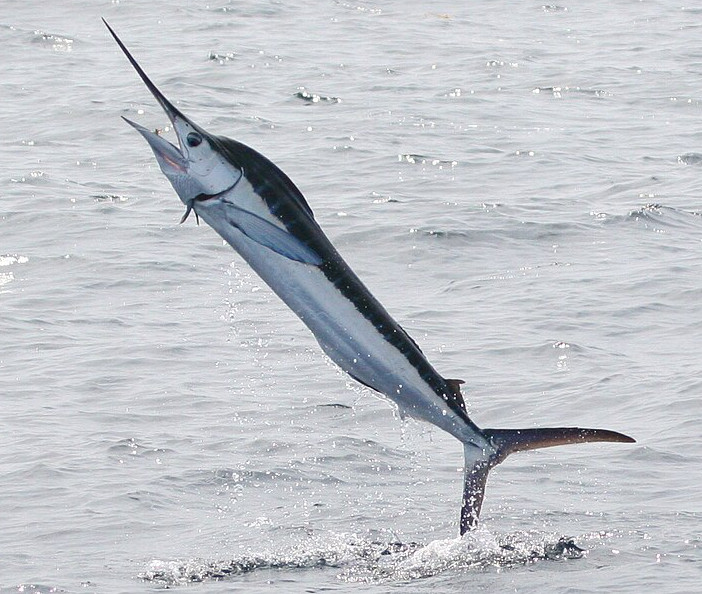 WorldWhite marlin
A fast-swimming billfish of the Atlantic Ocean.Other · Open ocean · 1860
 WorldOarfish
Extremely long pelagic fish known for their ribbon-like bodies and association with sea serpent myths.Other · Open ocean · 1772
 WorldStriped marlin
Fast pelagic predator with blue stripesOther · Open ocean
 WorldAnglerfish
Ray-finned fish using a modified dorsal fin ray as a lure to catch prey.Other · Coasts and shelves · 1829

