
Greater amberjack
Large predatory jack found in warm seas worldwide.
The greater amberjack is a large marine fish in the jack family. It inhabits tropical and subtropical waters globally. Anglers prize it for its strong fight, while commercial fisheries value its meat. It is the largest species within its taxonomic family.
- Largest species in the jack family Carangidae
- Can reach lengths of 190 cm and weights over 80 kg
- Farmed in the Mediterranean since the 1980s
- Known as reef donkey for its strong fight when angled
- Found in tropical and subtropical seas worldwide
What it is
This fish has an elongated, compressed body covered in small scales. Its colour ranges from brownish-grey on top to silvery-white below. A dark diagonal stripe runs from the snout across the eye. Fins are often dusky, though juveniles display vertical bands. It is the largest member of the jack family, reaching nearly two metres in length. Adults typically measure one metre and weigh significantly less than the maximum recorded eighty kilograms.
Where it lives
It lives in temperate, subtropical, and tropical oceans worldwide. In the Atlantic, it ranges from Nova Scotia to Brazil, including the Gulf of Mexico. The Mediterranean and eastern Atlantic host populations as far north as the British Isles. In the Indo-Pacific, it occurs from South Africa to Japan and Australia. It inhabits reefs, rocky outcrops, and deep offshore caves. Juveniles sometimes shelter among floating algae far out at sea.
How it lives
Adults are opportunistic predators that hunt other fish, squid, and crustaceans. They often swim in small schools near the seabed or in open water. Younger fish feed on plankton before switching to larger prey as they grow. Larger individuals prefer deeper waters, while smaller ones stay in shallow coastal areas. Predators include tuna, hake, and seabirds. Parasites such as tapeworms and gill flukes occasionally infest them.
Breeding and life cycle
Males and females are separate sexes with no external differences other than size. They mature between three and five years of age depending on the region. Spawning occurs over reefs and wrecks during warmer months. In the western Atlantic, peaks happen in spring, while Mediterranean fish spawn in summer. A single female can release millions of eggs. Embryos hatch within two days, and larvae develop into juveniles over a month.
Fish and people
Anglers value this species for its powerful resistance, earning it the nickname reef donkey. Commercial fisheries catch it for fresh meat, which is fried, grilled, or used in sushi. Aquaculture operations in the Mediterranean have farmed it since the nineteen eighties. Sustainability concerns exist because farming requires fish-based feed. It is often caught incidentally by those targeting snappers or groupers on the seabed.


Questions people ask about Greater amberjack
How big do greater amberjacks get?
They are the largest jacks, reaching up to 190 cm in length. The heaviest recorded specimen weighed 80.6 kg. Most adults caught are around 100 cm long.
Where can you find greater amberjack?
They live in tropical and subtropical seas globally. You can find them in the Atlantic, Pacific, and Indian Oceans, often near reefs, wrecks, and drop-offs.
Is greater amberjack good to eat?
Yes, it is a popular food fish. The meat is served fresh, fried, or grilled in places like Florida and Mexico. In Japan, it is commonly used for sushi and sashimi.
Why is it called reef donkey?
Anglers gave it this nickname because of its stubborn and powerful fight when hooked. It is a prized game fish that pulls hard against the line.
Good reading and sources
- Greater amberjack on WikipediaEncyclopedia
- More photos on Wikimedia CommonsPhotos
- Wikidata recordOpen data
The facts on this page come from the Wikipedia article "Greater amberjack", written by its contributors and used under the CC BY-SA 4.0 licence, and from its Wikidata record (CC0). EveryFish rewrote the text in its own words, with AI assistance, and compares every page with the article to make sure no passage is copied. It may be reused under the same CC BY-SA 4.0 licence with a link back.
It may contain mistakes, and figures change over time. Nothing here is investment or buying advice. If something is wrong, tell us. Last refreshed 2026-11-15.
Like Greater amberjack
All other fish 🇦🇺 Australia and 1 moreYellowtail amberjack
Large pelagic fish of the Southern Hemisphere oceansOther · Coasts and shelves · 1833
 WorldBigeye trevally
A large marine fish found in tropical oceans, known for its nocturnal hunting and distinctive dark dorsal fin.Other · Coasts and shelves · 1825
 WorldRoundscale spearfish
Atlantic billfish often mistaken for white marlinOther · Open ocean · 1841
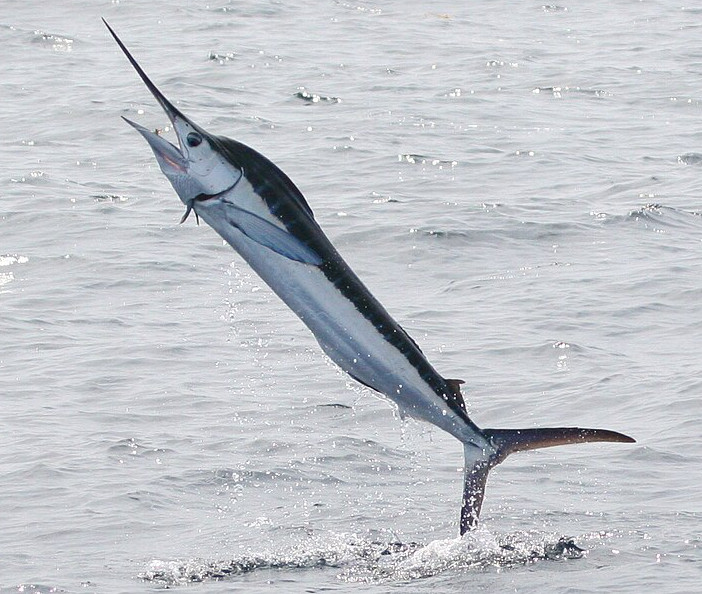 WorldWhite marlin
A fast-swimming billfish of the Atlantic Ocean.Other · Open ocean · 1860
More from Carangidae
All of them WorldBluefin trevally
Large tropical marine predator with electric blue finsPerch-like · Coasts and shelves · 1833
 🇨🇱 Chile and 3 moreChilean jack mackerel
A pelagic fish vital to global fisheries and salmon feed.Tuna · Coasts and shelves · 1920
 WorldPompano
Deep-bodied marine fish in the genus Trachinotus.Perch-like · Coasts and shelves
 🇯🇵 Japan and 1 moreJapanese jack mackerel
A silver coastal fish prized in East Asian cuisine.Tuna · Coasts and shelves