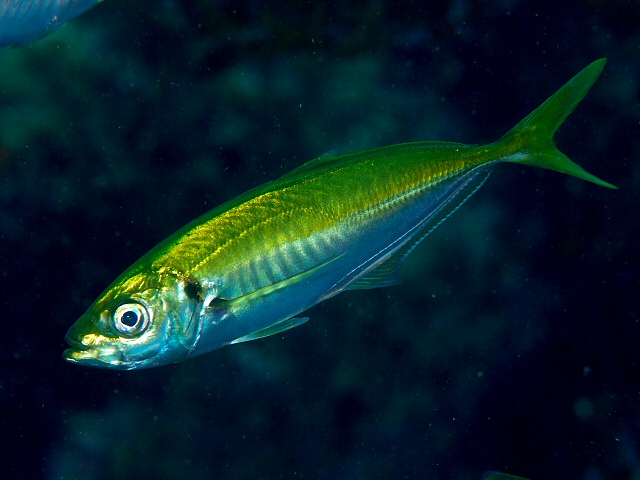
Japanese jack mackerel
A silver coastal fish prized in East Asian cuisine.
The Japanese jack mackerel is a pelagic species found in the seas around Japan and Korea. It supports major fisheries and is a staple in local diets, often grilled or served raw. Conservation limits now regulate catches to protect spawning stocks.
- Max length 50 cm with a bright yellow tail
- Spawns in warm coastal currents from April to July
- Catch limits stabilized yields after 1997 decline
- Popular in Japan as grilled aji or raw sashimi
- Juveniles thrive in shallow waters above 19 °C
What it is
This species is a medium-sized fish with a greyish blue back and silver belly. A distinct black blotch sits over the gills, and the tail fin is bright yellow. The dorsal fin has two parts, with bony spines at the front and soft rays behind. Scales are dense and curved on the front half of the body. Adults typically reach 35 cm, though they can grow to 50 cm and weigh up to 0.66 kg.
Where it lives
It inhabits the East China Sea and Sea of Japan, ranging from tropical to temperate zones. The fish migrates seasonally, moving to warmer southern waters in colder months. Ideal temperatures range from 15 to 26 °C. Juveniles stay in shallow, warm waters above 19 °C, while adults dive to depths of 275 m. Spawning occurs along the coasts of Kyushu and Taiwan.
How it lives
Juveniles feed on zooplankton and drift algae. Adults hunt copepods, small shrimp, and other fish in large schools. Some individuals associate with jellyfish for protection and feeding opportunities. Predators include tuna, sharks, dolphins, and sea birds. Larvae are vulnerable to larger fish before they develop full mobility.
Breeding and life cycle
Spawning takes place from late April to early July as water warms. Eggs are pelagic and float freely in the currents. Larvae hatch at about 2.4 mm and absorb their yolk sac within four days. They reach the juvenile stage after 29 days and mature fully around 60 days post-hatching, growing rapidly in warm coastal nurseries.
Fish and people
This fish is a key ingredient in Japanese and Korean cooking. It is often deep fried, salt-grilled, or served raw as sashimi. In Korea, it is used in soups and grilled dishes. Commercial fishing uses trawls and purse seines. It is also a popular target for sport anglers using lures or live bait due to its fighting spirit.
Status and threats
Overfishing reduced catches from peak levels in the 1960s to low points in the 1980s. Annual catch limits were introduced in 1997 to stabilize yields. Conservation zones were established in 2013 in key spawning areas like the Uwa Sea to protect juveniles. Aquaculture production remains small compared to wild capture.


Questions people ask about Japanese jack mackerel
What does Japanese jack mackerel taste like?
It is a versatile fish used in many dishes. In Japan, it is commonly salt-grilled, deep fried, or served raw as sashimi. The flesh is firm and suitable for various cooking methods.
Where do these fish live?
They are found in the East China Sea and Sea of Japan. They migrate seasonally based on temperature, preferring waters between 15 and 26 °C. Adults live deeper than juveniles.
Is this fish endangered?
The text does not list an IUCN status. However, overfishing caused significant population drops in the past. Catch limits and conservation zones now help manage the stock sustainably.
How big do they get?
The maximum recorded length is 50 cm, with a common size of 35 cm. They can weigh up to 0.66 kg and live for up to 12 years in the wild.
Good reading and sources
- Japanese jack mackerel on WikipediaEncyclopedia
- More photos on Wikimedia CommonsPhotos
- Wikidata recordOpen data
The facts on this page come from the Wikipedia article "Japanese jack mackerel", written by its contributors and used under the CC BY-SA 4.0 licence, and from its Wikidata record (CC0). EveryFish rewrote the text in its own words, with AI assistance, and compares every page with the article to make sure no passage is copied. It may be reused under the same CC BY-SA 4.0 licence with a link back.
It may contain mistakes, and figures change over time. Nothing here is investment or buying advice. If something is wrong, tell us. Last refreshed 2026-11-15.
Like Japanese jack mackerel
All tunas and mackerels 🇺🇸 United States and 3 morePacific bonito
Striped marine fish of the Pacific coastTuna · Coasts and shelves
 🇳🇴 Norway and 2 moreAtlantic mackerel
Fast-swimming, oily fish of the North AtlanticTuna · Coasts and shelves · 1758
 WorldLittle tunny
A fast, coastal tuna of the Atlantic and Mediterranean.Tuna · Coasts and shelves · 1810
 WorldBlue mackerel
A small, fast pelagic fish found in tropical Indo-Pacific waters.Tuna · Coasts and shelves
More from Carangidae
All of them 🇯🇵 Japan and 2 moreJapanese amberjack
A prized jack fish native to the northwest Pacific Ocean.Other · Coasts and shelves
 WorldPompano
Deep-bodied marine fish in the genus Trachinotus.Perch-like · Coasts and shelves
 WorldGreater amberjack
Large predatory jack found in warm seas worldwide.Other · Coasts and shelves · 1810
 WorldBigeye trevally
A large marine fish found in tropical oceans, known for its nocturnal hunting and distinctive dark dorsal fin.Other · Coasts and shelves · 1825