
Giant trevally
Large marine jack found across the Indo-Pacific, known for size and hunting skill.
The giant trevally is a large saltwater fish in the jack family. It lives from South Africa to Hawaii and hunts other animals. Anglers prize it as a sport fish, though it can carry toxins.
- Max length reaches 170 cm and weight hits 80 kg.
- Mature males often turn completely black.
- Juveniles tolerate fresh water in rivers and lakes.
- Hunts by shadowing monk seals for escaping prey.
- Can cause ciguatera poisoning if eaten raw.
What it is
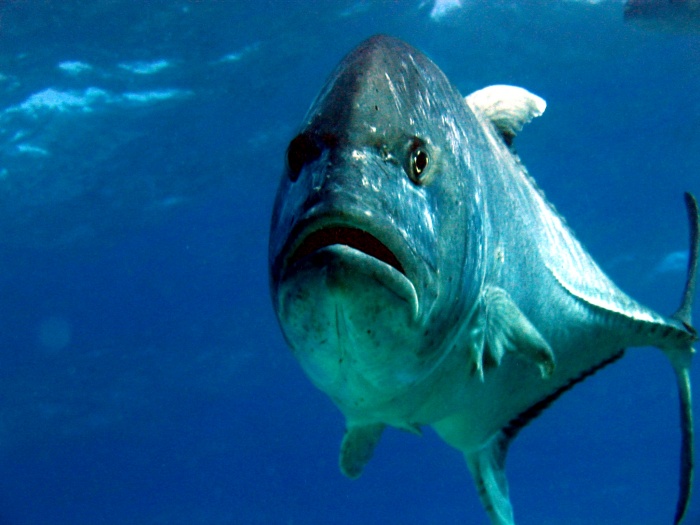
This large saltwater fish belongs to the jack family. Adults reach up to 170 centimetres long and weigh 80 kilograms. Young fish appear silvery-grey with darker backs. Mature males often turn jet black, while females stay lighter. The body is oval and compressed. Fins are dark grey or black. A strong forked tail helps it swim fast. The head slopes steeply upward. Eyes have a special horizontal band for wide vision.
Where it lives
It lives in tropical seas from South Africa eastward to Hawaii. The range includes Japan north and Australia south. Fish inhabit coral reefs, rocky shores, and lagoons. Juveniles enter rivers and estuaries with low salt levels. Adults prefer deeper offshore waters near atolls. Some populations live in landlocked lakes like Taal Lake in the Philippines.
How it lives
Adults hunt alone but school when spawning. They eat fish, crabs, squid, and shellfish. Hunting tactics include chasing seals and leaping for birds. Young fish form schools in murky water. Older fish patrol home ranges up to nine kilometres. They move between shallow reefs and deep drop-offs. Predators include larger sharks and humans.
Breeding and life cycle
Reproduction happens in warm months. Spawning peaks follow lunar cycles. Large groups gather over reefs to release eggs. Fish grow quickly, reaching maturity at sixty centimetres. This usually occurs around three years of age. Larvae develop in coastal nurseries before moving seaward.
Fish and people
Commercial nets and angling lines catch this species. Hawaii harvests about ten thousand pounds annually. The meat quality varies from poor to excellent. Ciguatera poisoning is a common risk from consumption. Numbers near Hawaiian islands have dropped. Managers propose reducing catches there. Small farms raise juveniles for release or food.
Status and threats
Populations remain stable in most areas. Overfishing threatens numbers near main Hawaiian islands. Commercial pressure reduces large fish counts in Oman. Dams and pollution affect river habitats. No global extinction risk exists currently. Conservation efforts focus on local catch limits.


Questions people ask about Giant trevally
What does the giant trevally eat?
They primarily hunt other fish. Diets also include crustaceans, squid, and shellfish. Adults use clever tactics like following seals to catch fleeing prey. Juveniles feed on smaller organisms in estuaries.
Is the giant trevally safe to eat?
It is edible but carries risks. Ciguatera poisoning is common in some regions. Meat texture and taste vary by location. Cooking thoroughly reduces bacterial risks. Always check local advisories before consumption.
Where do young giant trevally live?
Young fish enter rivers and estuaries. They tolerate low salt levels in coastal lakes. Turbid muddy water provides cover. As they grow, they move to coral reefs and deeper ocean waters.
Good reading and sources
- Giant trevally on WikipediaEncyclopedia
- More photos on Wikimedia CommonsPhotos
- Wikidata recordOpen data
The facts on this page come from the Wikipedia article "Giant trevally", written by its contributors and used under the CC BY-SA 4.0 licence, and from its Wikidata record (CC0). EveryFish rewrote the text in its own words, with AI assistance, and compares every page with the article to make sure no passage is copied. It may be reused under the same CC BY-SA 4.0 licence with a link back.
It may contain mistakes, and figures change over time. Nothing here is investment or buying advice. If something is wrong, tell us. Last refreshed 2026-11-15.
Like Giant trevally
All other fish WorldBigeye trevally
A large marine fish found in tropical oceans, known for its nocturnal hunting and distinctive dark dorsal fin.Other · Coasts and shelves · 1825
 WorldGreat barracuda
Large predatory fish found in warm oceans worldwide.Other · Coasts and shelves
 WorldBlue-spotted grouper
A widely distributed Indo-Pacific grouper known for its blue spots and invasive impact in Hawaii.Other · Coasts and shelves
 WorldShrimp scad
Tropical jack with a yellow tail found on reefs.Other · Coasts and shelves · 1775
More from Carangidae
All of them WorldGolden trevally
A bright yellow juvenile marine fish that turns golden-silvery as an adult.Other · Coasts and shelves · 1775
 🇮🇩 Indonesia and 4 moreTorpedo scad
A fast, torpedo-shaped marine fish found across the Indo-Pacific.Other · Coasts and shelves · 1758
 WorldBigeye scad
Tropical marine fish with large eyes and metallic blue skinOther · Coasts and shelves · 1793
 WorldGreater amberjack
Large predatory jack found in warm seas worldwide.Other · Coasts and shelves · 1810