
Panda corydoras
Small armoured catfish with distinctive black eye patches
This freshwater fish from Peru and Ecuador is known for its striking black markings around the eyes and dorsal fin. It thrives in cool, clear rivers near the Andes and is a popular choice for aquariums due to its social nature and unique appearance.
- Named for black eye patches resembling a giant panda
- Prefers cooler water temperatures between 16 and 28 °C
- Requires groups of eight or more to thrive socially
- Spawns in mid-water rather than on the river bed
- Can live over 15 years in well-maintained aquariums
What it is
The panda corydoras is a small ray-finned fish belonging to the armoured catfish family. Instead of scales, its body is covered in bony plates called scutes. It has a pale pinkish-orange base colour with a faint green sheen under certain light. The most notable features are large black patches around the eyes and a solid black mark on the dorsal fin. A black band also encircles the tail base. Adults reach about 5.5 centimetres in length, with females growing slightly larger and rounder than males.
Where it lives
This species is native to South America, specifically found in Peru and Ecuador. Its distribution includes the Huánuco region and river systems such as the Río Ucayali, Río Aquas, and Río Amarillae. These waters flow from the Andes mountains, resulting in clear, well-oxygenated currents over sandy or gravelly beds. The proximity to high-altitude snowmelt means the fish tolerates cooler temperatures than many tropical species, preferring ranges between 16 and 28 degrees Celsius.
How it lives
Panda corydoras are highly social and live in groups. In the wild and in tanks, they thrive when kept with at least eight companions of their own kind. They feed primarily on animal-based foods, scavenging for insects, larvae, and small crustaceans. Unlike some relatives that rest on the bottom, these fish are active and may swim in mid-water. They are sensitive to poor water quality and require clean, mineral-deficient environments with neutral to slightly acidic pH levels to avoid stress and disease.
Breeding and life cycle
Spawning is triggered by an influx of fresh, cool, and oxygenated water, mimicking the rainy season. Males chase females and stimulate them using barbels before forming a T-shape position for fertilisation. Unusually for this genus, they often perform this act in mid-water rather than on the substrate. Females lay up to 25 eggs on fine-leaved plants like Java moss. The eggs hatch in three to four days at 22 degrees Celsius. Fry are tiny and translucent, developing adult colouration over ten to twelve weeks.
Fish and people
Aquarists value this fish for its attractive pattern and lively behaviour. It is not a scavenger that survives on waste; it needs high-quality varied diets including live or frozen foods like bloodworms and brine shrimp. Tank maintenance must be rigorous, as the species is intolerant of dirty substrates. Due to its preference for cooler water, it pairs well with other temperate tankmates. With proper care, individuals can live for more than fifteen years, making them a long-term commitment for hobbyists.


Questions people ask about Panda corydoras
What temperature does the panda corydoras need?
This fish prefers cooler conditions than many tropical species, ideally between 20 and 25 degrees Celsius. It can survive briefly at 12 degrees but thrives best in the lower end of its 16 to 28 degree range.
How many panda corydoras should be kept together?
They are highly gregarious and need companionship to feel secure. A minimum group of eight individuals is recommended, though larger numbers are better if tank space allows for their social nature.
What do panda corydoras eat in an aquarium?
They require high-quality animal-based foods, not just leftover flakes. Ideal diets include live or frozen bloodworms, brine shrimp, daphnia, and tubifex worms to ensure long-term health and vitality.
Why are they called panda corydoras?
The common name comes from the distinct large black patches surrounding their eyes, which look similar to the facial markings of a giant panda. They also have a black blotch on their dorsal fin.
Good reading and sources
- Hoplisoma panda on WikipediaEncyclopedia
- More photos on Wikimedia CommonsPhotos
- Wikidata recordOpen data
The facts on this page come from the Wikipedia article "Hoplisoma panda", written by its contributors and used under the CC BY-SA 4.0 licence, and from its Wikidata record (CC0). EveryFish rewrote the text in its own words, with AI assistance, and compares every page with the article to make sure no passage is copied. It may be reused under the same CC BY-SA 4.0 licence with a link back.
It may contain mistakes, and figures change over time. Nothing here is investment or buying advice. If something is wrong, tell us. Last refreshed 2026-11-15.
Like Panda corydoras
All catfishes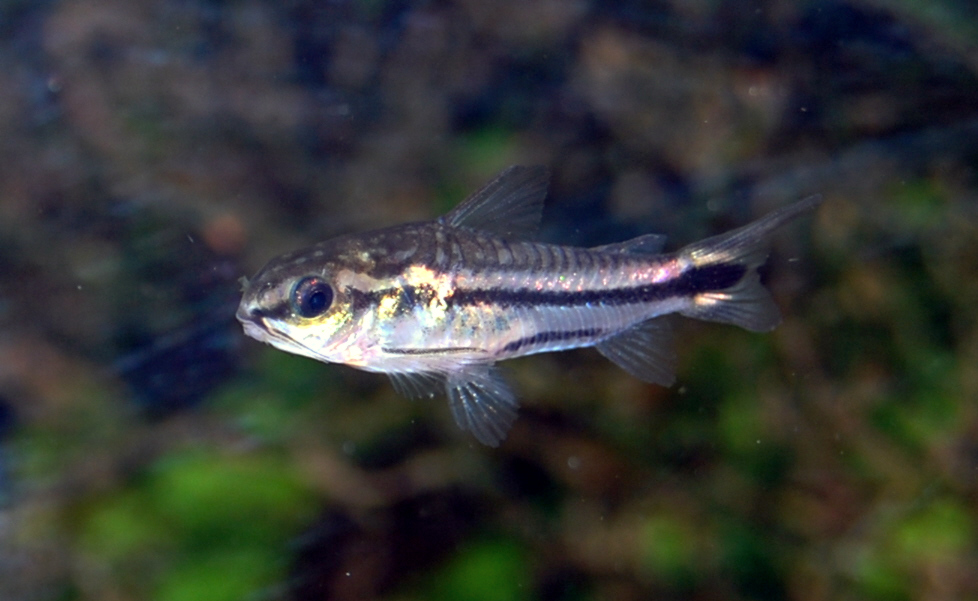 🇧🇷 Brazil and 2 morePygmy corydoras
A tiny armored catfish from South America kept in community aquariums.Catfish · Rivers and lakes · 1966
 🇧🇷 BrazilZebra pleco
Striped catfish from the Rio XinguCatfish · Rivers and lakes · 1991
 🇹🇭 Thailand and 2 moreGiant pangasius
A large freshwater catfish from Southeast Asia, now critically endangered due to overfishing and habitat loss.Catfish · Rivers and lakes · 1931
 🇹🇭 ThailandGlass catfish
A small, transparent freshwater catfish from Thailand.Catfish · Rivers and lakes · 2013

