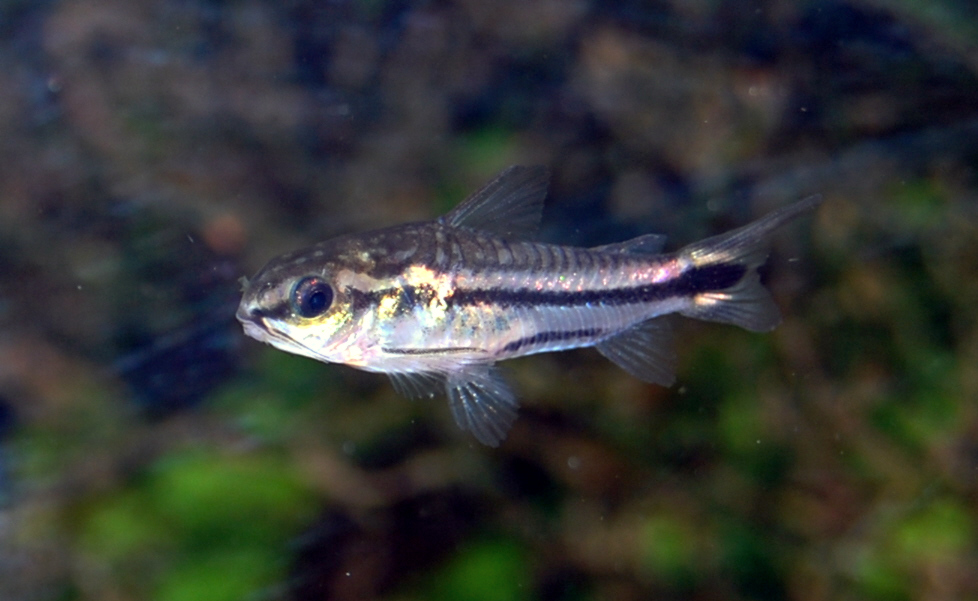
Pygmy corydoras
A tiny armored catfish from South America kept in community aquariums.
The pygmy corydoras is a small freshwater fish native to the Madeira River basin. It was first described by Joachim Knaack in 1966 and is popular among aquarists for its peaceful nature and miniature size.
- Maximum length is 3.2 cm.
- First described by Joachim Knaack in 1966.
- Native to Madeira, Nanay, and Aguarico river basins.
- Females are larger and rounder than males.
- Requires fine sand substrate to protect barbels.
What it is
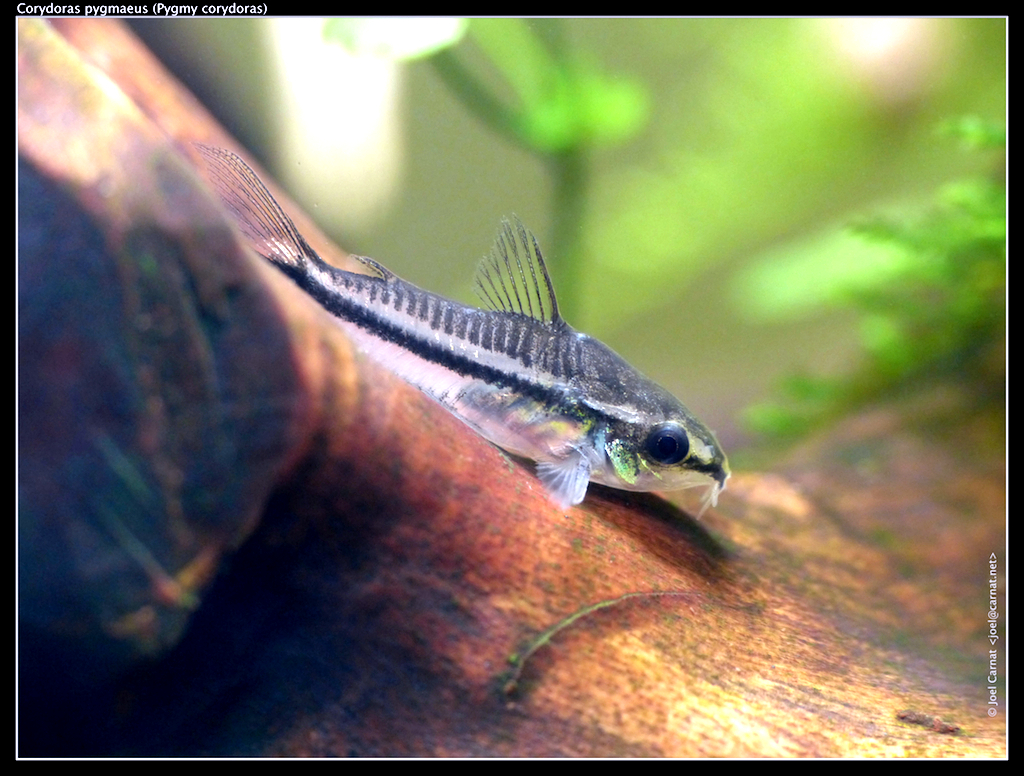
This species belongs to the armored catfish family and measures just over three centimetres at full growth. Adults display a silver body marked by a horizontal black line running from snout to tail. A second thin line appears lower on the side. The dorsal area shows dark grey shading. Young fry start with vertical stripes that fade after one month as adult patterns emerge. Females are larger and rounder than males, particularly when carrying eggs.
Where it lives
These fish inhabit inland waters across Peru, Ecuador, and western Brazil. Specific locations include tributaries of the Nanay and Aguarico rivers. In Brazil, they are found in the Madeira River system near the Ji-Paraná River mouth. They thrive in tropical climates within water conditions ranging from pH 6.0 to 8.0. Water hardness varies between two and twenty-five degrees dGH. Temperatures remain steady between twenty-two and twenty-six degrees Celsius.
How it lives
They feed on worms, benthic crustaceans, insects, and plant material. As shoaling fish, they prefer groups of four or more individuals. In captivity, they often swim through mid-water and lower tank regions rather than staying strictly at the bottom. They require fine substrates like sand to protect their barbels from injury. Sharp gravel can cause damage to these sensitive sensory organs used for foraging.
Breeding and life cycle
Females hold two to four eggs in a pelvic fin pouch during fertilisation, which lasts about thirty seconds. After fertilisation, the female carries the eggs to a safe spot. She attaches the sticky eggs to a surface where they remain for approximately three days before hatching. Newly hatched fry develop colouration after five days. Their body shape and barbels become distinct around two weeks later.
Fish and people
Aquarists keep this species in community tanks with small fish like ember tetras. They coexist well with small shrimp and snails. Keepers provide sinking foods, flakes, frozen items, and wafers. Live foods such as microworms and brine shrimp nauplii are beneficial. They are peaceful and should not be housed with aggressive tankmates. Planted species tanks offer the best environment for breeding and natural behaviour.

Questions people ask about Pygmy corydoras
What is the maximum size of a pygmy corydoras?
The species reaches a maximum length of 3.2 centimetres. Typical adults measure less, with males averaging 1.9 cm and females 2.5 cm. Females are also broader and rounder than males, especially when carrying eggs. Fry grow rapidly, reaching 13 mm within six to eight weeks after hatching.
How do pygmy corydoras reproduce?
Females hold two to four eggs in a pelvic fin pouch while the male fertilises them. This process takes about thirty seconds. The female then attaches the sticky eggs to a surface in a safe location. The eggs remain there for roughly three days before hatching into opaque, tan-coloured larvae.
What kind of tank setup do they need?
They require fine-grained substrate like sand to prevent injury to their barbels. Sharp gravel can damage these sensitive organs. They are peaceful shoaling fish that thrive in groups of four or more. A planted species tank or a community tank with small shrimp and snails is ideal for their care.
Are they difficult to keep in an aquarium?
They are peaceful and adaptable but need specific conditions. They prefer water with a pH between 6.5 and 7.0. Feeding them includes sinking foods, flakes, and live options like microworms or brine shrimp nauplii. They should not be kept with aggressive tankmates that might harm them.
Good reading and sources
- Pygmy corydoras on WikipediaEncyclopedia
- More photos on Wikimedia CommonsPhotos
- Wikidata recordOpen data
The facts on this page come from the Wikipedia article "Pygmy corydoras", written by its contributors and used under the CC BY-SA 4.0 licence, and from its Wikidata record (CC0). EveryFish rewrote the text in its own words, with AI assistance, and compares every page with the article to make sure no passage is copied. It may be reused under the same CC BY-SA 4.0 licence with a link back.
It may contain mistakes, and figures change over time. Nothing here is investment or buying advice. If something is wrong, tell us. Last refreshed 2026-11-15.
Like Pygmy corydoras
All catfishes WorldHypostomus plecostomus
A tropical armored catfish from South America, kept in aquariums for algae control.Catfish · Rivers and lakes · 1758
 Sub-Saharan AfricaSynodontis
A large African genus of spotted catfish known for squeaking sounds and belly-up swimming.Catfish · Rivers and lakes
 🇧🇷 Brazil and 4 moreRedtail catfish
A large South American catfish known for its red tail and popularity in the aquarium trade.Catfish · Rivers and lakes
 🇧🇷 Brazil and 4 moreAmazon sailfin catfish
A large freshwater armored catfish from South America, often kept in aquariums and known as an invasive pest elsewhere.Catfish · Rivers and lakes
More from Callichthyidae
All of them 🇵🇪 Peru and 1 morePanda corydoras
Small armoured catfish with distinctive black eye patchesCatfish · Rivers and lakes · 1971
 WorldBronze corydoras
Small armored catfish popular in home aquariumsCatfish · Rivers and lakes · 1858
 🇧🇷 Brazil and 3 moreBlue leopard corydoras
Small peaceful armoured catfish from South AmericaCatfish · Rivers and lakes