
Blue leopard corydoras
Small peaceful armoured catfish from South America
The blue leopard corydoras is a small freshwater catfish native to southeastern South America. It lives in river basins and coastal streams across four countries. This hardy species is popular in home aquariums for its peaceful nature and distinctive mottled appearance.
- Grows to 7 cm in length
- Produces sound using pectoral fins
- Found by Charles Darwin in 1830s
- Peaceful community aquarium fish
- Lives in Paraná River basin
What it is
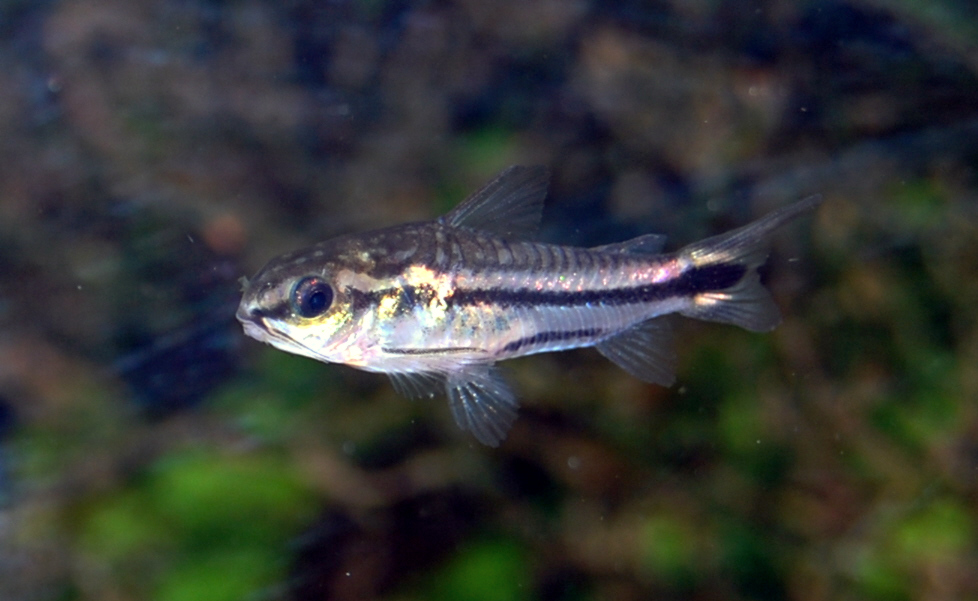
This fish is a member of the armoured catfish family. It grows to about seven centimetres in standard length. Females are larger than males. Males have proportionally longer dorsal and pectoral fins. The body features a mottled or peppered pattern. It belongs to the subfamily of corys within the larger catfish group. Its small size and peaceful temperament make it suitable for shared tanks.
Where it lives
The species inhabits southeastern South America. Its range includes the lower Paraná River basin. You can find it in waters within Paraguay, Argentina, and Brazil. It also lives in coastal rivers in Brazil and Uruguay. These freshwater environments provide the habitat necessary for its survival. The distribution covers multiple countries in the region.
How it lives
It feeds on a varied diet including worms, crustaceans, and insects. Plant matter is also part of its food intake. This catfish can produce sounds by moving its pectoral fins. Males use this sound during courtship rituals. Both sexes and young fish make noise when distressed. Males do not fight each other or guard mating areas aggressively. They engage in a specific T-position during courtship.
Breeding and life cycle
Reproduction involves a courtship behaviour known as the T-position. This pattern is common among related corydoras species. Males are not aggressive toward one another during this time. They do not monopolize females or specific mating zones. This lack of aggression allows for a more relaxed breeding environment compared to some other fish species.
Fish and people
Charles Darwin encountered this fish during his voyage on the Beagle. He found it near Buenos Aires in the 1830s. Today, it is a frequent choice for community aquariums. Hobbyists value it because it is hardy and peaceful. It coexists well with other non-aggressive tank mates. Its interesting behaviour and manageable size add to its appeal in the trade.


Questions people ask about Blue leopard corydoras
How big does the blue leopard corydoras get?
This fish reaches a standard length of about 5.9 to 7 centimetres. Females are generally larger than males. Males have longer fins relative to their body size.
Can this catfish make noises?
Yes, it produces sound by abducting its pectoral fins. Males use this during courtship. Both sexes and juveniles make noise when they are distressed.
Where is this fish found in the wild?
It lives in southeastern South America. Its range includes the lower Paraná River basin in Paraguay, Argentina, and Brazil. It is also found in coastal rivers in Brazil and Uruguay.
Is it safe for a community tank?
Yes, it is a common choice for community aquariums. The fish is relatively hardy and peaceful. It does not show aggression toward tank mates.
Good reading and sources
- Hoplisoma paleatum on WikipediaEncyclopedia
- More photos on Wikimedia CommonsPhotos
- Wikidata recordOpen data
The facts on this page come from the Wikipedia article "Hoplisoma paleatum", written by its contributors and used under the CC BY-SA 4.0 licence, and from its Wikidata record (CC0). EveryFish rewrote the text in its own words, with AI assistance, and compares every page with the article to make sure no passage is copied. It may be reused under the same CC BY-SA 4.0 licence with a link back.
It may contain mistakes, and figures change over time. Nothing here is investment or buying advice. If something is wrong, tell us. Last refreshed 2026-11-15.
Like Blue leopard corydoras
All catfishes Sub-Saharan AfricaSynodontis
A large African genus of spotted catfish known for squeaking sounds and belly-up swimming.Catfish · Rivers and lakes
 🇧🇷 Brazil and 4 moreAmazon sailfin catfish
A large freshwater armored catfish from South America, often kept in aquariums and known as an invasive pest elsewhere.Catfish · Rivers and lakes
 🇧🇷 Brazil and 4 moreRedtail catfish
A large South American catfish known for its red tail and popularity in the aquarium trade.Catfish · Rivers and lakes
 🇻🇪 Venezuela and 1 moreOtocinclus
Small South American armored catfishes known for algae eating and air breathing.Catfish · Rivers and lakes
More from Callichthyidae
All of them WorldBronze corydoras
Small armored catfish popular in home aquariumsCatfish · Rivers and lakes · 1858
 🇧🇷 Brazil and 2 morePygmy corydoras
A tiny armored catfish from South America kept in community aquariums.Catfish · Rivers and lakes · 1966
 🇵🇪 Peru and 1 morePanda corydoras
Small armoured catfish with distinctive black eye patchesCatfish · Rivers and lakes · 1971