
Giant pangasius
A large freshwater catfish from Southeast Asia, now critically endangered due to overfishing and habitat loss.
The giant pangasius is a massive catfish native to the Mekong and Chao Phraya river basins in Indochina. Its numbers have collapsed because of heavy fishing pressure and dam construction, leading to its classification as Critically Endangered.
- Reaches up to 300 cm and 300 kg in weight.
- Native to Mekong and Chao Phraya river basins.
- Spawns in April and May in muddy river areas.
- Considered Critically Endangered globally.
- Introduced to South Africa and Malaysia for farming.
What it is
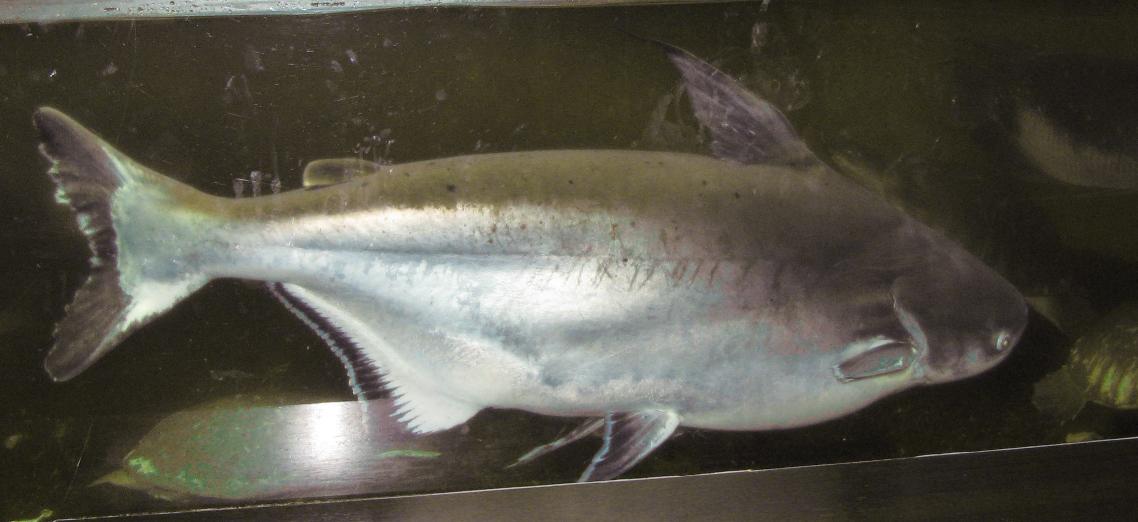
This species belongs to the shark catfish family, distinguished by swimming near the river bottom rather than hiding in crevices like many other catfish. Adults display a silver curved underside and a dark brown back, with dusky spots aiding camouflage. The body is elongated and compressed, featuring a flat head without whiskers. Fins are often dark grey or black, contrasting with the lighter body, and possess extended filament rays. Fully grown individuals can reach three metres in length and weigh up to three hundred kilograms, though two metres is more typical.
Where it lives
Native populations inhabit the Mekong and Chao Phraya river systems across China, Cambodia, Thailand, Vietnam, and Laos. A natural barrier at Khone Falls separates two distinct sub-populations within this range. The species has also been introduced to central Anatolia, South Africa, and Malaysia for aquaculture purposes. It thrives in deep river depressions and tolerates brackish conditions, though it primarily occupies freshwater environments.
How it lives
As a benthopelagic migrator, this fish acts as an apex predator in its ecosystem. Juveniles and adults feed on crustaceans, smaller fish, and animal carcasses found on the river floor. This predation helps control smaller fish populations, maintaining ecological balance. The species undertakes seasonal migrations within rivers but does not migrate from outside sources to spawn. Its role as a top predator exerts top-down control on prey numbers, preventing overpopulation of smaller organisms.
Breeding and life cycle
Spawning occurs between April and May, coinciding with the monsoon season. Fish release eggs and sperm in muddy areas to prevent adhesion, producing around six hundred eggs per session. There is no parental care, and broods show low genetic variation. While lifespan data is scarce, rapid growth rates suggest shorter lives, potentially exacerbated by high fishing mortality. Spawning happens within inhabited rivers rather than through long-distance migration to breeding grounds.
Fish and people
Historically, fishing involved religious ceremonies, and the fish remains a popular food source marketed fresh. Local communities rely on it for income and sustenance. It is also hunted as a trophy sport fish due to its immense size. In the aquarium trade, specimens are kept but rarely reach full size without massive ponds. A stocky 'balloon' variant exists. Introduction to South Africa aimed to support local fisheries, though conservation concerns now limit harvesting.
Status and threats
Classified as Critically Endangered, the population faces severe threats from overharvesting, pollution, and river damming. Dams segment habitats, blocking migration routes essential for spawning. Although protected in Yunnan, China, since 1989, enforcement across international borders remains weak. Conservation efforts include breeding programmes and harvest bans, but these may reduce genetic diversity. The species serves as an umbrella for ecosystem protection, highlighting the need for broader regulatory measures to ensure survival.



Questions people ask about Giant pangasius
How big does the giant pangasius get?
Fully grown individuals can reach three hundred centimetres in length and weigh up to three hundred kilograms. Typical adults measure around two metres long.
Why is the giant pangasius endangered?
Populations have declined drastically due to overfishing, river damming which blocks migration, and pollution. These factors prevent successful spawning and habitat connectivity.
What does the giant pangasius eat?
It is a predatory bottom-dweller that feeds on crustaceans, smaller fish, and animal carcasses found on the river floor.
Can you keep a giant pangasius in an aquarium?
Yes, they appear in the aquarium hobby. However, most specimens do not reach their full massive size unless kept in extremely large ponds or tanks.
Good reading and sources
- Giant pangasius on WikipediaEncyclopedia
- More photos on Wikimedia CommonsPhotos
- Wikidata recordOpen data
The facts on this page come from the Wikipedia article "Giant pangasius", written by its contributors and used under the CC BY-SA 4.0 licence, and from its Wikidata record (CC0). EveryFish rewrote the text in its own words, with AI assistance, and compares every page with the article to make sure no passage is copied. It may be reused under the same CC BY-SA 4.0 licence with a link back.
It may contain mistakes, and figures change over time. Nothing here is investment or buying advice. If something is wrong, tell us. Last refreshed 2026-11-15.
Like Giant pangasius
All catfishes 🇺🇦 Ukraine and 4 moreWels catfish
A large freshwater catfish native to Europe and Western Asia, known for its size and bottom-feeding habits.Catfish · Rivers and lakes · 1758
 🇹🇭 Thailand and 4 moreMekong giant catfish
A massive freshwater fish native to the Mekong basin, now critically endangered.Catfish · Rivers and lakes
 🇧🇷 Brazil and 4 moreTiger shovelnose catfish
Large striped South American river catfishCatfish · Rivers and lakes · 1862
 🇺🇸 United States and 1 moreYellow bullhead
A medium-sized North American catfish known for its bright yellow belly and scavenging habits.Catfish · Rivers and lakes · 1819
