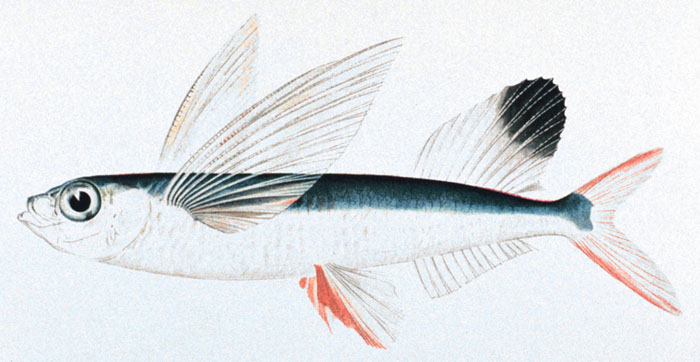
Tropical two-wing flyingfish
A gliding fish of tropical seas with large pectoral fins.
The tropical two-wing flyingfish is a ray-finned species found in warm oceans worldwide. It uses enlarged fins to glide above water, escaping marine predators while facing risks from seabirds. The population remains abundant and faces no major commercial threats.
- Glides above water using large pectoral fins
- Reaches a maximum length of 30 cm
- Found in tropical and subtropical oceans globally
- Lays 300 to 400 eggs in open water
- Assessed as least concern by IUCN
What it is
This ray-finned fish reaches a maximum length of 30 cm, though 20 cm is more typical. Its body features an iridescent dark blue back and a silvery white belly. The most striking feature is the pair of exceptionally large pectoral fins, which allow it to glide over the sea surface. The dorsal and anal fins lack spines, containing only soft rays. Juveniles may display black bars on their bodies. The tail and pectoral fins appear greyish, while other fins remain colourless.
Where it lives
The species inhabits tropical and subtropical zones across all global oceans. It occurs in the Caribbean Sea and the western Mediterranean. However, it is absent from the Gulf of Mexico. It also largely avoids inland southeastern Asian seas, including the Celebes, Sulu, and Flores Seas. These fish live in surface waters, ranging from the open ocean to areas close to the coast.
How it lives
Feeding occurs in the open sea on planktonic fauna and crustaceans like copepods. To escape marine predators such as tuna, dolphinfishes, and snake mackerel, the fish launches itself into the air. This gliding behaviour exposes them to aerial hunters like gulls and cormorants. They often exit the water in shoals and may land on boat decks. Genetic studies show high similarity due to significant gene flow and recent population expansion.
Breeding and life cycle
Reproduction takes place in the open water. Females release clutches containing between 300 and 400 eggs. These eggs float freely in the sea rather than being attached to substrate or guarded by parents. The specific timing of spawning seasons is not detailed in the available records, but the process occurs within their pelagic habitat range.
Fish and people
This species is not targeted by commercial fisheries. As a result, there are no significant economic uses recorded for human consumption or trade. While they occasionally land on boats, this is incidental rather than a planned harvest. Their abundance and lack of commercial pressure mean they do not face immediate threats from human activity.
Status and threats
The International Union for Conservation of Nature lists the species as least concern. It remains abundant in tropical and subtropical waters worldwide. No particular threats have been identified that would endanger the population. The high rate of gene flow helps maintain genetic health across its wide distribution.


Questions people ask about Tropical two-wing flyingfish
How far can this fish fly?
The text states it can glide for long distances above the water surface using its large pectoral fins. It does not provide a specific measurement in metres or feet for these glides.
What does the tropical two-wing flyingfish eat?
It feeds in the open sea on planktonic fauna. Its diet specifically includes crustaceans such as copepods. It does not hunt larger prey or bottom-dwelling organisms.
Is this fish endangered?
No, the International Union for Conservation of Nature assesses its status as least concern. The species is abundant in tropical and subtropical oceans and faces no identified major threats.
Where can you find this fish?
It lives in tropical and subtropical zones of all world oceans. Specific locations include the Caribbean Sea and western Mediterranean. It is absent from the Gulf of Mexico and many inland southeastern Asian seas.
Good reading and sources
- Exocoetus volitans on WikipediaEncyclopedia
- More photos on Wikimedia CommonsPhotos
- Wikidata recordOpen data
The facts on this page come from the Wikipedia article "Exocoetus volitans", written by its contributors and used under the CC BY-SA 4.0 licence, and from its Wikidata record (CC0). EveryFish rewrote the text in its own words, with AI assistance, and compares every page with the article to make sure no passage is copied. It may be reused under the same CC BY-SA 4.0 licence with a link back.
It may contain mistakes, and figures change over time. Nothing here is investment or buying advice. If something is wrong, tell us. Last refreshed 2026-11-15.
Like Tropical two-wing flyingfish
All other fish 🇺🇸 United States and 1 moreNorth Pacific hake
A silver-gray marine fish found in the northeast Pacific Ocean, used for surimi production.Other · Coasts and shelves
 🇺🇸 United States and 2 moreLingcod
A large predatory fish of the North American Pacific coast.Other · Coasts and shelves
 WorldPorcupinefish
Spiny marine fish that inflate into a defensive sphere to deter predators.Other · Coasts and shelves
 WorldIndo-Pacific sailfish
Fast ocean predator with a large dorsal finOther · Coasts and shelves