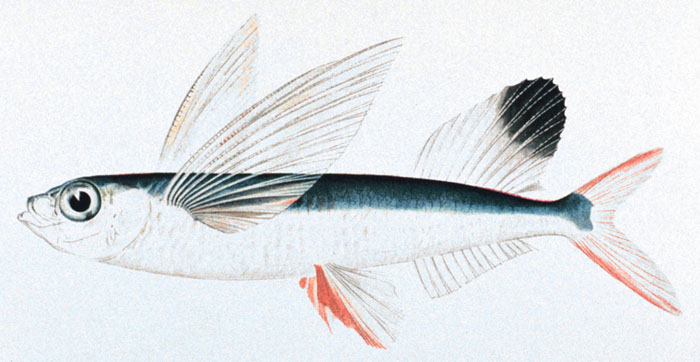
Flying fish
Saltwater fish that glide above the ocean using wing-like fins to escape predators.
The Exocoetidae are a family of ray-finned fish found in tropical and warm subtropical oceans worldwide. They use enlarged pectoral fins to leap from the water and glide for considerable distances, primarily to evade underwater hunters like tuna and marlin.
- Fins act as aerofoils to generate lift for gliding.
- Flight speeds exceed seventy kilometres per hour.
- Roe is known as tobiko in Japanese cuisine.
- National symbol of Barbados.
- French Exocet missile named after the fish.
What it is
These saltwater ray-finned fish belong to the order Beloniformes and include roughly sixty-four species across seven genera. They possess elongated, wing-like paired fins that function as aerofoils when they leave the water. Their bodies range from streamlined shapes optimized for speed to flattened forms designed to maximize air time. The main purpose of this aerial display is to escape underwater predators such as swordfish, mackerel, tuna, and marlin. While airborne, they remain vulnerable to birds like frigatebirds. They inhabit the upper layers of the ocean, typically within two hundred metres of the surface.
Where it lives
Members of this family live in all oceans, with a strong preference for tropical and warm subtropical waters. They occupy the epipelagic zone, which extends down to approximately two hundred metres. In Barbados, populations historically migrated between the coral-rich Atlantic surrounding the island and plankton-heavy outflows from Venezuela's Orinoco River. Today, due to overfishing and pollution, their northern migration limit has shifted to around Tobago. They are also found near Indonesia, Japan, Vietnam, China, and Peru.
How it lives
Flying fish feed primarily on plankton. To glide, they generate lift by leaping from the water and maintaining a rigid vertebral column. They can reach speeds exceeding seventy kilometres per hour and cover distances up to four hundred metres using wave updrafts. A recorded flight lasted forty-five seconds, reaching heights of six metres above the sea. At the end of a glide, they fold their fins to re-enter the water or drop their tails to push against the surface for another jump. Predators include dolphins, squid, porpoises, and various seabirds.
Fish and people
In Japan, Vietnam, China, Indonesia, and India, these fish are commercially caught using gillnets or dipnets. Japanese cuisine often preserves them by drying for dashi broth, while the roe of the Japanese flying fish is known as tobiko and used in sushi. In Barbados, the fish is a national symbol and part of the traditional dish cou-cou and flying fish. Peruvian locals use the roe, called cau-cau, in various dishes. Solomon Islands fishermen catch them mid-air using torches and nets from outrigger canoes during moonless nights.
Status and threats
The International Union for Conservation of Nature does not list a specific conservation status in the provided text. In Barbados, historical abundance declined due to ship-based pollution and overfishing, causing the population to migrate further south. Maritime disputes arose between Barbados and Trinidad and Tobago over fishing rights, leading to a United Nations ruling in 2006 requiring both nations to preserve stocks for the future.


Questions people ask about Flying fish
How do flying fish move through the air?
They leap from the water and use long, wing-like paired fins as aerofoils to create lift. This allows them to glide for considerable distances above the surface, sometimes using updrafts from waves to extend their flight time and distance.
Why do flying fish leave the water?
The primary reason is to escape underwater predators such as tuna, marlin, swordfish, and mackerel. However, being airborne exposes them to aerial predators like frigatebirds, creating a trade-off between safety from water and air threats.
What is the culinary significance of flying fish roe?
The roe is highly valued in several cuisines. In Japan, it is known as tobiko and used in sushi. In southern Peru, it is called cau-cau and used in local dishes. It is also a staple food for the Tao people of Orchid Island in Taiwan.
Is the French Exocet missile related to the fish?
Yes, the anti-ship missile is named after the flying fish. The name reflects its ability to launch from underwater and follow a low, sea-skimming trajectory before striking targets, mimicking the fish's movement pattern.
Good reading and sources
The facts on this page come from the Wikipedia article "Flying fish", written by its contributors and used under the CC BY-SA 4.0 licence, and from its Wikidata record (CC0). EveryFish rewrote the text in its own words, with AI assistance, and compares every page with the article to make sure no passage is copied. It may be reused under the same CC BY-SA 4.0 licence with a link back.
It may contain mistakes, and figures change over time. Nothing here is investment or buying advice. If something is wrong, tell us. Last refreshed 2026-11-15.
Like Flying fish
All other fish WorldPorcupinefish
Spiny marine fish that inflate into a defensive sphere to deter predators.Other · Coasts and shelves
 🇵🇭 Philippines and 4 moreMilkfish
The sole living species of the family Chanidae, found across the Indo-Pacific.Other · Coasts and shelves
 🇳🇬 NigeriaHingemouth
Small African fish with a unique proboscis-like mouthOther · Rivers and lakes
 🇩🇪 Germany and 4 moreEuropean smelt
Small coastal fish with a cucumber scentOther · Rivers and lakes
