Caspian kutum
A prized ray-finned fish from the Caspian Sea.
The Caspian kutum is a medium-sized fish native to the Caspian Sea and its tributaries. Once abundant, it faces population decline due to overfishing and pollution, though it remains culturally significant in Iran.
- Reaches up to 71 cm in length
- Prized for roe in northern Iran
- Spawns in rivers during spring
- Population supported by aquaculture
- Extirpated from the Volga River
What it is
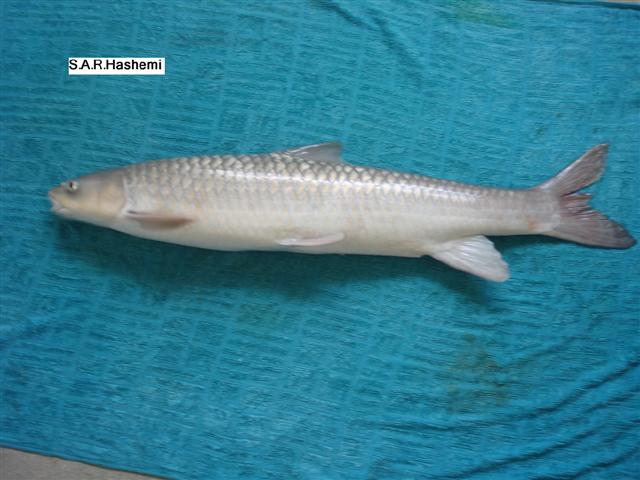
This ray-finned fish belongs to the Leuciscidae family, related to daces and minnows. It has reddish fins, which inspire its genus name Rutilus. Adults typically measure 45 to 55 cm, though they can reach 71 cm. The body is streamlined for life in both salt and fresh water. Its common name comes from Russian vernacular, while Persian speakers call it white fish.
Where it lives
The species inhabits the western and southern coasts of the Caspian Sea. Its range extends from the Kura River to Gorgan Bay. It historically lived in the Volga River but has disappeared from that area. The fish moves between brackish marine environments and freshwater tributaries for breeding. Temperature changes drive these movements between habitats.
How it lives
These fish feed on bottom-dwelling organisms. Their diet includes molluscs, crustaceans, and insect larvae. They can live up to twelve years and reach sexual maturity at four years old. Predators are not explicitly detailed, but their benthic feeding habits suggest they forage near the seabed. They migrate slowly as larvae back to the sea after hatching.
Breeding and life cycle
Spawning begins when water temperatures hit 9–10°C, usually in late February. Migration peaks in March and April as temperatures rise to 12.6°C. Females lay between 30,000 and 300,000 eggs among reeds and water lilies. This occurs when the water reaches 13–15°C. Larvae start their return journey to the Caspian Sea in mid-May.
Fish and people
Fishermen value this species for its flesh and roe. It is especially prized in the Gilan and Mazandaran provinces of Iran. Commercial harvesting was once widespread. Today, stocks in the southern Caspian are supported by aquaculture programmes. Releases of farmed fish help maintain populations for local fisheries and cultural consumption.
Status and threats
Populations have collapsed due to heavy fishing pressure and marine pollution. The species is no longer found in the Volga River. Conservation efforts now rely on artificial breeding and release programmes. These measures aim to sustain stocks against environmental degradation and historical overexploitation in its native range.
Questions people ask about Caspian kutum
What does the Caspian kutum eat?
It feeds on benthic organisms found at the bottom of the water. Its diet consists mainly of molluscs, crustaceans, and aquatic insect larvae.
Where does the Caspian kutum spawn?
It migrates from the sea into freshwater rivers to spawn. Eggs are laid among reeds and water lilies when water temperatures reach 13–15°C.
Why is the population declining?
The population has collapsed due to overfishing and marine pollution. It has already disappeared from the Volga River region.
Is the Caspian kutum farmed?
Yes, aquaculture programmes support stocks in the southern Caspian Sea. Farmed fish are released to help maintain commercial fisheries.
Good reading and sources
- Caspian kutum on WikipediaEncyclopedia
- More photos on Wikimedia CommonsPhotos
- Wikidata recordOpen data
The facts on this page come from the Wikipedia article "Caspian kutum", written by its contributors and used under the CC BY-SA 4.0 licence, and from its Wikidata record (CC0). EveryFish rewrote the text in its own words, with AI assistance, and compares every page with the article to make sure no passage is copied. It may be reused under the same CC BY-SA 4.0 licence with a link back.
It may contain mistakes, and figures change over time. Nothing here is investment or buying advice. If something is wrong, tell us. Last refreshed 2026-11-15.
Like Caspian kutum
All carps and minnows 🇮🇷 Iran and 3 moreMangar
Large cyprinid fish of the Tigris and Euphrates rivers.Carp · Rivers and lakes · 1843
 EuropeAsp
A predatory freshwater fish native to Europe and western Asia.Carp · Rivers and lakes · 1758
 🇮🇷 Iran and 1 moreShabout
A large freshwater carp native to the Tigris-Euphrates basin in Western Asia.Carp · Rivers and lakes
 🇮🇳 India and 4 moreRohu
A large silver carp from South Asian rivers, farmed for food and prized as a game fish.Carp · Rivers and lakes
More from Leuciscidae
All of them 🇷🇺 RussiaCaspian roach
A brackish water fish from the Caspian Sea region, widely consumed as a dried snack.Carp · Estuaries and mangroves
 🇷🇺 Russia and 4 moreSabre carp
A silvery surface feeder from Eastern Europe and Asia.Carp · Rivers and lakes
 🇨🇦 Canada and 1 moreLake chub
A small cold-water minnow native to Canada and the northern US.Carp · Rivers and lakes
 🇺🇸 United States and 1 moreCreek chubs
Small North American minnows with a distinctive dorsal spotCarp · Rivers and lakes